
When I went to Schiedam for the Open Monumentendag festivities, I stopped at Delfshaven, which is conveniently located on the way to Schiedam. Delfshaven was also participating in the Open Monumentdag. The Pilgremvaderskerk, or Oude Kerk (Pilgrim Father's Church, or Old Church) was one of the places that was open extra hours and had special stuff going on for the weekend. I stopped here on the way out because it opened earlier than most of the things I wanted to see in Schiedam and I figured by the time I walked through Schiedam I wouldn't really enjoy more walking around on the way back.
There was a little museum in the back of the church that had a Pilgrim Fathers Presentation. There was a video that could be played in English or Dutch, and several different displays around the room.


If you look at their logo below, though, you can see that they hearken back to their old roots.


They had several different displays of Puritan paraphernalia as well, including this pretty plate, the ship shaped cake server and the itty, bitty, tiny "Mayflower" in the bottle.
Even in the church, there were all kinds of memorials of the Puritans. There were two maritime themed stained-glass windows.

The first commemorated the sailing of the Speedwell, on which the Pilgrim's departed Delfshaven on the 22nd of July, 1620. If you notice date differences, it is because the English didn't change to the new Gregorian calendar until much later than the rest of Europe and so a lot if the dates in the 17th century can be off by 10 or so days.

The second window commemorates the founding of the Dutch State. It says (I think) "The port of salvation comes only from the Lord of Zion, 9 September 1574." I am not certain because "haave" is not a word I can find anywhere in modern Dutch dictionaries. But I am going with a blind assumption that it is etymologically related to "haven."
There were also stained glass windows that depict the six days of creation. The text around each picture is a quote from Genesis--"in thus and such a day, God created . . ."


 There were large plaques that were on all of the walls around the pulpit. Some showed different Puritan documents. This one shows the Ten Commandments. You can't really read them very well, but you can tell from the density of the text that the Puritans didn't hold with any abbreviations for the purpose of making posting easier. When they refurbished the church they had to repaint each of these boards, by hand, with tiny paint brushes and gold paint while set up on scaffolding.

There were also boards that had the names and tenures of every pastor who has served at the church for the entire history of the church--so a little over 400 years worth of pastors. They also have a gallery of picture of former pastors but they don't have pictures of everybody.

There is a display of the original church bells from the church. The large bell is chest high.

There were also models of the Mayflower and the Speedwell out in the the sanctuary, with teeny little sailors working in the rigging.
The plaque on this ship says
"The 'Mayflower', the ship on which the Pilgrims sailed from Plymouth in September 1620 on their way to America, from England to Cape Cod."

This one is the Speedwell. The plaque on this one says: "The 'Speedwell'. the ship on which the Pilgrims sailed from Delfshaven to England on July 31, 1620 (July 22, 1620 according to the Julian Calendar)."
 This is one of the grave markers that line the entire floor of the sanctuary. The weird "F" symbol looks very familiar but I can't remember what it is from. Perhaps it is a Masonic symbol? Although the grave markers are about 2 feet by 6 feet, it looks like they were doubled-up because most of them had "Hier leijt . . ." messages at the top and then had a second engraving at the bottom of the slab.
This is the grave stone on which I sat when I went to church here.
These are the doors as you see them as you exit the sanctuary:

This door lintel says "Bewaart uwen voet als gij ten huize gods ingaat." Which is from Ecclesiasties 5:1 and says "Keep they foot when thou goest to the house of God."

What was really entertaining, though, was that this old and sedate looking plaque was right next to this plaque: advertising what appears to be an Hasidic Jewish rock concert by a folk-music group named "Unicorn."


Even in the church, there were all kinds of memorials of the Puritans. There were two maritime themed stained-glass windows.

The first commemorated the sailing of the Speedwell, on which the Pilgrim's departed Delfshaven on the 22nd of July, 1620. If you notice date differences, it is because the English didn't change to the new Gregorian calendar until much later than the rest of Europe and so a lot if the dates in the 17th century can be off by 10 or so days.

The second window commemorates the founding of the Dutch State. It says (I think) "The port of salvation comes only from the Lord of Zion, 9 September 1574." I am not certain because "haave" is not a word I can find anywhere in modern Dutch dictionaries. But I am going with a blind assumption that it is etymologically related to "haven."
There were also stained glass windows that depict the six days of creation. The text around each picture is a quote from Genesis--"in thus and such a day, God created . . ."


 There were large plaques that were on all of the walls around the pulpit. Some showed different Puritan documents. This one shows the Ten Commandments. You can't really read them very well, but you can tell from the density of the text that the Puritans didn't hold with any abbreviations for the purpose of making posting easier. When they refurbished the church they had to repaint each of these boards, by hand, with tiny paint brushes and gold paint while set up on scaffolding.

There were also boards that had the names and tenures of every pastor who has served at the church for the entire history of the church--so a little over 400 years worth of pastors. They also have a gallery of picture of former pastors but they don't have pictures of everybody.

There is a display of the original church bells from the church. The large bell is chest high.

There were also models of the Mayflower and the Speedwell out in the the sanctuary, with teeny little sailors working in the rigging.
The plaque on this ship says
"The 'Mayflower', the ship on which the Pilgrims sailed from Plymouth in September 1620 on their way to America, from England to Cape Cod."
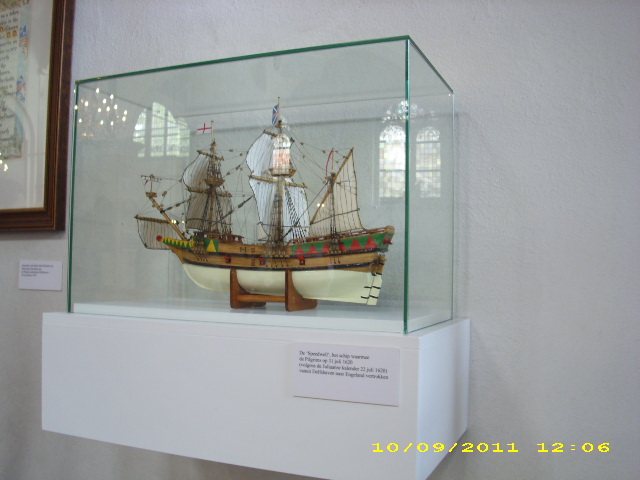
This one is the Speedwell. The plaque on this one says: "The 'Speedwell'. the ship on which the Pilgrims sailed from Delfshaven to England on July 31, 1620 (July 22, 1620 according to the Julian Calendar)."

This is the grave stone on which I sat when I went to church here.
These are the doors as you see them as you exit the sanctuary:

This door lintel says "Bewaart uwen voet als gij ten huize gods ingaat." Which is from Ecclesiasties 5:1 and says "Keep they foot when thou goest to the house of God."
This door lintel below says "Eere zij God in de hoogste hemelen." This is from Luke 2: 14 and says "Glory to God in the highest."


There is a plan of the church posted on the outside of the church. When you go into the church, you go into the little vestibule to the bottom right of the cross-shaped nave.


There is a plan of the church posted on the outside of the church. When you go into the church, you go into the little vestibule to the bottom right of the cross-shaped nave.

