This Tuesday night was the final Dutch cafe. A couple of other students from my class came as well, to say good-by to our teacher whom everyone liked a lot. There was also one of the ladies who is in charge of the Language Training Center. She said that although the LTC won't be doing the Dutch Cafe anymore (at least for students) there is some talk of the Erasmus Student Network taking over and starting up a Dutch Cafe instead. Since ESN is the author of such events as "Cafe BED" (which runs from 10pm-4am every Tuesday, offers 1 euro drinks--the cheapest booze in the Netherlands, as far as I have heard--plus the occasional free shot, featured the delightful ad campaign "Will you go to BED with me?", and which is known for having inebriated students littering the floor in piles of vomit) I am guessing that the new Dutch Cafe might have a little different flavor from the old one. But I guess we will just have to see. Maybe I will have to see if I can weasel my way into the faculty and staff Dutch Cafe.
I asked about "Haave" (which was I word I couldn't translate from one of the windows of the Pilgremvaderskerk). They said that they weren't familiar with that word. However, there is a word "have" which means "creatures", as in all kinds of animals/living things. So it could possibly be translated as "Salvation for His creatures comes only from God in Zion" or something similar, which would fit with the creation of the Dutch State/reliance on God's providence/etc. in a Matthew 10:29 type way ("Are not two sparrows sold for a farthing? and one of them shall not fall on the ground without your Father.")
Also, the cafe was nice enough to bring us authentic Dutch hors d'oeuvres/snacks, on the house, since we had been showing up every week. Everyone thought that was pretty nice, although since that was the last night, now it will look like we just grabbed the free food and ran. There were three kinds of snacks, all deep-fried, so you have to know they started out right. There were chicken nuggets that were just like McDonald's chicken nuggets (people seem to really like McDonald's around here). There were also small fried meatballs that tasted kind of like a slightly spicy curried chicken, but I don't know what the actual name of them is. The other thing was Bitterballen. I do not know what the name exactly means but it is kind of like a thick, white, sausage gravy, deep fried in a crumb coating. This makes it a little difficult to eat neatly. It also means that there is a MASSIVE quality difference if you get one when it is fresh and hot or if you get it when it is cooler and has started nastily congealing. However, Bitterballen (they are sometimes called croquettes) are ubiquitous. You can get larger versions of them in hamburger or brat shapes and then you eat them in a bun. They are pretty tasty but I don't think I could eat a whole sandwich made out of them. I saw some one eating one of the sandwiches and the inside gooey stuff was oozing everywhere and was not a very pretty picture.
Showing posts with label EUR. Show all posts
Showing posts with label EUR. Show all posts
Wednesday, September 28, 2011

Saturday, September 24, 2011
Mapping Global Order and other fun school things
This week has been very, very busy. The school schedule here is a little weird because you essentially have classes in 8 week chunks, plus an exam period, so all of the assignments that would normally be stretched out over a 15 week semester are all now due in the first 8 weeks of the semester instead. While I appreciate this little help with not procrastinating, it does cut into my "fun" time a bit. This week was especially busy. Between last Thursday and this past Thursday I had three papers (about 15 pages all told) and two presentations, plus a bunch of fairly boring readings to do. This coming week should be easier since I only have one paper due. The week after that I only have two papers due and a mid-term exam and I will be starting (probably) my second Dutch class, so that week might be a tad busy as well.
This term, everyone in the Master's program is taking one class together, although they are divided up into a Dutch class and an English class. For the other three terms, there is a little more flexibility because half of the courses we take will be Research Workshops and Thesis Conferences. Also, I think that the Dutch and English tracks separate a fair bit as well.
I have two courses this term: "Mapping Global Order--1600-2000" which is about Empires and what they do and how to stop them and how to get rid of the US Empire because it is impinging on the (finger's crossed) European Empire of the EU.
My second course is "Historical Culture in a Globalizing World" and it is about the way people remember things and think about history. The text for this was actually pretty interesting (it is called "Time Maps") but it is often a bit disconcerting to read through books like this (the author is a Jewish guy who grew up in Israel) to see people trying to figure these things out from an evolutionary stand-point--"When did people first remember that there was a yesterday and expect that there would be a tomorrow?" "When would they remember that they ate yesterday and that they ought to eat something today?" "When would they stop forgetting that they had left-over bronto-burgers going greenish at the back of the cave?" (Oh, wait, people still forget about the leftovers at the back of the 'fridge so I guess that's going to be never . . . sorry about that Mom.)
This term, everyone in the Master's program is taking one class together, although they are divided up into a Dutch class and an English class. For the other three terms, there is a little more flexibility because half of the courses we take will be Research Workshops and Thesis Conferences. Also, I think that the Dutch and English tracks separate a fair bit as well.
I have two courses this term: "Mapping Global Order--1600-2000" which is about Empires and what they do and how to stop them and how to get rid of the US Empire because it is impinging on the (finger's crossed) European Empire of the EU.
My second course is "Historical Culture in a Globalizing World" and it is about the way people remember things and think about history. The text for this was actually pretty interesting (it is called "Time Maps") but it is often a bit disconcerting to read through books like this (the author is a Jewish guy who grew up in Israel) to see people trying to figure these things out from an evolutionary stand-point--"When did people first remember that there was a yesterday and expect that there would be a tomorrow?" "When would they remember that they ate yesterday and that they ought to eat something today?" "When would they stop forgetting that they had left-over bronto-burgers going greenish at the back of the cave?" (Oh, wait, people still forget about the leftovers at the back of the 'fridge so I guess that's going to be never . . . sorry about that Mom.)
Thursday, September 1, 2011
. . . and Again . . .
This Tuesday I went to the Dutch Cafe for a third time. I was the only student there again. It is a shame that more people aren't taking advantage of free Dutch language practice. On the other hand, though, it does mean I get loads and LOADS of practice. This time there were two of the teachers there--my teacher and the teacher who was there last week.
We talked about organic farming, needlework, home-ec and the "home-arts" schools that girls in the Netherlands used to go to instead of, or in addition to regular school, to learn how to make a home. We talked about when and why women's suffrage came to America and the Netherlands, milk and dairy product production in the US, how you say "butter" in Dutch, Dutch history, and the way that the Dutch Language program works.
(The "butter" question was important--I tried to find butter at the store on Tuesday and could not find it. So I asked a clerk who didn't speak much English. And I couldn't remember learning the Dutch word for butter, so I hoped that it might be similar to the French word (since, because of Napoleon, there is a fairly large incidence of French words in Dutch).
"Waar is de beurre?" I asked.
She looked puzzled.
"Beurre? Berrrre? Buuuurrrrrrrr?" I said.
She showed me where the batteries were.
Then I had a lightning flash of inspiration--the Dutch use the same word for margarine as we do. I could use margarine instead of butter or perhaps the margarine would even be stored next to the butter.
"Margarine?!" I asked triumphantly.
She looked puzzled and started talking to a customer standing in the check-out line.
"Markhgareen" said the customer.
"Ohhhhhh" said the clerk. And showed me were it was. It was next to the "boter".)
I could tell that it is harder to remember language things after not using them very often. I haven't gone to the library, or watched Dutch TV, or listened to Dutch radio in a while and I think that it showed in the fact that it took so long for me to come up with sentences. And in the fact that many of my sentences were grammatical nightmares. So, back to the Asterix and Obelix comic books and the dubbed over Sponge-Bob-Square-Pants television shows I go.
It's for homework.
I promise.
We talked about organic farming, needlework, home-ec and the "home-arts" schools that girls in the Netherlands used to go to instead of, or in addition to regular school, to learn how to make a home. We talked about when and why women's suffrage came to America and the Netherlands, milk and dairy product production in the US, how you say "butter" in Dutch, Dutch history, and the way that the Dutch Language program works.
(The "butter" question was important--I tried to find butter at the store on Tuesday and could not find it. So I asked a clerk who didn't speak much English. And I couldn't remember learning the Dutch word for butter, so I hoped that it might be similar to the French word (since, because of Napoleon, there is a fairly large incidence of French words in Dutch).
"Waar is de beurre?" I asked.
She looked puzzled.
"Beurre? Berrrre? Buuuurrrrrrrr?" I said.
She showed me where the batteries were.
Then I had a lightning flash of inspiration--the Dutch use the same word for margarine as we do. I could use margarine instead of butter or perhaps the margarine would even be stored next to the butter.
"Margarine?!" I asked triumphantly.
She looked puzzled and started talking to a customer standing in the check-out line.
"Markhgareen" said the customer.
"Ohhhhhh" said the clerk. And showed me were it was. It was next to the "boter".)
I could tell that it is harder to remember language things after not using them very often. I haven't gone to the library, or watched Dutch TV, or listened to Dutch radio in a while and I think that it showed in the fact that it took so long for me to come up with sentences. And in the fact that many of my sentences were grammatical nightmares. So, back to the Asterix and Obelix comic books and the dubbed over Sponge-Bob-Square-Pants television shows I go.
It's for homework.
I promise.
Wednesday, August 31, 2011
Dutch Cafe Again
Last Tuesday I went to the Dutch Cafe again. It turned out to be kind of interesting (but the trips to and from the Cafe were tedious and involved no amorous drunk guys, so I guess you can't have everything). I was the only student that showed up which meant that for an hour and a half I essentially got private Dutch classes from one of the other Dutch teachers (not mine) and two of the ladies from the Language Institute.
One of the ladies had studied Arabic and had lived in Egypt for a while (perhaps two years?) while she worked on languages. So it was fun to talk about that. Also, it is fun to say "Egypt" in Dutch. It sounds kind of like e-KGi-ptu.
It did mean that I had to work really, really hard, though. It is tiring work to think that hard about what one is saying as well as listening that hard to figure out what everyone else is saying. I think that it was good for my Dutch but it was also quite difficult. It is also hard to always have to think of super simple ways to say everything because you don't have much of a vocabulary. I think I definitely take vocabulary for granted in English.
I had a cappaccino, which probably wasn't the wisest move at 8 o'clock at night, but it was pretty tasty. It came with a little candy. At the end of the evening, when they brought the bill, they also brought mints, so I had one of those, and it turned out to be banana-mint flavored. I guess it tasted fine, actually, but that is not really a flavor combination that I would have thought of.
One of the ladies had studied Arabic and had lived in Egypt for a while (perhaps two years?) while she worked on languages. So it was fun to talk about that. Also, it is fun to say "Egypt" in Dutch. It sounds kind of like e-KGi-ptu.
It did mean that I had to work really, really hard, though. It is tiring work to think that hard about what one is saying as well as listening that hard to figure out what everyone else is saying. I think that it was good for my Dutch but it was also quite difficult. It is also hard to always have to think of super simple ways to say everything because you don't have much of a vocabulary. I think I definitely take vocabulary for granted in English.
I had a cappaccino, which probably wasn't the wisest move at 8 o'clock at night, but it was pretty tasty. It came with a little candy. At the end of the evening, when they brought the bill, they also brought mints, so I had one of those, and it turned out to be banana-mint flavored. I guess it tasted fine, actually, but that is not really a flavor combination that I would have thought of.
Friday, August 26, 2011
Dutch Language Class Happenings
I am pleased to report that today I got the official information that I had passed my Dutch Intensive Class and have been officially declared "sufficient" at speaking, understanding, reading, and writing Dutch to have an Exam Level of A2.1 which means that I am approximately an advanced beginner. So now I am very cheerful. =-)
Our teacher, Marjolein Vierhout, was definitely the best teacher. I thought that she was very good and, from what I heard, other teachers this year were using more "progressive" teaching methods. For instance, prepositions are difficult. They are very difficult in Dutch and they don't really translate directly from English. In at least one of the other classes, the teacher had the students acting out the prepositions. So you would say "op de tafel" and climb onto the table, "onder de tafel" and crawl under it, "aan de tafel" and sit at the table. While I don't doubt the efficacy of this approach (if "School House Rock" has taught us anything it's that these kinds of things work), I do think that 30 years old is far too old an age to have to be jumping around and climbing on the furniture in class.
One of the other complicated things about Dutch is that while English uses loads and loads of simple pasts ("I went to the library") Dutch almost always uses past perfects ("I have gone to the library"). Possibly because it sounds cooler. But it does make sentence structure more complicated. Simple past: ("I went to the library") "Ik ging naar de bibliotheek"; past perfect ("I have gone to the library") "Ik ben naar de bibliotheek geweest." There are very specific rules about when you are allowed to use the simple past and I still haven't quite figured them out--they are the kind of rules where you just kind of have to know how to use them and it is hard to learn them.
Dutch also doesn't really use the future tense (or at least it doesn't at the "advanced beginner's" level). You just use the present tense and rely on context: "I go to the library tomorrow." This sort of makes it easier, because you don't have to remember extra conjugation, but, for me at least, there is always a second's catch where I am trying to remember how to make things future before I remember that I don't have to.
One thing I have learned, though, is that, at least in the Netherlands, language teachers do not think very highly of the Rosetta Stone language programs. In the Dutch program that I did, there were a couple of places were there were actual errors in the program and I learned something wrong (that would have to have been when I was paying attention) and there were other places where they used archaic or regional words or phrases which aren't generally used in most places.
Before we took the exam, our teacher gave everybody these little lady-bug candies "for luck". I think that they look a little too bug-like for candy but I suppose that chocolate is chocolate.

Also, after the final exam, I went and picked up my student ID and I also got a welcome pack that included a map of Rotterdam (it still wasn't one that included Zuid-Rotterdam), some informational things, some VVV (tourist bureau) things, and these little things:

Little wooden clog key-chains! Aren't they cute?
One of the other students (who is going to the law school) picked up her bag as well and she only had one pair. She was very sad. It turns out that the little orange ones were given out by the University.

These little blue ones were given out by the School of History, Society, and Culture, which is the faculty with which I am studying, so score!

Our teacher, Marjolein Vierhout, was definitely the best teacher. I thought that she was very good and, from what I heard, other teachers this year were using more "progressive" teaching methods. For instance, prepositions are difficult. They are very difficult in Dutch and they don't really translate directly from English. In at least one of the other classes, the teacher had the students acting out the prepositions. So you would say "op de tafel" and climb onto the table, "onder de tafel" and crawl under it, "aan de tafel" and sit at the table. While I don't doubt the efficacy of this approach (if "School House Rock" has taught us anything it's that these kinds of things work), I do think that 30 years old is far too old an age to have to be jumping around and climbing on the furniture in class.
One of the other complicated things about Dutch is that while English uses loads and loads of simple pasts ("I went to the library") Dutch almost always uses past perfects ("I have gone to the library"). Possibly because it sounds cooler. But it does make sentence structure more complicated. Simple past: ("I went to the library") "Ik ging naar de bibliotheek"; past perfect ("I have gone to the library") "Ik ben naar de bibliotheek geweest." There are very specific rules about when you are allowed to use the simple past and I still haven't quite figured them out--they are the kind of rules where you just kind of have to know how to use them and it is hard to learn them.
Dutch also doesn't really use the future tense (or at least it doesn't at the "advanced beginner's" level). You just use the present tense and rely on context: "I go to the library tomorrow." This sort of makes it easier, because you don't have to remember extra conjugation, but, for me at least, there is always a second's catch where I am trying to remember how to make things future before I remember that I don't have to.
One thing I have learned, though, is that, at least in the Netherlands, language teachers do not think very highly of the Rosetta Stone language programs. In the Dutch program that I did, there were a couple of places were there were actual errors in the program and I learned something wrong (that would have to have been when I was paying attention) and there were other places where they used archaic or regional words or phrases which aren't generally used in most places.
Before we took the exam, our teacher gave everybody these little lady-bug candies "for luck". I think that they look a little too bug-like for candy but I suppose that chocolate is chocolate.

Also, after the final exam, I went and picked up my student ID and I also got a welcome pack that included a map of Rotterdam (it still wasn't one that included Zuid-Rotterdam), some informational things, some VVV (tourist bureau) things, and these little things:

Little wooden clog key-chains! Aren't they cute?
One of the other students (who is going to the law school) picked up her bag as well and she only had one pair. She was very sad. It turns out that the little orange ones were given out by the University.

These little blue ones were given out by the School of History, Society, and Culture, which is the faculty with which I am studying, so score!

Thursday, August 18, 2011
Dutch Cafe
Tuesday evening was the "Dutch Cafe." It is a program put together by the Language Institute here at Erasmus. Since they recognize that most people in the Netherlands speak English and that there is, therefore, limited opportunity and incentive to actually put Dutch into practice, they have started this program this year. It is modeled on a similar program of several years which they have had for international teachers and employees of the University. Everyone from the five classes was invited to get together at a cafe for an hour-and-a-half to speak only Dutch.
We went to the Hoofdstuk II, which is, literally, "Chapter 2". (I didn't ask, but it didn't seem like the kind of cafe that serves marijuana--most of those places are, as far as I can tell, in South Rotterdam in the way seedier parts of town. At least that is where I periodically see little bitty zip-lock bags with pictures of marijuana leaves on them (I keep wanting to take a picture of the baggies for you guys but I am never in a part of town where it seems like a good idea to start randomly taking pictures of things)). The cafe was really nice (it was a Tuesday evening so I assume that things may be different on the weekend) and it was quiet enough that you could hear other people talking fairly easily. There were lots of big wooden tables and comfy chairs and all of the walls, under the edges of the windows, were lined with all kinds of old, picturesque books that you could read while you sipped your cappuccino. They also had some pretty, pleasant-looking tables outside.

Tuesday night was the first night of the Dutch Cafe so I decided to give it a shot and it turned out to be a lot of fun. The coordinator for the Language Institute was there and so was one of the teachers from the course (I think they plan on rotating the baby-sitting) and this week it was the lady who teaches our class. Four students from my class attended, two students from one of the other classes, and six or seven students from the German -speaking class came, so from the "normal" classes, our class had the greatest representation by far. The German students, because of the similarity of Dutch to Deutsch (see what I did there?), have a big advantage over us English speakers. Not only have they gone through the whole book but they seem to speak much more quickly and fluently. They are also pretty sure of themselves--the kept getting told to stop speaking German and to speak only Dutch and one of the guys said "Hey, we're so far ahead that we don't even need to practice anymore." That was when the girl sitting next to me, who is in my class, asked if my family had emigrated because they hated Germany, like everyone else she knew.
Communicating only in Dutch was more difficult and also easier than I had expected. On the one hand, everyone else is taking just as long as you are to come up with recognizable sentences (except the Germans, of course) and so there is less pressure to hurry up and say something. Also, since we were meeting the other folks for the first time, we were able to use the bulk of our Dutch vocabulary since it has been pretty much devoted to first-contact type situations. I think that later cafes might be more difficult as you try to discuss things beyond your home country and when you arrived in Rotterdam. Also, the teacher and the LI coordinator did a very good of facilitating conversation: I know I didn't really want to start out with asking perfect strangers personal questions about themselves. Also, you accidentally pick up a lot more vocabulary than you know, what with listening to the radio and hearing people on the subway and, when you really have to, even if your sentences end up being simultaneously juvinile and convoluted, you can usually end up with something resembling a comment or question.
On the other hand, no matter how much vocabulary you can pick up from watching Dora the Explorer and Sponge Bob Square Pants dubbed over in Dutch (Nickelodeon and Nickelodeon, Jr. provide programming to Dutch TV and Dutch TV streams it over the internet), there are certain times when that fails you and, if you aren't careful, you kind of end up frozen, thinking "Why can't I remember to verb "to tell", why, oh, why . . ." (It's "vertellen", by the way, not really the most difficult verb to remember) And the half sentence seems to stretch on forever . . .
But the teacher and the coordinator were really good about giving vocabulary help, as well as giving pronunciation and idiom tips and, all in all, I think it was a really useful experience, as well as being a lot more fun than I had really anticipated. We actually ended up hanging around talking (mostly in Dutch) for over two hours.
We went to the Hoofdstuk II, which is, literally, "Chapter 2". (I didn't ask, but it didn't seem like the kind of cafe that serves marijuana--most of those places are, as far as I can tell, in South Rotterdam in the way seedier parts of town. At least that is where I periodically see little bitty zip-lock bags with pictures of marijuana leaves on them (I keep wanting to take a picture of the baggies for you guys but I am never in a part of town where it seems like a good idea to start randomly taking pictures of things)). The cafe was really nice (it was a Tuesday evening so I assume that things may be different on the weekend) and it was quiet enough that you could hear other people talking fairly easily. There were lots of big wooden tables and comfy chairs and all of the walls, under the edges of the windows, were lined with all kinds of old, picturesque books that you could read while you sipped your cappuccino. They also had some pretty, pleasant-looking tables outside.

Tuesday night was the first night of the Dutch Cafe so I decided to give it a shot and it turned out to be a lot of fun. The coordinator for the Language Institute was there and so was one of the teachers from the course (I think they plan on rotating the baby-sitting) and this week it was the lady who teaches our class. Four students from my class attended, two students from one of the other classes, and six or seven students from the German -speaking class came, so from the "normal" classes, our class had the greatest representation by far. The German students, because of the similarity of Dutch to Deutsch (see what I did there?), have a big advantage over us English speakers. Not only have they gone through the whole book but they seem to speak much more quickly and fluently. They are also pretty sure of themselves--the kept getting told to stop speaking German and to speak only Dutch and one of the guys said "Hey, we're so far ahead that we don't even need to practice anymore." That was when the girl sitting next to me, who is in my class, asked if my family had emigrated because they hated Germany, like everyone else she knew.
Communicating only in Dutch was more difficult and also easier than I had expected. On the one hand, everyone else is taking just as long as you are to come up with recognizable sentences (except the Germans, of course) and so there is less pressure to hurry up and say something. Also, since we were meeting the other folks for the first time, we were able to use the bulk of our Dutch vocabulary since it has been pretty much devoted to first-contact type situations. I think that later cafes might be more difficult as you try to discuss things beyond your home country and when you arrived in Rotterdam. Also, the teacher and the LI coordinator did a very good of facilitating conversation: I know I didn't really want to start out with asking perfect strangers personal questions about themselves. Also, you accidentally pick up a lot more vocabulary than you know, what with listening to the radio and hearing people on the subway and, when you really have to, even if your sentences end up being simultaneously juvinile and convoluted, you can usually end up with something resembling a comment or question.
On the other hand, no matter how much vocabulary you can pick up from watching Dora the Explorer and Sponge Bob Square Pants dubbed over in Dutch (Nickelodeon and Nickelodeon, Jr. provide programming to Dutch TV and Dutch TV streams it over the internet), there are certain times when that fails you and, if you aren't careful, you kind of end up frozen, thinking "Why can't I remember to verb "to tell", why, oh, why . . ." (It's "vertellen", by the way, not really the most difficult verb to remember) And the half sentence seems to stretch on forever . . .
But the teacher and the coordinator were really good about giving vocabulary help, as well as giving pronunciation and idiom tips and, all in all, I think it was a really useful experience, as well as being a lot more fun than I had really anticipated. We actually ended up hanging around talking (mostly in Dutch) for over two hours.
Tuesday, August 9, 2011
A Little Bit of Erasmus
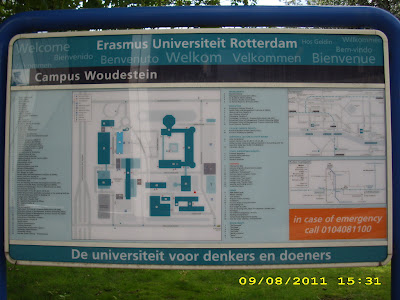
Since I had to run around campus today to print things and see people, I decided to get some pictures of the campus. This is a campus sign. They emphasize the inter-nationality of the university. The slogan at the bottom reads "The university for thinkers and doers." There are at least four different Erasmus campuses around Rotterdam and the surrounding area. I am at the Woudestein campus which houses the Faculty of Society and History, the Law School, the School of Economics and Business, and a few others, mostly grad programs. Also, please note the "emergency" number. 911 is catchy and 112, which is the Dutch version, is not too bad. I think, though, that in the middle of a fire or something I would have a really hard time remembering 0104081100.
This is the university map. My language classes are in building G, which is in the vaguely H-shaped building at the bottom-right. All of my other classes, and the whole Faculty of Society and History, is in building L, which is the really long one in the middle. All the rest of the middle of the campus, pretty much, is in the middle of a massive construction progress. To get from G to L you have to go all the way around the outside edge of the campus which makes getting places take a really long time and which really messed me up my first day when I was trying to figure out how to get across campus when my carefully detailed instructions were all for naught. On the plus side, since classes don't start until the first full week of September, they do have almost a month to finish stuff up. The yellow "M" at the very bottom right points to the Kralingse Zoom Metro stop where I arrive and leave every day.

This is one of the many water features around campus. They have loads of ponds as well as loads of marshy bits which are less intentional but are the result of all of the rain they have been having. There are lots of water lillies and also a bunch of basket type things which I assume are bird houses or nesting spots. However, what I first thought when I saw them was "Hey, little aquatic Plants v. Zombies pea shooters!"

This is Erasmus himself. He is very studious, apparently.


This is the university map. My language classes are in building G, which is in the vaguely H-shaped building at the bottom-right. All of my other classes, and the whole Faculty of Society and History, is in building L, which is the really long one in the middle. All the rest of the middle of the campus, pretty much, is in the middle of a massive construction progress. To get from G to L you have to go all the way around the outside edge of the campus which makes getting places take a really long time and which really messed me up my first day when I was trying to figure out how to get across campus when my carefully detailed instructions were all for naught. On the plus side, since classes don't start until the first full week of September, they do have almost a month to finish stuff up. The yellow "M" at the very bottom right points to the Kralingse Zoom Metro stop where I arrive and leave every day.

This is one of the many water features around campus. They have loads of ponds as well as loads of marshy bits which are less intentional but are the result of all of the rain they have been having. There are lots of water lillies and also a bunch of basket type things which I assume are bird houses or nesting spots. However, what I first thought when I saw them was "Hey, little aquatic Plants v. Zombies pea shooters!"

This is Erasmus himself. He is very studious, apparently.


Subscribe to:
Posts (Atom)