Showing posts with label Rotterdam. Show all posts

Saturday, June 2, 2012

Jael Takes Rotterdam

Jael is handy to have around because she climbs on things and gets into the picture taking spirit--as a model. So, we kept running across stuff and then she would climb on/in/over it and I would get fun pictures.  She did say I wasn't allowed to publish the really funny posterior shots of her climbing on stuff but there are still some pretty good ones.
This giraffe is part of a pretty nifty playground/park area that is on my walk home from school.  There are little parks all over the place in Rotterdam and they are a lot of fun to stumble across.  This one has a play ground area with a  bunch of wooden animals in it.  (There was also a giant wooden alligator but Jael was bored of giant animals by that time.
The park also has a big collection of giant climbing rocks that are pretty nifty.  There are also a few seating areas, a large section of reeds or bamboo or something that I've seen bunches of kids playing in.  The big, empty middle area is used as a soccer field.  The last time I walked through there, a couple of days ago, there were some kids playing soccer there.  Then one of them started calling "Mevrouw! Mevrouw!" (Ma'am! Ma'am!) and I looked over and realized that there ball was bouncing toward me and they wanted me to stop it before it got to the street.  So, I kicked it to them.  And it ran into a rock and then bounced back to me.  I eventually got it kicked to them and then I zipped away.  Now I feel kind of goofy going by there again because I was so obviously inept at kicking a little soccer ball. 
I had class one day while Jael was here and so I went off to class earlyish in the morning while Jael slept in.  (But then she did the dishes so I forgive her for not having to go to a boring class. =-)  She walked over and met me so we could go off and do other fun things.  She had to wait about a half hour  past the time I told her to meet me because the class went long.  I don't know if it makes it better or worse that we never once got out of class less than 5 minutes late the whole term.  This picture, though, is of Jael by the statute of Desiderius Erasmus, the famus Dutch Enlightenment-era philosopher, translator of the Bible, and name-sake of Erasmus University.
This is just what the metro-station at Rotterdam Centraal looks like.  They have been doing all kinds of renovations and have decorated it mighty pretty.  The colored stripes on the ceiling are just long, hollow, colored tubes.  And the have colored spotlights on the walls.  All of the metro stations are decorated just a bit differently from the others.  

Monday, May 28, 2012

Hup Holland Hup

This Wednesday, I get to go see a the Oranjes, the Dutch National Soccer team, play the Slovakian national team at the soccer stadium that is right next to my house.  It should be fun.  This game is part of the Euro-something Cup, a pan-European Championship.  (I keep wanting to call it the Eurovision Cup but that is a pan-European singing competition instead.)

I am going with a bunch of international students from the University which will be nice.  That way, if I can't find my seat or something, at least I will be amongst others similarly situated.  Also, apparently, the Oranje team is less likely to provoke riots than, say, Feyenoord (the Rotterdam team), so things should be less wild.  I don't think there is a big rivalry with the Slovaks so it should be relatively peaceful.  (The Dutch are all riled  up about Eastern Europeans coming in and taking all of their jobs but I think they are mostly concerned about the Poles and the Romanians as I don't think there are a significant number of Slovakian immigrants in the area.)

Hup Holland Hup is the Oranje fight song so I need to learn the words before I go, or at least write them down somewhere convenient.  If you go here, you can see a video bunch of picture of happy Dutch soccer fans, their fancy decorations, and can hear the Dutch football song.  It is kind of a nonsense song, I think, but part of the refrain (which is written below the video) is "Go Holland Go, don't let the lion stand in the bench . . . put on your football shoes . . . and take the whole world on."  I wrote a little bit about this last year, as well.

Now the only thing left to do is to decide if my hat clashes with my new hairdo.


Saturday, February 4, 2012

Nog meer sneeuw!

That is: "even more snow!"

In case you were wondering, the amount of snow needed to bring the Dutch public transport system to its knees is approximately one half inch.  Yesterday we got around a whole inch.  It is pretty delightful.  I love that squeaky crunch sound that snow makes when it is really cold out.  This morning it was down to around 8 degrees (-13 Celsius) and I don't think it ever got up above 15.  But the sun was shining almost all day and it was just beautiful.

Although the snow stopped the trains going (The transport system "tweeted", apparently in response to customer concerns about the slowness of regular train service to resume--"We don't know what all the fuss is.  They still don't have trains running in Antarctica, do they?") it didn't stop the Afrikaanderplein Markt.  Although it was pretty slushy.  But, I got eggs and plums and didn't freeze to death or slip and fall in the slush puddles, so it was a good day.

In the Netherlands, they are somewhat hampered with regard to snow removal because many of the side roads and most of the sidewalks are made out of paving stones set in sand and not out of regular pavement.  This makes repairing pipes under the streets fast, convenient, and cheap but it makes plowing impossible--if you caught a corner of a stone with the plow blade you would just rip the street up.  As a result, while a few people shoveled with little hand shovels, most people just threw out some salt and called it good.  This results in some rather disgusting slush puddles.  On the streets where there is pavement, then they did have plows out.  They even have plows with blades the correct size to clear out the bike lanes.

The picture on the right is of a sidewalk which has been ripped up a little.  They build the side walks and the roads by making a flat base of sand, lining up the blocks on top of it, covering them with more sand, then running a giant pounding machine over the blocks to settle them, and then sweeping up the leftover sand.


The Dutch, generally, seem pretty tickled about the snow.  There were loads of people out running around, playing in the snow, and seeming pretty cheerful overall.

I do not know how things are freezing up in Friesland (to run the Elfstedentoch they need to have 6" of ice all along the route) but the canals are frozen over here in Rotterdam.  I was out walking and shopping this afternoon, unfortunately without my camera, and, lo and behold, there were a whole bunch of folks playing on the canals.  They weren't skating, sadly.  They were just running around playing soccer in their tennis shoes.  I suppose that the snow was sufficient to provide traction but, as far as I was concerned, it would have been far superior if they were sailing along on skates, with their scarves floating behind them.  I might have gone back with my camera if they had been.  As it was, it mostly just looked like they were playing in a flat ditch.  I wouldn't have even known it was a canal if I hadn't seen it previously in an unfrozen state.

Tuesday, January 3, 2012

New Year's Resolution

New Year's Resolution: Next year, I plan to live in a paternalistic society which prohibits the use of firecrackers in residential areas (or at least in places near me) or in a place so boring they don't do anything bigger than a sparkler.


This is what Rotterdam looked like most of the evening.  This is around midnight and it kept up, about like this, until around 3 am.  These are not the official city fireworks (those were out over the Erasmusbrug which is on the other side of my building).  These are all personal fireworks which, apparently, every Rotterdammer and his brother had bought by the truck load.

Saturday, December 3, 2011

Kijkubus

One of Rotterdam's notable attractions is its wild architecture.  Everything in Rotterdam is curvy, or spiky, or weird just for the sake of having cool architectural designs.  One of my professors called it a disease, it is so prevalent.  One of Rotterdam's major sights is just such a thing.  The Cube Houses, which are located by Blaakplein--which is where the Blaak Markt is held every Tuesday and Saturday.  The Cube House complex was one of the first Rotterdam landmarks I saw when I arrived.  According the the official Cube House website, which you can find here in English, the architect wanted the buildings to look like trees.

This is a scale model of the Cube House complex and the
Blaaktoren showing nearby buildings and the
location of the canals, etc.
The Kubuswoning were built in the '80s as part of an integrated living arrangement (like Windhurst) which also served as a pedestrian bridge over the rather busy road that runs through this part of town.


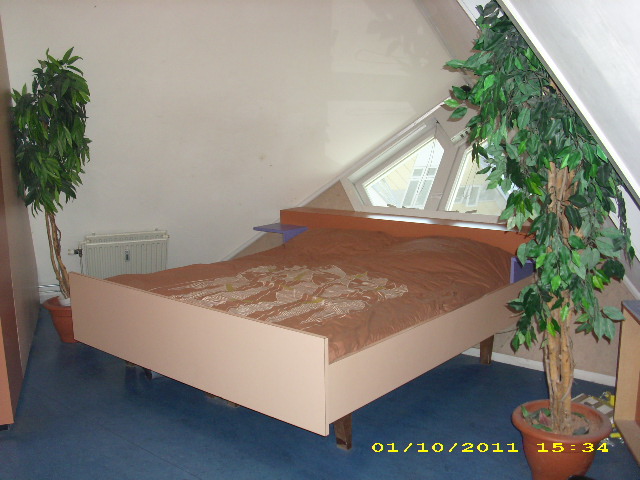
The buildings include businesses on the lower levels and apartments in the cube shaped top parts.  One of the cubes is a student hostel with a hostel company that specializes in having hostels located in unique or historical buildings.  One of the cubes is set up as a museum.  It is called the Kijkubus which kind of a play on words since "kijk" is root of the Dutch "to look" and "kubus" means "cube".
This is the very compact, but kind of cute, kitchen.
Notice how the walls are slanting out at an angle.
The house is very tiny, with itty-bitty stairways.  There are three floors in each house (and they are all flat) but the layout is such that there really isn't very much room.
This is the dining area and the beginning of the kitchen
plus part of the living room.


This is the living area/little gift shop area that makes up the rest of the first floor.  The stairs are on the left, just past the monkey, as is the teeny-tiny bathroom.  They were installing a new shower door on the door I was there which is one of the main reasons that I think that the museum curator also lives in the house.

The second floor includes a bedroom and a little den area organized around the central column of the house where the stairs are located.  There are shelves all around that central column.  These shelves are full of all kinds of little trinkets and books.
There were all kinds of little collectable things.
Like these little pieces of dollhouse furniture.
I do like the little elephants, though.
This is a chess set made out of famous Rotterdam landmarks.  You will notice that the King is the Euromast, the Queen is the Erasmusbrug, the Bishops are the the World Trade Center, the Knights are the Shipping and Transport College, the Castles are the Maas Tower, and the pawns are little Cube Houses.  I really, really want this chess set.


There were also shelves and shelves of Tolkien character busts, Tolkien books, and other SciFi type books.

The third floor was set up like a little sitting room but was unbelievably hot, even with a dedicated air conditioning unit.  This is not really surprising considering that the top floor was set up kind of like a green house.  There were loads of cactus up there and they seemed to be thriving.


On the left below are the stairs leading down from the third floor to the second.  Note the walls.  On the right is the view from the third floor, across the other cube houses out to the Williamsbrug.
 

I found this sign entertaining.  Since the door is on one of the walls that is leaning in at a 45 degree angle, I suppose it would be pretty painful to let the door slam on your fingers.


The Cube House complex is actually a large group of buildings which covers a pedestrian bridge over a major 6 lane road.  Inside the complex there are little pedestrian complexes and there are businesses in the "trunk" sections of the buildings.  There were accounting businesses, several nail and hair places, and at least one tattoo place.  There were lots of potted plants and little miniature-sized work equipment.


Tuesday, October 11, 2011

It's not easy being not orange . . .

I have discovered that, by some sort of massive sartorial oversight, I have arrived in the Netherlands without one one single piece of blaze orange clothing to my name.  It is plenty tragic.  The enormity of this problem was brought home to me as I was traveling home from Leiden Friday evening.  The train was very crowded--surprisingly crowded, I thought, considering that one would have expected the rush hour to be leaving Rotterdam at that time of the day.  But, as we went through more and more train stations, more and more people started to climb on and it got more and more crowded.  Not only that, the closer we got to Rotterdam, the more orange people were wearing.  Blaze orange shirts.  Neon orange jackets.  Bright orange fluffy earmuffs bigger than their heads.  Blaze orange feather boas.  Neon orange foam cowboy hats (apparently this is a real Dutch thing.  I have no idea why).  Bright orange jeans.  I have run through my list of appropriate modifiers.  Suffice it to say, everyone was very bright, neon, blaze, brilliant (hey, there's another one) orange.  My giant blaze orange hunting jacket would have been perfect.

The reason for all of this orange, and for everyone heading to Rotterdam, was that the Netherlands were playing Moldova, in Rotterdam, in the EuroCup Soccer Qualifiers.  The Dutch national soccer team is called the Oranjes (which means "oranges" (as in multiples of the color, not as in the fruit) and is pronounced or-an-yus).  The Oranjes' fighting song is "Hup Holland Hup" (Go Holland Go) but, in looking for a good You Tube video it appears that most people don't even remember that part of the song and, instead, sing "Lo, lo, lo, lo, lo" to the tune of "Hup Holland Hup."  The fact that many of the people in the videos appear to have been partaking freely of spirituous beverages may be one of the reasons no one can remember the words.  If you go here, though, you can see a very short video of people wearing orange and funny hats, and forgetting the words to "Go Holland Go."

My very favorite Dutch football thing, though, is a picture of a guy that I found on a report from a big Dutch win over Italy a few years back.  You can see the whole video here, if you want, but it is almost 6 minutes long and the reporting is all in Dutch (although it does have some pretty fun footage mixed in there).  This photo, though, is priceless.  This fellow seems pleased with the way things have turned out.  His shirt says "We will make hamburger out of you" but I think it almost sounds better in Dutch.


Now, I am off to find something orange to wear.

(P.S.--"Gehakt" just means chopped.  An alternate translation of the vest (or possibly a butcher's apron?) would be "We'll make minced meat out of you."  However, if you are in the grocery store, looking at the meat section, hamburger is just labeled "gehakt" so that it is also a legitimate translation.  Plus, I like it better that way.)

(P.P.S.--I am sure you are dying to know:  the Oranjes won!  Now they have to play some one else at a different qualifying match but they are the official winners of the group E qualifiers.  Whatever that means.)

(P.P.P.S.--That win resulted in a lot of late night fireworks and carrying on.  As near as I can figure, the stadium is 2 or 3 miles away from my house and I was still able to hear the chanting and screaming during the game.)

(P.P.P.P.S.--Now, I think that I know why the "van ze" is in a larger font than the rest of the font although, I will freely admit, puns are one of those things you probably need more experience to get for sure and it could be just to make the point more emphatic but, the Dutch name for Venice (which, as far as I can tell, is the most popular vacation place for Dutch folk) is "venitie" which is pronounced kind of like van-i-tse, which, especially if you are kind of drunk, could sound like a pun on "van ze" and, since this was a game against Italy, it is just possible that that was what he was going for.  Or maybe he was just trying to make it fit width wise.)

Friday, October 7, 2011

Wereldmuseum part 2


The Wereldmuseum had really interesting displays on Chinese and Japanese culture, primarily on religion.  They had rooms set up like temples, with tapes of Buddhist/Shinto/etc. monks chanting in the background.  It was an interesting way to display all of the stuff they had, instead of just looking at shelves and shelves of stuff.  One things, of which I was not aware, is that many kinds of Buddhists use "skull cups" as parts of rituals.  These are cups made out of the top of people skulls.  There is one particular sect of Buddhism that is especially into using bits of people in their worship (or perhaps it is Buddhists who have achieved a certain level of enlightenment, I wasn't quite clear on that).  They use the skull cups.  And rattles, knives, and other implement made out of femurs and other human bones.  And they drape human skins and intestines over their alters.  I wasn't entirely soothed by the official museum notation that the use of these things was "merely ritual."  I am not sure that that really speaks to my concerns about this practice.

There was a large section on Oceana and Indonesia.  There was one section that I thought was particularly entertaining.  There was one group of Indonesians who used to carve statues of those who died and then erect them around the town as temporary habitations for their ghosts, until the ghosts got used to things and headed off wherever the ghosts went, after which the statue would be buried.  Apparently, the length of time that it took for the ghost to head home was more or less tied to the length of time it took his family to pay for the giant funeral dinner everyone had.  The longer that it took to pay for the dinner, and the longer the little statue was out where everyone could see it, the more embarrassing it was and, also, the more likely it was that the ghost would get annoyed and start making trouble.  That seems like a pretty effective way of making sure people paid their debts.

They had a large display on Headhunters.  Let me just start this by saying that they did not have one single, soletary, shrunken head.  Let's just all say together: "EPIC FAIL."  That is all there is to say about that.

They had a really nice display on Headhunter carvings.  Apparently, it was traditional for them to chop down a nutmeg tree and then carve giant, elaborate totem poles out of the trunk.  They had one 12 foot long pole which was suspended from the ceiling and it was pretty impressive to think of people doing all that detailed work out of a whole tree trunk.

In case anyone is wondering why a museum exhibit entitled "HEADHUNTERS" spends a significant majority of the exhibit displaying giant carved tree trunks, then we are on the same page.  I was definitely expecting more shrunken heads and less carved aromatic nutmeg trees.

Apparently, the Headhunters used the totem poles to honor their dear departed and to appease their ghosts.  The headhunting comes in to play with regard to the spirits of the un-departed.  Now, in a lot of the world, people didn't used to sleep on pillows.  They had hard (really uncomfortable looking) neck rests made out of wood or other hard materials (if you remember Egyptian tombs, they usually had those kinds of neck rests).


These are some versions of African native headrests which are currently up for auction.  They appear to be quite plentiful and fairly popular.  These all seem to be priced around $300.  I think, though. that I might just stick with my fluffy squishy pillow.

In any case, most folks were satisfied with wood, or maybe some ivory.  These headhunter fellows were not.  They believed that the head was the center of psychic energy/enlightenment/good juju or something like that.  And, since they worried that, while they slept, their souls would wander away and forget to come back, they liked to have as many skulls around as possible, to lure their souls back home.  So they used skulls for their neck rests.  The museum did have some of these skulls on display (they were, sadly enough, normal sized, although that was probably more convenient for the purpose of sleeping on).  They were decked out with feathers and stuff.  'Cause no one likes to sleep on a boring old un-decorated skull, after all.

You may be sad to know that these poor fellows are no longer allowed to pick up any new skulls.  Headhunting is now illegal.  It has been since the 1960s.  Fortunately (the little audio guide told me) the Headhunters are still able to perform their rituals, just without the headhunting.  But just answer me this, how is all the ritual in the world going to get your soul back if you don't have some extra skulls lying around to lure him back in?

Monday, October 3, 2011

Wereldmuseum, part 1

On Friday, I walked across the Erasmusbrug to see the Wereldmuseum--the World Museum.  This museum holds all kinds of cultural artifacts from around the world.  Anyone can see the permanent collection for free but the special exhibit, which they have in honor of the museum's 125th anniversary, costs 12 euros.  Fortunately, I have a Museumkaart and that meant I could see the whole museum for free.  You get a little audio-guide to take with you and, periodically through the museum there are little tabs and, when you hold your little guide up to it, it tells you about things in the room.  It was actually pretty handy.  The museum takes up the top three floors and there is a restaurant and gift shop on the ground floor.  You ride up to the second floor in an elevator to start the tour and then you walk through the whole rest of the museum and, when you leave, the only way out of the museum is through the gift shop.

According to the audio guide, the Wereldmuseum had started out as a Gentleman's Club.  I think, however, that there may have been a little cross-cultural mis-translation and, from the context, that they meant "Gentleman's Club" in terms of the kind that Bertie Wooster used to go to.  Club members were traders and people in the shipping business who used the club as a place to network and to display the treasures that they had brought back from all over the world.  Eventually they decided to open up the building to the public and eventually they donated/sold the building, and its artifacts to the city.  The museum had a major overhaul a couple of years ago so it is all new and fancy and a lot of fun to look through.  It took me about two hours to walk  through the whole thing.  The 125 Masterpieces Special Exhibit is a collection of the best objects from the collection.  You can see a little photo album of some of the pieces from the permanent collection here.  You can see a little photo album of some of the pieces from the 125 Masterpieces exhibition here.  They did not allow photography at the museum.

A lot of the stuff was from Indonesia, which makes sense, considering the length and depth of the Dutch involvement there.  However, a lot of Dutch collectors have donated their collections to the museum over the years so, at least according to the museum's own little audio guide, the Wereldmuseum has one of the best collections of world cultural and religious artifacts in the world.  The have a large collection of Peruvian stuff and a really incredible collection of stuff from the far east. They even had pieces from James Cook's own collection.  They also had North American native work.  One of the 125 Masterpieces pieces was a beaded Lakota bag (Hey!  I used to live where they used to live!).

They also had a large collection of Islamic art, mostly pictures and book covers from the 15th and 16th centuries.  They were painted with silver and gold leaf accents and were really quite beautiful.  There were a couple of interesting things.  One was the parallels with Byzantine art--there are similarities in structure and style that are interesting.  For one thing, apparently, the Islamic equivalent of Byzantium's golden halo to signify divinity or spirituality is golden flames.  It was quite interesting.

Byzantine Art--notice the halo around Justinian's head.

Islamic Art--notice the flames around Muhammed (on the right) and Moses, Abraham,  etc. (on the left).

The other interesting thing was the number of "Christian" themes that showed up in the works. There were pictures of Jonah and the Whale, different scenes with Abraham and a picture of "the Sacrifice of Ishmael" which looks like the sacrifice of Issac except that, in this particular picture at least, it looks like the angel is showing up with a spotted goat.

Did you know that Batik fabric was originally made as a form of worship to Indonesian idols?  The fabric was used in ceremonial clothing and patterns were woven together in a special order during religious ceremonies. This was important because, they say, the weaving s a textile representation of the same kinds of things as their chanting, or the way they combined scents, to assist in the path to enlightenment.  Once they had noted the commercial value of Batik, they started selling it to other folks.  They now differentiate between the regular stuff and the sacred stuff by decorating the religious stuff with gold leaf.

If you look at the photo album from the museum's permanent collection (right here), the very last picture is of a very colorful picture.  This picture is impressive because it is made entirely with colored sand. Apparently sand pictures, which are called mandalas, are used in Buddhist worship as a way of incorporating prayers.  It can take weeks for a design to be made, during which time they pray a lot.  Then, when it is done, the sweep up all the sand and dump it in the river as a symbol of the transience of life.  Can you imagine?  The one at the Wereldmuseum was made as a prayer for the safety of the Dahli Lama (I think) but for some reason it was preserved.  The little audio tour said that it is one of only two sand mandalas that are retained in the West.  I have attached some links to different websites that show the way they make these mandalas.  It is some pretty impressive artistry.   Here and here are two different sites that show pictures of different mandalas.  Here is a site that shows a mandala that was made after the September 11, 2001 attacks in New York and Washington and here is a site that shows time elapse photography of the mandala being built and then destroyed.  They had a 1000 piece puzzle of the mandala at the museum available at the gift shop and I was almost tempted to get it.

Saturday, October 1, 2011

Toevlucht Vinden--Finding Refuge

I was out walking on Friday and I saw this monument.  It commemorates the bombing of Rotterdam by the Germans on May 14, 1940.  The way that this is commemorated deserves its own post, and a little more research, because it is fascinating but I found this story first.  In the map of Rotterdam that is printed on the stone below, the gray blob in the middle is the area of the city that was destroyed by the bombing and the fires that resulted.  The line around the edge of the bombed out area was called the "brandgrens"--literally, "the fire border."


When I got home, I looked up the website that is listed on the monument--www.brandgrens.nl.  It is the official Rotterdam website for an oral history and cultural memory project about WWII and it looks like it will be really interesting to look through.  By accident, I stumbled upon a set of interviews with people who were living in Rotterdam when the Germans bombed the city and invaded the Netherlands.  There are several interviews and I decided to listen to them because the subject sounded interesting and because it seemed like a good chance to practice my Dutch listening skills.

The second video I watched was an hour and a half long and was with Elizabeth Rippe.  She was fourteen years old when the Germans came.  At the beginning of the interview, she was asked what her family did during the war and she talked about reading the Bible and singing psalms.  Later, she talked about memorizing the Psalms in school. She talked about what it was like living through the bombings, with the noises and the debris flying everywhere.  When she was talking about how hard it was to breath with the dust, she sounded like she was choking just on the memory of it.

But what really struck me was when the interviewer asked how she and her family and those around them dealt with the  trauma and the uncertainties that the war must have produced.  She said that they read the Psalms.  She remembered, as the bombs were falling, that they would open up the Bible and, every time, would read from Psalm 91.  And fifty years later, she quoted what she had learned as a little girl:

"For he shall give his angels charge over thee, to keep thee in all thy ways.
They shall bear thee up in their hands, lest thou dash thy foot against a stone."

She remembered people asking what was going to happen and what to do and where to turn and she remembered the answer: "Alleen God kan us help en God is nog bij"--"Only God can help us and God is still with us."  And she cried.

At the end of the interview, she got out her Bible and read the whole of Psalm 91 and she looked up and she smiled and she said "I go here to find my refuge."  "Is this still your refuge?" asked the interviewer.  "Yes" she said. "Always, forever."


If you click here, you can see the section of the interview where Elizabeth Rippe reads Psalm 91.  It is in Dutch of course, but you might be able to follow along anyways.

If you click here, you can see the English language version of the home page of the "brandgrens" page.


Friday, September 30, 2011

Rotterdam Lights

Tuesday evening after the Dutch Cafe was, in keeping with this ridiculously beautiful and unseasonable weather we are having, a really beautiful evening out, so, after going down into the metro, realizing that I had a 10 minute wait until the next train came anyway, and thinking that it just seemed particularly stuffy down there, I decided to walk to Beurs Metro, where I would be switching lines anyways.  It was such a nice evening for walking, and the general tenor of the whole area was just so conducive to strolling that I ended up walking all the way home, which was just about three miles.  The weather was perfect and it was just the perfect time to walk through town (I went the long way which goes around through the nicer/more business oriented part of town) because restaurants, but not bars, were starting to close so there were a fair number of couples strolling through town, as well as a lot of people out jogging.

The walking trip did make me wish that I 1) knew how to work the night photo settings on my camera, 2) had a tripod so I could take pictures at night without them turning out all jiggly looking, and 3) had even brought my camera with me at all.  Rotterdam has been designed to look awfully photogenic at night.  The cranes and ships in the Haven Museum are all lit up with colored spot lights (and there were quite a few people out taking pictures of it) plus almost all of the other buildings have decorative lights on them with stripes and designs in different colors and configurations.  The slant-y, leaning building that I have pointed out before, had all of its flashy green lights doing different pictures.  For a while it was doing a spinning globe, so that the different continents were going 'round and 'round.  Then it did a heart that would start out small, grow to fill the screen, and then go back to small again.  Then it had "1888" scrolling across the front of the building in numbers as tall as the building.  1888 is apparently the Dutch equivalent of "0"--it is directory inquiries.  If you look at this site, it shows a picture of the building with a giant heart on it.  If you want to see what Rotterdam really looks like at night (I am pretty sure that my pictures wouldn't look like this, even if I had taken my camera) you can go to this site to see a few pictures.

One other thing I noticed, as I was walking home, was that the Luxor Theater (a pretty famous theater in Rotterdam) is having, on October 11th, a concert of two of Carl Orff's works, the most famous being "Carmina Burana"--it is one of those pieces of classical music that everyone has heard, even if they don't know it, because it is used in television commercials all the time.  I happen to like Orff's oeuvre, so I am trying to decide if I should go and see it.  The super-cheap tickets are 25 euros and tickets go up from there to 48 euros, which is a little more than I really want to spend.  However, one hour before the show starts, they will give you a 50% discount with a student card (among other things) so, if any of the cheapo seats are still available, that might be a pretty good deal.  I wonder if I would have to get dressed up?  The Luxor Theater is nothing if not eclectic.  The program for the next month or so (which you can see here) covers everything from a flamenco-musical called "Zorro" to a Neil Diamond impersonator and last month they had a flying trapeze act in as well (and if you think that doesn't result in some dopey looking advertisements, you couldn't be wronger).
The Luxor Theater, looking north.  You can see the Erasmusbrug just to the right of the theater.  It is the tipi shaped thing over the road. 

Tuesday, September 27, 2011

Kinderdijk Molens

A little while ago I posted about the University sponsored trip on the Pancake Boat to Kinderdijk.  Well, after a longish lull, this is the Kinderdijk section of that trip.  Kinderdijk is an area where there are still loads of windmills.  People still live inside them and they still sometimes use them to help regulate the water levels.

The name apparently comes from a story about how, after a big storm or after some flooding, or something like that, some folks came along and saw a cat sitting in a cradle that had wedged up on the dike.  Assuming that they would find something sad, they went and got the cradle and found a live little baby inside and figured that the cat had kept the cradle from capsizing and had kept the baby safe (although I am going to go out on a limb here  and say that that was from purely self-interest and not out of humanitarian motivations).

There was a storm coming in while we were there (fortunately, it didn't hit until about three seconds before I got to the metro station, so the whole trip was super windy, with really interesting clouds coming in, but still quite dry).


This was the first place that I actually saw any wooden shoes.   This is apparently a highly tourist-oriented area.


These are the large screws that regulate the water levels in the polder.  It is mostly run by electricity nowadays.


I do not know why there is a little cut-out goat on top of this hay bale, but I thought it was pretty cute.


Do you notice the Holstein cow grazing in the field by the canal below?


We were supposed to get to go into one of the windmills to look around and see what it was like inside but the mill-owner wasn't there, so we just went wandering around, looking at the mills and checking out the canals.


While we were out walking around, I talked to a couple of girls who are on an exchange program from a university in Austria.  One was Austrian and the other was from Munich.  They were a lot of fun to talk to and both seemed very German.  Somehow, and I am sure that it will thrill some of you to hear this, we got onto the subject of German beverages.

I mentioned "Rrrradler."
The girl from Munich said "What?"
I said "Rrrrrrrrrradler!"
The girl from Munich looked very uncertain.
The girl from Austria said "She's saying "Rraddddlllerr.  I know, because I knew another American who said it that exact same way."
"Oh," said the girl from Munich, "yeah, rraddddlllerr."

I did, specifically, ask how "Radler" ought to be pronounced and what I was doing wrong.  They both said that it wasn't, in fact, an issue of how the "r" is rolled.  Rather, it is a question of how the "d" and the "l" get rolled together.  SO, even if I still can't order a Radler by myself, and even if other people can, it still isn't an issue of how well one rolls one's "r"s.

We had a fun time, though, talking about the superiority of German food over Dutch food and, especially, the terrible, relative, horribleness of Dutch bread and "bratwursts".

Monday, September 26, 2011

Pilgremvaderskerk, a.k.a., Oude Kerk


When I went to Schiedam for the Open Monumentendag festivities, I stopped at Delfshaven, which is conveniently located on the way to Schiedam.  Delfshaven was also participating in the Open Monumentdag.  The Pilgremvaderskerk, or Oude Kerk (Pilgrim Father's Church, or Old Church)  was one of the places that was open extra hours and had special stuff going on for the weekend.  I stopped here on the way out because it opened earlier than most of the things I wanted to see in Schiedam and I figured by the time I walked through Schiedam I wouldn't really enjoy more walking around on the way back.

There was a little museum in the back of the church that had a Pilgrim Fathers Presentation.  There was a video that could be played in English or Dutch, and several different displays around the room.


This is a tile painting that shows the Pilgrim embarkation at Delfshaven.  There was a long history of ship travel between the Netherlands and America after 1620, with the Holland-America Line of ships which used to be one of the premier lines.  It is still in operation and, as far as I can tell, is still well regarded.  Every now and then you will seem someone carry a bag with the Holland-America logo on it.

If you look at their logo below, though, you can see that they hearken back to their old roots.


They had several different displays of Puritan paraphernalia as well, including this pretty plate, the ship shaped cake server and the itty, bitty, tiny "Mayflower" in the bottle.


Even in the church, there were all kinds of memorials of the Puritans.  There were two maritime themed stained-glass windows.


The first commemorated the sailing of the Speedwell, on which the Pilgrim's departed Delfshaven on the 22nd of July, 1620.  If you notice date differences, it is because the English didn't change to the new Gregorian calendar until much later than the rest of Europe and so a lot if the dates in the 17th century can be off by 10 or so days.


The second window commemorates the founding of the Dutch State.  It says (I think) "The port of salvation comes only from the Lord of Zion, 9 September 1574."  I am not certain because "haave" is not a word I can find anywhere in modern Dutch dictionaries.  But I am going with a blind assumption that it is etymologically related to "haven."


There were also stained glass windows that depict the six days of creation.  The text around each picture is a quote from Genesis--"in thus and such a day, God created . . ."


There were large plaques that were on all of the walls around the pulpit.  Some showed different Puritan documents.  This one shows the Ten Commandments.  You can't really read them very well, but you can tell from the density of the text that the Puritans didn't hold with any abbreviations for the purpose of making posting easier.  When they refurbished the church they had to repaint each of these boards, by hand, with tiny paint brushes and gold paint while set up on scaffolding.


There were also boards that had the names and tenures of every pastor who has served at the church for the entire history of the church--so a little over 400 years worth of pastors.  They also have a gallery of picture of former pastors but they don't have pictures of everybody.


There is a display of the original church bells from the church.  The large bell is  chest high.


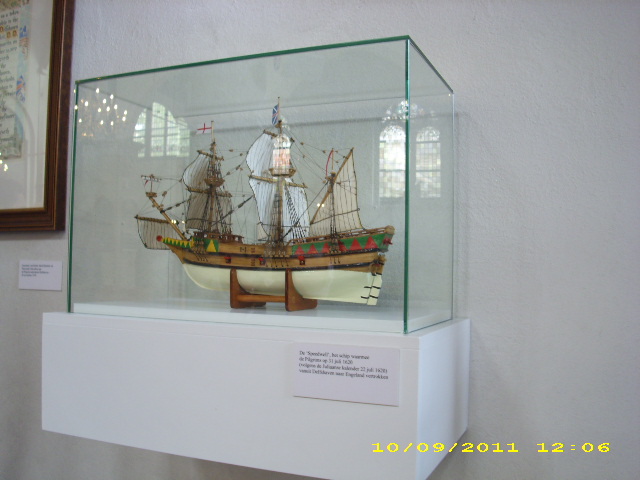
There were also models of the Mayflower and the Speedwell out in the the sanctuary, with teeny little sailors working in the rigging.

The plaque on this ship says
"The 'Mayflower', the ship on which the Pilgrims sailed from Plymouth in September 1620 on their way to America, from England to Cape Cod."


This one is the Speedwell.  The plaque on this one says: "The 'Speedwell'. the ship on which the Pilgrims sailed from Delfshaven to England on July 31, 1620 (July 22, 1620 according to the Julian Calendar)."


This is one of the grave markers that line the entire floor of the sanctuary.  The weird "F" symbol looks very familiar but I can't remember what it is from.  Perhaps it is a Masonic symbol?  Although the grave markers are about 2 feet by 6 feet, it looks like they were doubled-up because most of them had "Hier leijt . . ." messages at the top and then had a second engraving at the bottom of the slab.

This is the grave stone on which I sat when I went to church here.


These are the doors as you see them as you exit the sanctuary:


This door lintel says "Bewaart uwen voet als gij ten huize gods ingaat."  Which is from   Ecclesiasties 5:1 and says "Keep they foot when thou goest to the house of God."

This door lintel below says "Eere zij God in de hoogste hemelen."  This is from Luke 2: 14 and says "Glory to God in the highest."


There is a plan of the church posted on the outside of the church.  When you go into the church, you go into the little vestibule to the bottom right of the cross-shaped nave.


What was really entertaining, though, was that this old and sedate looking plaque was right next to this plaque:  advertising what appears to be an Hasidic Jewish rock concert by a folk-music group named "Unicorn."