Showing posts with label Church. Show all posts

Saturday, November 2, 2013

St. Paul's Within the Walls Episcopal Church (17 June 2012)

This is a Wikipedia Commons photo of the church, since I didn't get one,
but I love the stripes on it and the little blue dots and rose windows.
When I was in Rome, my plan was to go to an Anglican church on the Sunday morning.  (Anglican Churches turned out to be my go-to churches while I was traveling because they always have services in English and because they seem to often be located near big tourist centers.)  

However, and I cannot emphasize this enough, the Italians take a more relaxed approach to schedules than do the Dutch.  This lackadaisical approach extended to train, bus, and metro schedules and was quite a shock to the system.  For comparison, the Dutch Minister of Transportation got fired after heavy snowfalls disrupted train schedules in the Netherlands for too long.  In Italy, you would probably get fired for sticking to the schedule to closely--or you would run your train into the back of the train in front of you.  

In any case, after the late start from Milan, we made up some time overnight and only arrived in Rome about an hour after schedule.  It meant that I was running a bit late for church.  When you add in some confusion about the streets and things, I ended up missing church altogether.

My plan had been to go to St. Paul's Within the Walls Anglican Church, which has been having services since 1859.  It got its name, apparently, because it was the first non-Catholic church allowed to be organized in Rome, which is pretty impressive, actually.  You can see the official website here.  But if you go here you can see the facebook page (which I think you can see even without a facebook account) and if you click on the photo link, you can see a lot of pictures of the very pretty interior.

I was looking for  pictures of the church and came across this website.  It is a photography and tourism website that deals specifically with Italian churches and cathedrals.  The entry on St. Paul's Within the Walls is toward the bottom of the page but you may enjoy looking through all of the entries.  There are interior and exterior photos, as well as information about the history of the church.

More entertaining, I found a website with "Mystery Worshiper" reviews of various churches.  If you click here you can see a pretty detailed account of what it would have been like to go to church at St. Paul's Within the Walls if the trains had been a bit more prompt.

Just as interesting, I looked through the archives and found reviews of the other Anglican churches I went to while I was in Europe.  

There were loads of reviews on St. Alban's Anglican Church in Copenhagen, Denmark, where Jael and I visited (I posted about that here).  There were reviews from February 1999, November 11, 2004, August 16, 2009, and December 25, 2009.  It seemed like there were some wide variations in the quality of snacks. 

This review of St. Clement's Anglican Church in Prague, Czech Republic is from January 1, 2006, so it was almost exactly six years before I went to the church (I posted about my visit here).  I noticed that the reviewer also noticed how cold it was, except for your feet.

One of the very oddest things I noticed was that the sermons only lasted from 5-10 minutes each, with the average being about 8 minutes.  I just have to wonder what those folks would say if they accidentally wandered into one of Pastor Bradley's sermons!

Saturday, April 14, 2012

Stuff I Missed . . .

Jael took pictures and left them with me.  Unfortunately, she deleted all of the really funny pictures of her before she did that.  But, in any case, I just looked through those pictures and found out there are some of them that relevant to stuff I already put up.

So, here, and with proper photography credits to Jael are pictures of St. Alban's Anglican Church.  Somehow, Jael, who took a total of about three non-food-related pictures the entire trip, ended up with more pictures of the church than I.
This a back-view of the church (with its steeple cut off).  It is from over the moat that
surrounds the Kastilette.  You can also see the very famous Gifeon Fountain.
Also, notice the swan sitting on its nest under the edge of the bridge.
St. Alban's Anglican Church
And, finally, a picture of me, in our hotel, on my side of the room which had a closet and the exit.  I would totally have won the "get out alive" race in the case of a fire.  Jael's side of the room only had a window with no fire escape.  I really did not remember Jael taking this picture.  I think that I have blocked it from my memory.

Monday, April 9, 2012

St. Alban's Anglican Church (1 April 2012)

Last week, on Palm Sunday, Jael and I were in Copenhagen, Denmark.  We decided to go to St. Alban's Anglican Church because it is one of the few English language churches in Copenhagen and it was also easily accessible by public transport.

Somehow, I managed to only get one picture of the church.  I blame it all on Jael.  She was a very bad influence, photography-wise, because she kept interrupting my picture-taking by saying things like  "Now we're late for church!" and "If you don't hurry up, we're going to miss our train.  Again."

She was a real kill-joy to have along.


St. Alban's was built in 1887 and is right on the Baltic Sea.  It is just a few hundred yards from the statue of the Little Mermaid, from Hans Christian Andersen's famous story.  I never actually saw the statute, though, if you can believe it.  We missed it because of Jael's insistence that we get to church in a timely fashion.  I mean, really!


St. Alban's is part of the Diocese of Europe for the Anglican Church.  It is officially under the authority of the English Crown.  In fact, the week before Jael and I went, Prince Charles and his wife visited the church, officially, in honor of the Queen's Diamond Jubilee.  (You can see the pictures here.  The official church website is here.  And you can read a little history of the church here.)

We went on April 1st, which was Palm Sunday.  Apparently, the church has a tradition, on this holiday, of having all of the congregants go outside the building to sing the first hymn, and do the first prayer, before proceeding back into the church while waving palm fronds.  Since the temperature was about 35 degrees and it was very windy, this ended up being kind of inconvenient.

The church service, itself, ran a little differently than the Anglican service I attended when I was in Prague over Christmas.  For one thing, in Prague, there were some American accents and lots of foreign accents (such as French folks who apparently found it easier to follow an English language service than a Czech one).  In Copenhagen, perhaps because of its proximity to England and the amount of business done between the two nations, there was a much larger crowd (I didn't get an accurate count because there was a separate little wing with seating that I didn't get a chance to count but I would guess that there were 50 or more people in attendance) and everyone I heard had one of several regional English accents.

The service also seemed much more fancy and "high-churchey".  The Rev. Ricky, in Prague, seemed pretty easy-going, his wife played the organ, and that was about as much as went on.  In Copenhagen, there were a lot more folks to keep track of.  There were what I assume are the Anglican equivalent of alter boys, in addition to the choir.  There was the guy in charge of the service (in the same role, I think, as Rev. Ricky), wearing the white robes with the collar and fancy tie-thing--I looked it up on the website and he (Jonathan Lloyd) is an Archdeacon, and also a Chaplain, which jobs I did not know could go together.  Though, to be fair, I am not that up on my Anglican polity.  There was also an Assistant Priest who was wearing the white robe over the black robes.  When we were leaving, Jael said "He has such floppy English hair!"  (and he totally did--he reminded me of a 1990s Hugh Grant).  However, he is, apparently, from the Scottish Episcopal Church and his name is Fr Gottfried Grunewald, which doesn't sound particularly English, so he must have gotten the hair by osmosis.  Then, there was a lady who was dressed in blue robes with a fancy hood down the back.  She helped with passing the wine around during communion (they had a communal cup and she was in charge of wiping the rim between folks) and perhaps she was a trainee of some kind?  I have never seen robes like that in the few Anglican services I have been to.  She might have been the Parish Deacon (perhaps they serve different roles there).  There was, additionally, according to the order of worship, a president.  I don't know what office that is and couldn't find an explanation on the internet but, from what I could tell, she was the one who was actually broke the bread and blessed the communion table. According to the website, she is a "Reverend Canon" (another office with which I am unfamiliar) and is Diocesan Director of Training.  Everyone bowed toward the altar, when passing in front of it, which might be an Anglican thing, although I had always equated it more withe the Roman Catholic church.  A few people in the congregation crossed themselves while the blessings on the elements were being read but they may have actually been Catholics who just wanted to go to an English service and I forgot to notice how many fingers they used to do it.

There wasn't a sermon.  Instead, they had a dramatic reading of Mark's account of the Passion of Christ.  All of the people doing the reading had very plummy English accents which was kind of fun.  (The church website lists a "Licensed Reader" as a part of their Ministry Team).  I did keep the church bulletin as it has a devotional on the front page.  It is a devotional produced by the official Anglican publishing house.  To give you a little taste, I will just include a quote from the bulletin, which is entitled "The Glory of the Cross":
"This week, we see what it is to be God. . . God does not wash his hands of creation, disclaiming responsibility.  And he does not bring it to an abrupt end and start again with something less creative, less risky.  Instead, God redefines everything it is to be God; he comes to live in the world that he and we have made between us, and to die the death that such a world entails.  And in this, he shows his power.  This is God, taking the blame -- although most of it belongs to us, God shoulders it, as the one who allowed this possibility in the first place. 
"This is what we choose.  We choose a world in which we will have control, even over God, even if that means death.  And God, who gave us that power of choice, accepts what he has done.  He bows to our power."
Jael and I did some quiet gasping.

Tuesday, January 10, 2012

St. Clements Anglican Church (25 December 2011)

On Christmas day, which was Sunday, I went to St. Clement's Anglican Church.  I chose this church because it was the only English-language service not officiated by a woman that I found in my "English Language Church Prague" Google search.  For the record, however, I did indeed sneak out during the Eucharist (they make that easy by making everybody go up, a row at a time, for the laying on of hands).  The service was very, very English.  The sermon was "Make Room for Jesus" which seems like standard Christmas fare.  The church was pretty full.  The pastor was happy because he said that this year it looked like the regular members had put in an appearance--apparently, last year they were outnumbered by the tourists (or last week?  All of a sudden this story doesn't make sense to me.).  They sang some old, familiar hymns, but some of them didn't have the old, familiar tunes, which was a little confusing, and they did everything out of the Prayer Book.


The church was really chilly.  They had heaters under the seats, so your feet were toasty warm but your face and hands were very cold.  The church is old quite old.  It is kind of a cross between Gothic and Romanesque architecture.  It is getting taller and the windows are getting bigger, but it has the old Romanesque arches inside.  According to the church's website, about their history, which you can read here, if you are interested, while the church is only 108 years old, the building is almost a 1,000 years old.  I didn't get any pictures of the interior but, in searching the internet for pictures of the interior, I stumbled upon a blog written by the Rev. Ricky Yates, the pastor of the church.  If you go to this link, you will see some wedding pictures which show the interior of the church.  If you go here you can go to the home page of the blog, if you want to check up on what the Czech Anglicans are up to.


This plaque is on the side of the church.  It commemorates the 500th anniversary of Jan Huss's death.

Saturday, September 24, 2011

NeboKerk (18 september 2011)

I went to NeboKerk again last Sunday.  The sermon references were I Timothy 3: 15--"That thou mayest know how thou oughtest to behave thyself in the house of God which is the church of the living God, the pillar and ground of the truth" and Nehemiah 8:1-13, with an emphasis on verse 10-- "Then said he unto them, Go your way, eat the fat, and drink the sweet, and send portions unto them for whom nothing is prepared:  for this day is holy unto our Lord: neither be ye sorry, for the Lord is your strength."

Mostly the sermon was about enjoying the Lord's day but just today I saw, on Facebook, this article about the duties of the Sabbath, as referenced in the Sabbath-keeping decisions of a professional athlete, which I thought was quite interesting as well as being marginally related.  And Ben, this guy is from Glasgow, Scotland, so you just know he's a good guy.

Another interesting connection was that they had a special prayer for Prinsjesdag and the Dutch government.  Prinsjesdag is the official opening of the Dutch Parliament which seemed like a very good idea.

Prinsjesdag occurs on the third Tuesday of September every year.  It is full of pomp and circumstance and, if I had gone to Den Haag and fought the crowd, I might have even gotten a first-hand glimpse of the Queen or her fancy carriage on the way to open Parliament with a speech.  You can see the official homepage of the 2011 Prinsjesdag events here.

The Queen opens parliament by reading a "state of the nation" address and then the Finance Minister also gave a speech.  I listened to the speeches on Radio Nederland, which is kind of the Dutch equivalent of NPR, and was able to follow somewhat.  The Queen has a very nice  speaking voice and spoke very clearly so it was pretty easy to understand her.  The speeches weren't very positive.  Apparently they figured that things were going to get worse, economy-wise, before they got better.  You can see a picture of the queen reading her Troonrede (the official mane of her speech) here.  There is a very large photo gallery of the events that you can look through, if you are so inclined.

In my class on Monday, the teacher told us that if we went to Den Haag we could see the Queen riding around in a Golden Cage.  He mentioned it a few more times before realizing that people seemed a little perplexed.  Then he had to describe what he meant before we realized he meant "carriage."  Then, when we went to the Dutch Cafe that evening, the teacher had a newspaper that showed a picture of the carriage and, when she was explaining what had been going on English, she had to ask for the English word for carriage.  It was interesting to see that same tiny gap in English vocabulary in two people who otherwise have pretty impressive vocabularies.  I suppose, though, that there just aren't that many times, anymore, when you need to know the word for carriage.  If you want to see a picture of the carriage (which is very, very gold, by the way), you can see it here.

Friday, September 16, 2011

NeboKerk (11 september 2011)

On Sunday I went to the NeboKerk again.  It was their Children Focused Sunday.  So they had special music, sang lots of younger-type songs, and had a gospel-message type sermon that was especially directed toward children, from Ephesians 1:17:  "That the God of our Lord Jesus Christ, the Father of glory, may give unto you the spirit of wisdom and revelation in the knowledge of him."  This was part of their equivalent of a VBS program (although I didn't quite catch whether this was the conclusion or the kick-off for it).

On a related note, I am now the proud owner of a Dutch Bijbel!  I found an old, school Bible, the kind that, as appears on the name plate, were given as school prizes a long time ago.  This particular one was given to a student named Rienus van der Hulst at a Reformed Sunday school in Rotterdam on Christmas Day in 1925.  It is a little worn and the spine is held together with scotch tape but that just gives me an excuse to finally go buy some of the fabric that they have at the market, so that I can make a Bible cover.  And they have some really, really pretty fabric at pretty reasonable prices.


I got the Bible at the Blaak Markt on Tuesday out of one of the flea market type booths.  I just stopped by on my way to the Official Welcome stuff the school had for the international students and just happened to see some books and, after I had looked through the books and seen nothing I wanted, as I turned to leave, I just saw the Bible under some magazines out of the corner of my eye.  It costs 1 euro (or about $1.50) which is a pretty terrific deal as, even used, the Bibles I have seen have been over 30 euros ($50).  The one downside is that this is the good, solid, old-fashioned Statenvertalling Bijbel, which is the kind I kind of wanted anyways but is also the kind that none of the churches I have visited uses.  I will have to keep an eye out for some of the newer translations as well, I guess.  Although they will be much less historically interesting.  If you think that this Bible managed to survive not only the obliteration of Rotterdam in the war but also 86 years (almost) and ownership by a little kid, the fact that the binding is coming apart all of a sudden seems pretty minor.

By the way, for those of you looking for baby names, Rienus is an old fashioned name (or at least an old fashioned spelling) of a boy's name which means "from the sea."  Which makes all kinds of sense for a Dutch baby.  Anyways, it's a unique name--your little Rienus would probably never meet someone with the same name. . . (and also, no "J"s . . .)

Monday, September 5, 2011

NeboKerk (4 september 2011)

This Sunday I decided to go to Nebokerk for church.  It is part of the Christelijke Gereformeerde Kerk (CGK) (the Christian Reformed Church) which was recommended to me as being a solid reformed denomination.  Their website is here, if it is of interest: http://www.nebokerkrotterdam.nl/.

The church building, I am guessing, was built in the seventies.  There were about 70 people in attendance.  At a guess I would say the average age was around 60.  There were only a couple of kids and there were some college age kids but many of the congregants were, literally, getting around in wheel-chairs or with walkers.  The slogan on the front reads: "together with you for God and each other."


The preacher spoke very clearly and gesticulated a lot which made it a lot easier to understand what he was saying.  I think I probably understood about 75% of the sermon.  (The guy who read the announcements was not so clear.  Even with reading along in the bulletin I understood very little of what he was saying.)

This church (I do not know if it is denominational decision or not) uses the Nieuwe Bijbel (NBV).  However, they use the 1960s version of the NBV, not the 2004 edition that the Pelgrimvaderskerk uses.  I am sure that English translations are just as bad but, honestly, it gets so confusing!  I don't know how these two editions differ although the spelling and language (to my untutored eye) seemed more old-fashioned in the one from this week, and closer to the Statenvertaling Bijbel, than to the 2004 NBV.  One very good thing about this church is that they provided pew Bibles so I was able to follow along very nicely.  But in any case, it seemed like a fine sermon and I understood almost all of it!

Since it was communion Sunday (the first Sunday thing must be a worldwide phenomenon) the sermon was related to the Lord's Supper with texts from Isaiah 55:1-5 and John 6:48-58.  The title of the sermon was "Horen, Eten, and Genieten" or "Hear, Eat, and Enjoy," based on the Isaiah 55:2b--"Hearken diligently unto me, and eat ye that which is good, and let your soul delight itself in fatness."  The pastor presented these three ideas as three steps of ascending intensity--hearing comes from the outside, eating you take into yourself, and enjoyment is what you express as a result.  If you will forgive me as I cavil at a small point (I am just delighted that I was able to understand enough to complain), in discussing the first point "hearing" the pastor pointed out that what was meant by the language was not simply the physical action of hearing but something much more involved (as in the Mark 8 sense).  Taken in that light I am not sure that the step from "hearing" to "eating" was as large a distinction as he wished it to be a little later on.

The hymns were very nice--they were old  style tunes and very familiar.  Also the organist was quite good.  She played for accompaniment well, so that it assisted the singing instead of drowning it out.

Communion procedures were not what I am accustomed to however.  I do not know if having everyone go to the front of the church to take communion is a European thing, a Dutch thing, a new thing, or just something they do everywhere where I haven't been to church, but of the three churches I have been in for a Communion service since I arrived, all of them had people go to the front.  At this church, in addition, they had a long row of tables set up at the front and then everyone had to go to the front and sit at the table.  Then they passed out the communion (with communal wine cups) and then everyone sang hymns with the hymn books that were laid out at the table for that purpose.

My favorite thing about this church though, is where it is located.  It is far south of me (and not very convenient to get to).  It is in kind of a semi-suburban area and the road from the bus stop to the church is between a 3 or 4 acre empty lot on one side and what appears to be a community garden of some kind on the other.  There are horses being kept in the interior of the block or lot and, from the smell, I would say that there are either also cows being kept there or they ship in some fertilizer (it was a nice, homey smell).  It was a fun walk though.  There were all of these little garden plots, kept up to a greater or lesser degree, with all kinds of different vegetables and plants and things.  The fencing along the road and between the plots was mostly jury-rigged affairs with bits of this and bits of that strung together with barbed wire and propped up with sticks.  It would have made Grandpa proud.

It was a really pleasant walk though--it had been pouring rain all night, with terrific thunderstorms going on into the morning but it cleared up just in time to be a nice, clean, washed-up feeling Sunday.


Monday, August 29, 2011

Pelgrimvaderskerk (28 augustus 2011)

This Sunday I went to Pelgrimvaderskerk again.  I like the church pretty well, partly, I think, because it feels kind of familiar.  A lot of the song tunes are different but they are still similar in style, in meter, etc., which makes them seem familiar.

One of the songs this week was to a tune from the Psalter.  It was in a minor key and it is one that I always like when we sing it but I never remember to remember what it is.  And the name of the tune wasn't listed in the song book, at least that I could see.  The song books they use in church are the old fashioned kind where the first verse is written next to the tune and then all of the other verses are written below and sometimes even on the other side of the page.  It can make singing a little more challenging if you are trying to read and hear the words (to try to make sure you are pronouncing them right) and also trying to read and hear the notes, which are written in a different place (to make sure you are singing it right).

The sermon this week was on I Kings 18:3 (Obadiah would be a pretty good name for a baby, by the way--it means "servant of God"--and not a "J" in sight), Colossians 3:18-4:1, and Psalms 111:6.  The main point, I am fairly certain, was that, even in the face of adversity you ought to serve God because you ought to fear Him more than you are afraid of other things.

I did discover that I really do need to get the same kind of Bible that they use in church.  I wrote down the main verses that were going to be used and took them with me (I also wrote out the Lord's Prayer and took it along as well, to help with the memorization).  Unfortunately, I used the Statenvertaling Bijbel (SBV), since that is what I have on my computer.  This turned out to be quite different from the Nieuwe Bijbel Vertaling (NBV) that they use in church.  While I am sure that the difference wouldn't throw me that much if it were in English, it was sufficiently different that I wasn't really able to follow along at all in Dutch.

For example, the main verse for the sermon was I Kings 18:3 ("And Ahab called Obadiah, which was the governor of his house.  (Now Obadiah feared the Lord greatly).")
In the SVB the verse goes:
"En Achab had Obadja, den hofmeester, geroepen; en Obadja was den Heere zeer vrezende."
"Dat Achab zijn hofmeester Obadja ontboden had.  Deze Obadja had groot ontzag voor de Heer"
The second line is from the NBV and really doesn't match that well at all.

But the Psalm was even worse:  Psalm 111:6 ("He hath shewed His people the power of His works, that he may give them the heritage of the heathen,")


SBV
Hij heeft de dracht Zijner werken Zijn volke bekend gemaakt
Hun gevende de erve der heidene.
NBV
Hij toonde zijn volk de kracht van zijn daden
En gaf hun het land van andere volken.


The one good thing was that they kept the old SBV version of the Lord's Prayer, with one tiny change (that kind of made sense) because that is the version that I have been practicing and the NBV version is really, really different.

Wednesday, August 24, 2011

Pilgrimvaderskerk (21 augustus 2011)

On Sunday, I went back to the Pilgrimvaderskerk.  It wasn't quite as full as it was last week, so perhaps last week was special for some reason, but it was still pretty full.

I ended up sitting next to a very nice couple with a very beautiful baby and we had a nice chat.  They told me which version of the Bible the church used and offered to explain things if I couldn't keep up.

The PKN (the denomination to which the Pilgrimvaderskerk belongs) has officially adopted the Nieuwe Bijbelvertaling as the translation which they encourage the churches to use in worship.  The Nieuwe Bijbelvertaling is a newer translation (it came out in 2004).  It has a reputation as being kind of a "fluffy" read and not that useful for study.  One of the guys on the minority side of the PKN committee which ended up approving the use of the NBV said that the choice to use the NBV was an "irresponsible decision unworthy of the church." (http://www.pkn.nl/5/info.aspx?page=14820)  The reason that the PKN decided to use it was because it was popular with the "ordinary" reader.

On the other hand, whatever people say about the NBV version, as far as I know, no one has called it a "trick of the devil" which is what at least one pastor called the Herziene Statenvertaling Bijbel, the 2010 redo of the old Statenvertaling Bijbel.  (http://www.cip.nl/nieuwsbericht_detail.asp?id=19390)

In any case, I definitely need to get a Dutch bible of my own  (it turns out that they don't have pew-Bibles available at the church, it is just that a lot of the Bibles people bring with them look like the song books).  I have my English Bible and, once I get to the correct place, I at least know what the pastor's text is about but it is very difficult to listen to the Dutch and read the English at the same time and still have an idea what is going on.  I just have to decide if I want to go for the "fluff" Bible that will be easy to follow along with or if I want to go with a real Bible that will not match what the pastor is reading.


One good thing about church services is that there a lot of things that are the same no matter what the language, so there are things that you can recognize and it helps you feel like you know what is going on.  One such thing is the reading of the 10 commandments.  One thing I noticed this week, though, is that there is a little difference between the Dutch and the English commandments.  In the 9th and 10th commandments one is forbidden to bear false witness against a neighbor or to covet any of one's neighbor's things.  In Dutch, the typical word for neighbor (which you use in everyday conversations) is "buurman".  However, the Bible translation doesn't use that word either in the Nieuwe Bijbel or in the Statenvertaling Bijbel (I looked it up).  Instead it uses the word "naaste".  Usually you use this to mean something that is next to you.  Google Translate also gives an alternate translation of "fellow creature" which may be why it is used instead of "buurman"--it just gives a broader and more inclusive meaning.  (It could just be to avoid all of those jokes about being allowed to lie about the guy who lives across town.)  In any case, I don't suppose it matters that much; mostly I was just impressed with myself that I was understanding enough of what was going on that I could tell the difference.


My next big project (having, I feel, conquered the "trekken" and "duwen" (push/pull) challenge) is to memorize the Lord's Prayer in Dutch.  It is something that you learn almost without thinking about in church when you are little and I feel kind of silly not being able to follow along with the congregation when they pray it in Dutch.  This is the Lord's Prayer in Dutch:


Onze Vader die in de hemelen zijt,
Uw naam worde geheiligd

Uw Koninkrijk kome;
Uw wil geschiede,
Gelijk in de hemel alzo ook op de aarde.

Geef ons heden ons dagelijks brood;
En vergeef ons onze schulden,
Gelijk ook wij vergeven onze schuldenaren;

En leid ons niet in verzoeking,
Maar verlos ons van de boze.

Want uwer is het koninkrijk
En de kracht
En de heerlijkheid
In de eeuwigheid.  Amen.


If you want to hear what it sounds like, you can listen to it (in a variety of versions) at this website: http://web.me.com/schuffelen/Site/du3ourfathers.html.  The version I will practice is the Protestant version but I am going to have to make sure this is the one the church actually uses before I go and learn the whole thing wrong.


The sermon was on the Parable of the Prodigal Son.  From what I could tell, the pastor said that the parable was analogy of the relationship between God and the Church.  He also said (I think) that the church ought to work at having better internal relations between Christian brothers than the two brothers in the parable did.  It wasn't ground-breaking stuff but, to be perfectly fair, I had a lot of trouble figuring out what he was talking about most of the time, for some reason, and he could have had the best sermon ever and I would have been none the wiser.  I definitely do not think that I understood as much this week as I did last week.


Altogether, though, the most memorable thing about Sunday was probably that, as I came up out of the Metro station, there was a drag queen with a heavy five o'clock shadow, wearing a little, bitty evening dress and flip flops, walking down the road.


Tuesday, August 16, 2011

Pelgrimvaderskerk in Rotterdam--Delfshaven (14 augustus 2011)

An elder from Grace OPC in Lansing, MI, the church that I attended while I was in Mt. Pleasant, is from the Netherlands and he offered to find out about good, Reformed churches in the Rotterdam area.  He put me in touch with a minister in the Christian Reformed Church (Christelijke Gereformeerde Kerk) which is a pretty conservative denomination here in the Netherlands.  Dr. van Pelt pastors a church a ways outside of Rotterdam but he suggested two CGK congregations in Rotterdam, whose pastors he knew, and the Pelgrimvaderskerk, which is a part of the Protestant Church of the Netherlands (Protestantse Kerk in Nederland) which he says has a reputation for having good, solid preachers although it is a more "dynamic" and youthful church.

Since the Pelgrimvaderskerk was way easier to get to than either of the other churches--it is only about 8 minutes walk from the Delfshaven metro stop--I decided to try it out, since it has been pouring rain.

The church has roots in the Puritan's works on their way to America, hence its name--Pelgrimvaderskerk--the Pilgrim Father's Church.  Although most of the Puritans lived in Leiden (which is another place I figure I ought to go see) they actually disembarked from Delfshaven on their way to the New World.  The church is an historic landmark and you can go in and tour it during the week.  It was really pretty inside and I think that I will plan on stopping in again sometime, to tour the inside for fun.  Bits of the church are four- or five-hundred years old but it was rebuilt and added onto a couple of hundred years ago.


This is a view from across the canal.


This was the first view of the church that I had, as I was walking down Vuurplat and crossing the bridge over the canal.

This is a view from the other side.  The church bells ring a lot.  They ring when you ought to start heading for church, when church is about to start, and when church is over.  They church bells are also really old.  I don't know what the big antenna/flag pole is for, though.


The congregation was quite large.  I would guess that there were around 400 people.  It was a fairly youngish group, with the median age being 35-40, at a guess.  There were also quite a few children.  There was a lot of singing--five hymns, two psalms, and a children's hymn--with an organ, and, as you can imagine with that many people singing (and it seemed like everyone sang pretty heartily) it was pretty impressive sounding.

Everything was in Dutch, of course, but I was able to follow a fair bit of it.  I just had to listen really hard.  They had a little children's message at the beginning and the pastor spoke more slowly and clearly during that section so it was a lot easier to follow what he was talking about.  Plus, at one point, he said "Wie zijn op vakantie geweest?" (Who has gone on vacation?)  Which I understood very clearly because we were just talking about past-perfect tenses for the last couple of days in class and because we had a section on "vacations" on our second day in class.  So I felt very with it, and like I knew what was going on.  (This fit in with the sermon because it was about how Jesus never takes vacations.  The children's hymn was "Ik be veilig in Jezus armen"--"I am safe in Jesus' arms" but the words are kind of different from the Fanny Crosby song.  You can hear the song in Dutch here--http://www.youtube.com/watch?v=yqHKXaLOG64.  It is probably not the greatest song ever but it is kind of pretty and it was easy to sing along to.)

Also, the church was very crowded and when I got in there weren't very many seats left.  So I had to go down one of the side aisles and ask a lady "Is deze plaats vrij?" ("Is this seat free?")  She said it was and so I got my seat and then, after the service was over, she started talking to me in Dutch.  I had no idea what she was saying and so I had to say that I spoke very little Dutch (so I said "Sorry, Ik spreek beetje Dutch"--which kind of sounds like "I speak very little German" but really doesn't mean anything (I should have said "Ik spreek beetje Nederlands") so then the illusion was shattered pretty dramatically) but, for an hour or so, that lady thought that I knew how to speak Dutch!

I didn't follow all of the sermon.  I guess that I caught about 35-40% of the words, which meant that I probably understood about 20% of what was going on but there were chunks of it which I understood pretty well.  I was sitting behind a giant pillar so I couldn't see the board which showed the Bible readings so I had to figure out where to turn just by listening and I was able to find the correct place every time!  So score one for me =-)

The service started with an announcement that a woman in the congregation had died and the pastor quoted from Psalms 103 and also (I think) from Proverbs 31.  I understood most of this bit.

The Bible readings for the sermon were from Psalm 136-- "want Zijn goedertierenheid is in der eeuwigheid"--("For his mercy endureth forever") which was pretty easy to follow and John 1:1-5 which was also pretty easy to follow (I was using my English Bible because I still don't have a Dutch Bible but this church uses combination Bible/hymanl/Psalters which they have available at the front door (I didn't see them 'til the way out) and so I will probably use those for church until I can find one of my own).

The first part of the sermon was about Jesus' priesthood and how the the Levitical priests were looking forward to the incarnation, always remembering God's everlasting mercy and resting on that, as they offered sacrifices in the temple.  After the first 8 or 10 minutes though, I got kind of lost and then it was really hard to pick up the thread again.  But what I did hear sounded pretty good.

They had coffee afterwards but there were an awful lot of people and I didn't think that I was up to any more Dutch, so I just slipped out.  Other people were leaving right away though, too, so I wasn't the only one.

Also,  as I mentioned, I ended up sitting in one of the side aisles of the church, in folding chairs which were set up kind of under the semi-flying-buttresses.  As people were leaving they were folding up their chairs and leaning them against the wall and so I did so as well.  Now, during the service I had noticed that there were patterns of some kind on the floor, and, after all the chairs had been moved, I looked down and saw something that said "Hier ligt . . ."   That was when I realized that they were the grave markings for grave stones which were flush with the sanctuary floor.  I don't know who I was sitting on but I will have to check when I go back for a tour.


Monday, August 8, 2011

Scottish Seamen’s Kirk and Hope International Baptist Church--Mach 2 (7 augustus 2011)

This Sunday I went to the Scottish Seaman's Church and also went back to Hope International Baptist Church.

Hope International Baptist Church was the church that I went to last week.  The sermon this week was not very exegetical but it was pretty good.  It was, more or less, on election and vocation and the pastor threw in some jokes about Charismatics, just to top things off.  The problem with Charismatics, the pastor said, was that they thought they had the market cornered on the Holy Spirit, and they still didn't have the Spirit figured out at all.  They thought that they had to climb up to God and beg Him for the Spirit (and he mimed climbing a ladder).  "But that isn't how it is, is it?" he said.  "Jacob didn't have to about worry about trying to climb a ladder to God, did he?  God just reached down and smacked that ladder down right next to him and then He came down the ladder.  How worried was Lazarus about getting some Spirit work?  Not very--Jesus just showed up and called the Spirit  down on him. . . . And what does God expect you to do, now that He showed up and and hit you with the Spirit?  He expects you to work.  And when you work, no matter what you do, then you glorify God, and that is your real job."

There was about 20 people there, this time.  And it was fun to sit around and talk to everyone afterwards.

The Nigeran lady and her family who live in Zuid Rotterdam offered me a ride home again, which was really nice.  She went to get her car and I waited with her mother and with her two little kids.  The two little boys are bouncy little guys and they were running around and make a lot of noise.  The grandmother wasn't able to make much of an impression on them (she is kind of the epitome of what I imagine an African grandmother to be.  She even calls all of the ladies she talks to "Mma" like they do in "The No. 1 Ladies Detective Agency").  Then the church caretaker came by and said that the boys should stop swinging on the doors and climbing on the tables and the grandma said he ought to tell the little boys, because they wouldn't listen to her and then she turned around and told the little two year-old, Eedie, "You better stop doing that right now or that ----- man is going to get you and get you good."  (I couldn't tell for sure what she said but it sounded like she said "that white man is going to get you").  Well, the poor little guy just burst into tears and was standing there sobbing and the caretaker looked a little worried and he kind of took Eedie's hand as was patting it and telling him "Don't worry, I won't get you, it's okay . . ."


The Scottish Seaman's Church was quite the deal.  The normal pastor was on vacation so the associate, lady pastor delivered the sermon.  She looked an awful lot like Tyne Daley with really short hair.   It was also the next to last day for the student preacher whose name is Debby Dobby.  She looked an awful lot like Rachel Dracht.  She was also really, really short--I am guessing significantly less than five feet.  There was a large table at the front with a Bible on a bible stand and she stood there to read the scripture passage and you could just barely see her head.

The church was large: I am guessing the sanctuary is about the same size as Westminster's--a little longer but a little narrower as well and I would estimate there was about 130 people.  The congregation was pretty typical--the older people were wearing suits and were all dressed up, the younger people were wearing jeans and t-shirts.  There were also people wearing traditional Indian and African outfits.  The church seemed like it couldn't make up it's mind between high-church and low-church.  They used a beemer (Dutch for "projector") to put up all of the songs on the sanctuary wall as well as to put up announcements and picture slide shows.  But the pastor was also wearing full white clerical robes and they were very fancy about a lot of stuff.  I don't think that they were quite sure of what they were doing.

To start the service, everybody was sitting around waiting and then the pastor, from the back of the sanctuary, said "We're going to do things a little bit differently today" and then she proceeded to walk down the aisle, playing her guitar, and singing the call to worship, followed by about 6 people and the student pastor, who apparently made up the choir, and one lady who played the triangle.  What made it even odder was that all of them (they were all ladies) were carrying their purses with them.  The pastor just had a little shoulder bag but Debby Dobby had a giant white hand bag and she never put it down during the whole service.  It was kind of  unusual.

The sermon was on how you should only boast in Christ, which is a very worthy point.  However, about 1/3 to 1/2 of the sermon was a list of things you shouldn't boast in, illustrated by a picture slideshow (It is nice to have a family but you shouldn't boast in them; it is nice to have a job but you shouldn't boast in it; etc).  Then she said that you ought to be glad Jesus died for you.  Which is very true.  But she closed the sermon with a quote from Max Lucado as a "thought to take with you into the week."  Lucado says: "if you need a self-esteem boost remember: 'The Maker of the Stars would rather die for you than live without you.'”

For communion, things were very fancy.  They did the words of institution and then all of the elders took communion.  Then they had the congregation come to the front and take communion and the pastor did little blessings on everyone and they had someone up front ringing a little bell periodically during the whole thing.  I snuck out the back when they came to send my row up.

 When I saw that there was a  lady preacher I almost slipped out before the service started.  But I had paid 2 euro to ride the metro to get to church and I hated to skip out on that, so I stayed.  When I went in to the church, they asked me to sign the guest book.  Which I did.  I am nothing if not cooperative.  Then the greeter asked why I was in town, where I was from, just general, friendly type stuff.  Then I trotted up-stairs and thought nothing more of it.  Well, during the morning announcements, Debby Dobby said "We want to extend a very special welcome to Hannah Schultz who is here from the U.S.  We are very glad to have her here.  Hannah, won't you stand up so everyone can greet you?"

So anyways, I don't plan on going back.


Wednesday, August 3, 2011

Bijbel Shopping

I went to Selexyz Donner today, in the search for a Dutch Bible, specifically for a Statenvertaling Bijbel (or Authorized Version: the approximate equivalent in construction, date, and authority to the King James Version).  Selexyz Donner is one of the largest bookstores around.  It sells new and used books, music, cds, etc., and has a restaurant as well.  The store literature says that there are 10 floors of books but when I went only 9 floors had books--the top floor was under construction.  They had piles of "Asterix and Obelix" books in Dutch (and by the way, in Dutch the little dog's name is Idefix, like it ought to be), along with tons of other comic books.  The also had shelves and shelves of maps for every bit of Europe and every bit of the Netherlands--for seeing while walking, while biking, while driving, and while riding trains.  You can also buy cardboard model kits to build some of the famous buildings of Rotterdam, including the slanty-sided one that I saw on the way in to town.
 The "religion" section was pretty small, compared to what you would see in an American bookstore and Christian books are all shelved under "theologie," not religion, and that section is also quite small.  However, I did find Bruce Gordon's new book Calvin in paperback and WAY cheaper than the price I got it for this spring.  They also had Joel Bekke's book Calvinisme in Dutch--I could not figure out whether this was a book that was written in Dutch or if it was merely a translation of an English book.

I was not able to find a Statenvertaling Bijbel after all.  All they had was the Herziene Statenvertaling Bijbel which is the significantly altered 2010 revision of the original.  It does not have a very good reputation with Bible scholars, though, so I passed.  They did have a version which the New Testament of both versions side by side and even I could see that there were significant changes in translations.

There are a couple of Christian bookshops around town so I will probably stop at one of them when I get a chance, to see if they have the right Bible.  I would have started with one of them except that they are kind of far away, on different tram lines, and it has been raining.

I did buy a map of Rotterdam, though, since Zuid Rotterdam, where I live, is too far away to be included on the free maps that the University hands out to new students.  The map is pretty massive and would definitely be difficult to try to read on a street corner somewhere (it is about the size of a wall map) but it will be handy for planning purposes.  Since I couldn't find the maps at first, I decided to practice my Dutch:

"Heeft u een Rotterdam kaartje, alstublieft?" I asked.
"Say that again?" replied the store clerk in English.


. . .

Monday, August 1, 2011

Scottish Seaman's Church and Hope International Baptist Church (31 juli 2011)

Well, here's the thing.  While I was still in the States, I checked the time in the Netherlands.  Then I set my travel clock to that time.  Then I came to the Netherlands.  Now, after nine hours in an airplane and almost no sleep, my internal clock was a lot wonky.  Also, since I hadn't realized that I had internet before bedtime and since my cell-phone doesn't even get enough reception to display the time, I just took the time as read from my little travel alarm clock.  


Unfortunately, APPARENTLY the clock I looked at did not take into account daylight savings time or some such and, as I was riding the tram, I noticed that the "tijd" display said 11:11 and not 10:11.  So, since it seemed like bad form to show up at church an hour late, I figured out where the church was (Google maps hasn't been as accurate as one might hope) and then went home.


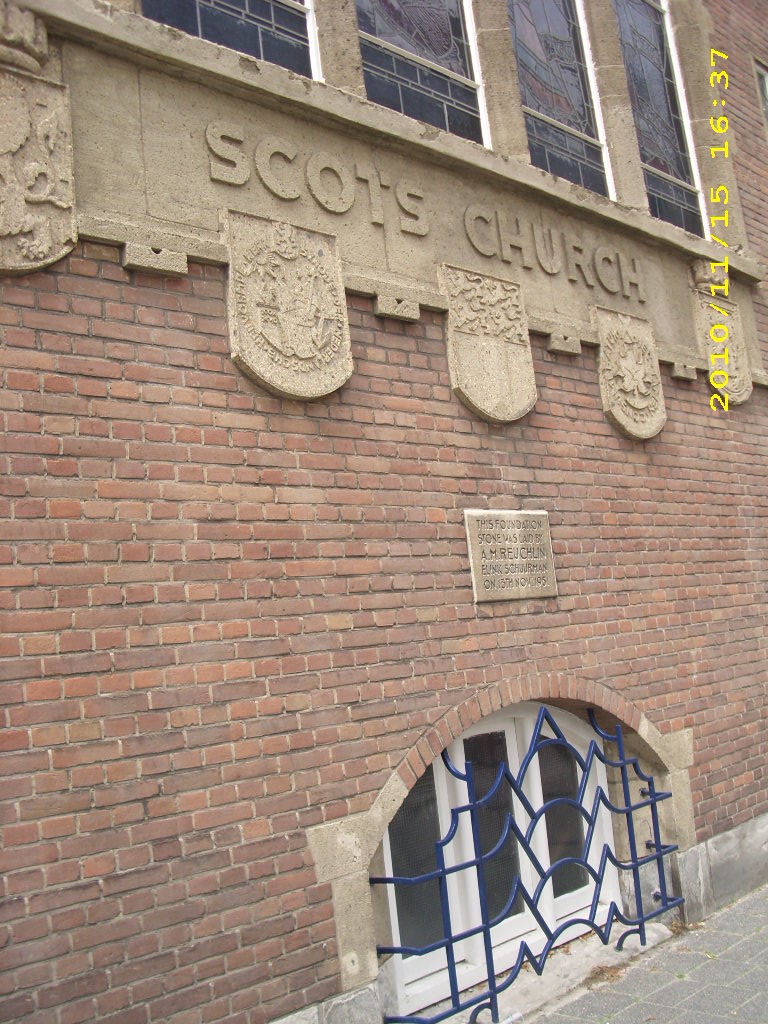
This, though, is the building where the Scots Church meets.  It is immediately in front of the "Gay Palace."  I do not know the purpose of the "Gay Palace" but it did have a gigantic pink and purple flag out front.


This building was built in 1951 because the original church, or at least the former one, was destroyed during the war.  The church institution itself is about 400 years old.  By the '50s, however, the church had lost its strict protestant roots.  The five large stained-glass windows at the front of the church feature portraits: Christ (not quite a "Marvin" picture but pretty near) flanked by St. Peter and St. Paul and St. James and St. John.  I wanted to take a picture of the window and of the plate which shows the name and tenure of every pastor since the founding of the church but it seemed kind of sacrilegious in a functioning church, on the way to a service.


It took me a little while to figure out why the whole interior of the church was decorated in x's before I remembered the St. Andrew's Cross.  There was also a ship on the cloth over the pulpit (which was one of those little raised, enclosed pulpits dealies).


In the afternoon, Hope International Baptist Church meets in the Scots International Church building so I attended that service, instead.  It is an English language church which is pastored by an immigrant from Ghana.  There were 17 people attending, including the pastor's daughter and three grandchildren.  There was a guy from Dallas there, who has been in Rotterdam for two months.  There was also a Nigerian grad student who is studying at Erasmus, although at a different campus from the one where I will be studying, her two children, and her mother.  She gave me a ride home after church since she also lives in Zuid Rotterdam.  


The service was about what I expect a typical, lively Baptist service might be anywhere.  Some of the songs were songs which I remember singing (or not) in Convo.  The sermon was rather ad hoc, based on Titus 3:1-11, and part of a series on the book of Titus.  The pastor's main point was that sanctification ought to lead to doing good.  He did, though, however, bring in some commentary on the ongoing financial situation in Europe. And apparently, this is something that he has mentioned before:


"Who is Paul writing to here?" asked the Pastor.
"To the Cretans!" said the Congregation
"And" queries the Pastor, "Who are the Cretans?"
"Greeks!" replies the Congregation.
"And the Cretans are as they ever were" (or words to that effect) says the pastor, "and Paul tells us exactly what they are: 'Cretans are always liars, evil brutes, lazy gluttons.' (Titus 1:12)."


They had good pound cake after the service, too.