Well, Winter has finally arrived. Sort of. We had our first real frost on Monday and today was the third morning that there was frost out. It got all the way down to about 29 degrees out (It was -1 Celsius). Brrrrrrrrr.
Maybe this will finally kill the mosquitoes off.
Tomorrow, though, it is supposed to be in the mid 40s again. I am afraid that, despite all the dire warnings I heard about this winter, we won't get any snow at all.
One thing to note, though, is that Dutch apartment buildings are well insulated. I can see the flat top of the apartment house across the street from me and there were no bare spots in the frost on the roof at all. It all stuck til the sun came up. I thought that was pretty good. Very efficient.
When I went to class today, there was a little skim of ice on the top of the little canal pond (where I took all of the pictures of the coots and geese that entertained you all so, this summer). It wasn't a very big skim--it didn't cover the whole pond--but one of the coots was running along on top of it.
Now, apparently, coots get really, really fluffy winter plumage and they fluff themselves to keep warm, as well. So, for the last little bit, they have looked like giant, fluffy, black marshmallows with teeny-tiny heads. They kind of resemble guinea fowl. Well, this one little guy was up on the ice and he didn't seem to happy about it. He was running along, trying to get to the edge and into the water, but his little feet would slip when he got going too fast so he was just this little, fluffy, fuzz-ball, wobbling along, slipping and sliding, and trying to get to the water. It was mighty cute. Though apparently it was upsetting for him.
Showing posts with label Fauna. Show all posts
Showing posts with label Fauna. Show all posts
Wednesday, January 18, 2012

Thursday, November 10, 2011
The Maternal Pelican
Thanks to Dad, I am very sadly no longer in the dark about why the Pelican is a symbol of maternal affection.
Apparently, folks used to think that pelican mothers would rip chunks out of their bodies to feed their little offspring, making it a common symbol of the Eucharist for the Catholic Church (which makes it seem very out of place in a Protestant church, by the way) and also, apparently, making it important in Free Masonry. About 7 o'clock this morning, as I was getting ready to do some homework, I innocently opened up an email link from Dad and found this lovely picture to illustrate this point.
On a less cheerful note, an older tradition, going back to the Romans, was that the father pelican would, when annoyed by the flailings of his little offspring, club them to death with his head. The mother, who apparently forgot how annoying they were after a couple of days, would bring them back to life by bleeding on them. The Catholic education website, however, only tells about the bringing back to life part of the story.
Who knew?
Apparently, folks used to think that pelican mothers would rip chunks out of their bodies to feed their little offspring, making it a common symbol of the Eucharist for the Catholic Church (which makes it seem very out of place in a Protestant church, by the way) and also, apparently, making it important in Free Masonry. About 7 o'clock this morning, as I was getting ready to do some homework, I innocently opened up an email link from Dad and found this lovely picture to illustrate this point.
On a less cheerful note, an older tradition, going back to the Romans, was that the father pelican would, when annoyed by the flailings of his little offspring, club them to death with his head. The mother, who apparently forgot how annoying they were after a couple of days, would bring them back to life by bleeding on them. The Catholic education website, however, only tells about the bringing back to life part of the story.
Who knew?
Wednesday, October 26, 2011
Klein Amerika
Groesbeek is in a weird part of the Netherlands. It is actually pretty hilly. What I didn't realize, until we saw a scale representation of the area, is that it is the only hilly part in the middle of the flat, flat Netherlands landscape. When you look at the 3-D map it is all flat, then a giant (relatively speaking) mound of hills, and then more flatness. It is very odd looking. In the walk to the cemetery, which was through a fairly rural area, you almost would have thought that you were near Lynchburg.

Rolly hills, trees turning colors, corn stubble, it all felt very familiar and, since it was pretty cloudy, you couldn't really tell that there weren't mountains in the background


And weird, pretty clouds. And cows.

And deer. The guys I was walking with thought that these were White-Tail deer but I am not convinced. I think that look more like Fallow deer which 1) look like this and 2) are much more common in the Netherlands than White-Tails.
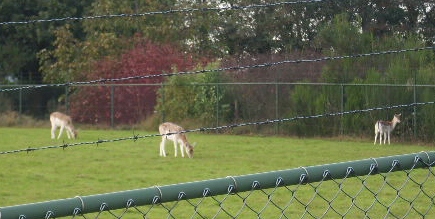
Now, it is quite possible that White-Tail deer populations in the Netherlands/in captivity/in other varieties of circumstances of which I am not aware could look different than I am used to, so these might still be them. These are pictures from the internet of the two kinds of deer. And, acknowledging that my photo quality is not so great, I think that they definitely look more like Fallow Deer.
 |
| Fallow Deer growing antlers |
 |
| Young White-Tail with spots |
Interestingly enough, this part of the Netherlands is called Klein Amerika particularly because of its different landscapes. Since it was hilly and forested, instead of building dikes and creating little narrow fields delineated by canals, the Dutch cleared the forests and had wider, squarer fields more like what you would see in the U.S. They equated this type of land usage with U.S. Manifest Destiny and so they called the area Klein Amerika--Little America.
This, for instance, is a Google Maps satellite picture of what the fields look like a few miles east of Rotterdam (and over most of the rest of the Netherlands). Notice the little marker on the bottom of the picture that shows the scale. All of these strips are separated by canals (often instead of fences) and most of the them are just a couple-three dozen feet wide. Can you imagine trying to turn a tractor with a baler and a hay wagon on these little fields? And if you guess wrong, you end up in a pretty wet ditch.

This, on the other hand, is the way the fields look around Groesbeek. I left this one a little further out so that you can see just how close to the German border we (and those Allied Paratroopers) were. The fields are still pretty small but they are much more convenient looking and, notice, there are also bits of forest.

There is a joke that, during the War, a German soldier got lost going through the area around Groesbeek and stopped to ask directions from a farmer.
"Where am I?" he asked.
"Little America," answered the farmer.
"Oh," said the German "I thought we had to go through England to get there."
It was a pretty fun day. On the way back to Rotterdam, a bunch of us stopped at Nijmegen for some supper, which was fun. We met at the train station at 7:15 am and we ended up getting back into Rotterdam around 10 pm (We were a little delayed on the way back because of mechanical difficulties with the train and because of a general slow-down that resulted from someone jumping in front of a train near Den Haag) but it was quite a fun excursie. The train ticket was kind of expensive so I figured that I probably wouldn't go back to see the museum at Arnhem or the other things I had thought of seeing in Nijmegen but now I think it might be worth it after all, especially if I have to go to Utrecht to do research anyways.

Monday, September 12, 2011
Schiedam Open Monumentendag
Saturday 10 September was Open Monumenten Dag in Rotterdam. That means that there were a lot of buildings open that are otherwise not open to the public. Most of those places were in the "artsy" part of town and looked pretty boring. However, there were also several other towns that were participating as well, including Schiedam, which is just outside of Rotterdam and which is accessible by the Rotterdam Metro system, and they had a lot of much more interesting looking buildings open.
Saturday was also the nicest, least rainy, and warmest day that we have had in a week or so. It got up to 80 and the humidity was around 95%. But it was still a really great day for walking around.
On my way out of town, I stopped and picked up a Museumkartje which gets you free access into a lot of museums all over the country for a year. The card costs 45 euros but I was able to get into museums for free where I would otherwise have had to pay 7 euros so I feel like a made a really good financial decision. =-)
I had a whole list of things that I wanted to see, and also things that I thought I might want to see if I had the time. I made a Google map of all of these things which is here: http://maps.google.com/maps/ms?ie=UTF&msa=0&msid=204591979570013338958.0004ac7eea5879bbe2600. If you click on that annoying looking hyperlink, you can see little blue markers of everywhere I went. If you click on the little blue markers you can see what the site is and, for some of them, you can zoom down to street level and see what the area looks like.
I started out by checking out the windmills and the Windmill Museum (Schiedam is known as the "Stad van Molens"--"City of the Windmills"). Then I walked quite a ways out of my way to a really pretty park to eat some lunch, and then walked back through the city, checking out museums and churches and lots of other fun things.
One thing which I noticed about Schiedam was the vast, really VAST, number of really large spiders that had webs everywhere, including places where you might want to walk. It was fairly disconcerting.


In the Middle Ages, Schiedam had a large wall built around it. There is only a little part of the original city wall left and it remains because it is the back of some other building. However, some of the new city buildings have been built up to represent the old city wall. The picture of the left is of apartments which are built into the new city wall. These apartments are above the road that goes into the city center and it is very Medieval looking, even with the modern highway signs and flower boxes.
I do not know why they chose to build like this, and I have to imagine that it can be kind of loud, sitting right above the road, but it sure is interesting looking.

Most of the way around the city I walked outside the old city walls. There is a sidewalk and road that go around the periphery between the walls and the canal. It was a really pretty walk.
There were birds everywhere, including swans that kept up-ending to get at food under the water and swans just don't look so regal when only their tails are sticking out of the water. Some of them were also bathing themselves, so they kept doing little barrel rolls and looked fairly ridiculous. I didn't get very good pictures of them because I know that swans can be kind of grouchy but I did get pictures of ducks. They were less entertaining.


After walking around the city, I stopped at the Julianpark for lunch. It was very pleasant in the shade. There were lots of people out walking their dogs. There were also a bunch of teenagers running around being a little dopey.


Walking through the city was interesting. I noticed this sign, so I took a picture and looked it up when I got home. It is a sign for a "Kingdom Hall of Jehovah's Witnesses."

It was interesting to walk through the city. Since it was such a big holiday, there were people all over the place checking out the city. But, for the most part, it wasn't too crowded to be enjoyable. All over the place there were stores having specials and all of the cafes looked like they were pretty full. The sign above was all over the city. The little red-hatted pilgrim fellow is the symbol for the Schiedam jenever industry (which I will mention later). The sign (the picture of which I took through the back, so it is reversed) says "Cheers from Schiedam."

While I was walking down one of the little side streets I saw this little bib which I think I ought to have gotten for somebody. It says "Mijn opa is de allerliefste van de hele wereld" or "My grandpa is the sweetest in the whole world."
The little bib on the right is kind of cute, too, as well. It says "Heineken Biertje." Which is meant to be cute because "biertje" is the diminutive of "beer."
I stopped at a number of different museums and churches. Most of them were pretty involved so I will do separate posts about them but some of them were smaller museums or I didn't see very much of them, so I will include a couple here.
 One museum, that was actually quite a bit more interesting than I had anticipated, was the Cooperative Museum which was dedicated to Coop grocery stores in the Netherlands. It was teeny tiny and apparently is located in what used to be an actual tiny grocery store. The front part still sells stuff: mostly wooden shoes and all kinds of dropjes (which are Dutch licorice candies) and other kinds of old fashioned candies. It smelled like what I remember coops smelling like from when we used to go with Mom.

In the back, they have a little living area set up, apparently more or less how it used to be. The museum was just those two rooms so it wasn't very extensive, but it was pretty interesting. I went in just after a Dutch couple so I just listened (and smiled and said "leuk!" (very nice!) and practiced my Dutch-understanding skills). It wasn't too challenging since the fellow who was talking about things kept gesturing to things as he was talking about them, so I could follow pretty well. The bed was the kind that is inside a cabinet, like a ship-board bed, and was quite, quite small. There was a large bin under the bed where the shop owner stored potatoes. I just cannot possibly imagine what you would do if one of those potatoes, right under your bed, in a little enclosed space, went bad sometime.
They museum also had a little collection of children's toys, which were very intricate. The older gentleman that I went in with was also pretty intrigued by the display of old pipes that they had. They did a pretty good job of dressing the place and, tiny or not, it was a fun place to stop on my way through town.
 I also stopped by the Stedelijk Museum. It was on my list of places I could see but it was also one that I didn't think I would bother with. It is the Modern Art Museum and that is just not something I get that excited about.
 However, when I saw the building, I thought that it might be fun to look at. Also, when I saw the entrance to the museum, it just looked intriguing. It looks just like a zipper and it seems like it would have taken an awful lot of planning to get the cobble stones to lay flat on the curve like that.
They were having a big exhibition over the weekend because of the festival. The exhibition was called "Nul = 0" (Zero = 0)and people had been spray painting little signs that said that all over town. Mostly what I saw was ranks of clear plastic noses laid out in a grid on the wall. It was not the most interesting art exhibit that I have ever seen. However, because this was the opening day, they were giving out free drinks to everyone that was there. Which might explain why there was such a crowd. It might also explain why the whole crowd was upstairs with the drinks and not downstairs with the noses. The building is an old church and was kind of attractive inside but I didn't take any pictures because I wasn't sure if there would be copyright issues with photographing near the art.

Schiedam was a really pretty city. They had loads of little parks and little strips of trees and things, all through the city. It made for a very pleasant walk. Although I was pretty tired by the end of it. All told, I was out touring for 8 hours, so I feel like I got my money's worth out of my metro ticket. I also had almost 500 pictures, so I feel like I did my duty photo-wise.

(I just took this picture because I thought it was interesting. This is a "Neighborhood Watch" sign.)
Saturday was also the nicest, least rainy, and warmest day that we have had in a week or so. It got up to 80 and the humidity was around 95%. But it was still a really great day for walking around.
On my way out of town, I stopped and picked up a Museumkartje which gets you free access into a lot of museums all over the country for a year. The card costs 45 euros but I was able to get into museums for free where I would otherwise have had to pay 7 euros so I feel like a made a really good financial decision. =-)
I had a whole list of things that I wanted to see, and also things that I thought I might want to see if I had the time. I made a Google map of all of these things which is here: http://maps.google.com/maps/ms?ie=UTF&msa=0&msid=204591979570013338958.0004ac7eea5879bbe2600. If you click on that annoying looking hyperlink, you can see little blue markers of everywhere I went. If you click on the little blue markers you can see what the site is and, for some of them, you can zoom down to street level and see what the area looks like.
I started out by checking out the windmills and the Windmill Museum (Schiedam is known as the "Stad van Molens"--"City of the Windmills"). Then I walked quite a ways out of my way to a really pretty park to eat some lunch, and then walked back through the city, checking out museums and churches and lots of other fun things.
One thing which I noticed about Schiedam was the vast, really VAST, number of really large spiders that had webs everywhere, including places where you might want to walk. It was fairly disconcerting.


In the Middle Ages, Schiedam had a large wall built around it. There is only a little part of the original city wall left and it remains because it is the back of some other building. However, some of the new city buildings have been built up to represent the old city wall. The picture of the left is of apartments which are built into the new city wall. These apartments are above the road that goes into the city center and it is very Medieval looking, even with the modern highway signs and flower boxes.
I do not know why they chose to build like this, and I have to imagine that it can be kind of loud, sitting right above the road, but it sure is interesting looking.

Most of the way around the city I walked outside the old city walls. There is a sidewalk and road that go around the periphery between the walls and the canal. It was a really pretty walk.
There were birds everywhere, including swans that kept up-ending to get at food under the water and swans just don't look so regal when only their tails are sticking out of the water. Some of them were also bathing themselves, so they kept doing little barrel rolls and looked fairly ridiculous. I didn't get very good pictures of them because I know that swans can be kind of grouchy but I did get pictures of ducks. They were less entertaining.


After walking around the city, I stopped at the Julianpark for lunch. It was very pleasant in the shade. There were lots of people out walking their dogs. There were also a bunch of teenagers running around being a little dopey.


Walking through the city was interesting. I noticed this sign, so I took a picture and looked it up when I got home. It is a sign for a "Kingdom Hall of Jehovah's Witnesses."

It was interesting to walk through the city. Since it was such a big holiday, there were people all over the place checking out the city. But, for the most part, it wasn't too crowded to be enjoyable. All over the place there were stores having specials and all of the cafes looked like they were pretty full. The sign above was all over the city. The little red-hatted pilgrim fellow is the symbol for the Schiedam jenever industry (which I will mention later). The sign (the picture of which I took through the back, so it is reversed) says "Cheers from Schiedam."

While I was walking down one of the little side streets I saw this little bib which I think I ought to have gotten for somebody. It says "Mijn opa is de allerliefste van de hele wereld" or "My grandpa is the sweetest in the whole world."
The little bib on the right is kind of cute, too, as well. It says "Heineken Biertje." Which is meant to be cute because "biertje" is the diminutive of "beer."
 One museum, that was actually quite a bit more interesting than I had anticipated, was the Cooperative Museum which was dedicated to Coop grocery stores in the Netherlands. It was teeny tiny and apparently is located in what used to be an actual tiny grocery store. The front part still sells stuff: mostly wooden shoes and all kinds of dropjes (which are Dutch licorice candies) and other kinds of old fashioned candies. It smelled like what I remember coops smelling like from when we used to go with Mom.
In the back, they have a little living area set up, apparently more or less how it used to be. The museum was just those two rooms so it wasn't very extensive, but it was pretty interesting. I went in just after a Dutch couple so I just listened (and smiled and said "leuk!" (very nice!) and practiced my Dutch-understanding skills). It wasn't too challenging since the fellow who was talking about things kept gesturing to things as he was talking about them, so I could follow pretty well. The bed was the kind that is inside a cabinet, like a ship-board bed, and was quite, quite small. There was a large bin under the bed where the shop owner stored potatoes. I just cannot possibly imagine what you would do if one of those potatoes, right under your bed, in a little enclosed space, went bad sometime.
They museum also had a little collection of children's toys, which were very intricate. The older gentleman that I went in with was also pretty intrigued by the display of old pipes that they had. They did a pretty good job of dressing the place and, tiny or not, it was a fun place to stop on my way through town.

 However, when I saw the building, I thought that it might be fun to look at. Also, when I saw the entrance to the museum, it just looked intriguing. It looks just like a zipper and it seems like it would have taken an awful lot of planning to get the cobble stones to lay flat on the curve like that.
They were having a big exhibition over the weekend because of the festival. The exhibition was called "Nul = 0" (Zero = 0)and people had been spray painting little signs that said that all over town. Mostly what I saw was ranks of clear plastic noses laid out in a grid on the wall. It was not the most interesting art exhibit that I have ever seen. However, because this was the opening day, they were giving out free drinks to everyone that was there. Which might explain why there was such a crowd. It might also explain why the whole crowd was upstairs with the drinks and not downstairs with the noses. The building is an old church and was kind of attractive inside but I didn't take any pictures because I wasn't sure if there would be copyright issues with photographing near the art.

Schiedam was a really pretty city. They had loads of little parks and little strips of trees and things, all through the city. It made for a very pleasant walk. Although I was pretty tired by the end of it. All told, I was out touring for 8 hours, so I feel like I got my money's worth out of my metro ticket. I also had almost 500 pictures, so I feel like I did my duty photo-wise.

(I just took this picture because I thought it was interesting. This is a "Neighborhood Watch" sign.)
Saturday, September 10, 2011
Afrikaanderplein
The back of my building looks out over Afrikaanderplein, or African Square. Twice a week, there is a market on the square. There is a large paved section where city workers set up the booths one day and take them down the next. In between markets, kids ride bikes, and roller skate, and scooter around. There are painted "roads" on the ground, I assume for the kids to play on and as a way to learn traffic safety.

There are trees, too, with platforms around them and lots of times you will see folks sitting on the platforms eating lunch or just hanging out and chatting. There are also several different playgrounds that are entirely fenced, presumably so that parents only have to watch for escapes at one place. The playgrounds are age segregated, so there is a little playground that is suited for little bitty kids and other playgrounds that have taller slides and bigger jungle gyms for older kids. There are a couple of day-cares/schools that are nearby and I think that they sometimes use the equipment.


There is also an indoor sports pavilion where kids can go play basketball and do other activities.
There are rows of public port-a-johns along one side of the park but I think they are only used when there are events. There is also an administration building of some kind, which has toilets, and during market days, it is open. They are pay toilets and you have to pay 0.30 euros to use them (about 50 cents).

There is also a row of storage sheds painted in bright, primary colors. They store balls and sports equipment in there for people to use.

There is a huge, open, grassy center to the square. It has paths running through it every which way and there are benches and tables scattered all through it where you can sit. There is even a bit of the canal, over which you can cross on a bridge and look at the birds and the submerged shopping carts.

Since it was beautifully sunny on Thursday, I went out and sat on a bench in the sunshine and read school books for this coming year. It was really pleasant and, even though the book was really boring, I finished it, so that makes me happy.

For some reason, there is a large stone hippopotomus at one of the entrances to the park. I do not know why.

Also, the park is full of all kinds of birds. Primarily seagulls, some kind of brown seagulls, some kind of smaller, cuter seagulls, some Eurasian Coots, and even some Mallards. People bring old bread and feed them in the park and it is pretty entertaining to watch the gulls fight over the food, although it does put one in mind of "The Birds". I don't know what the general pecking order is among the birds but I do know that Coots beat Mallards, because they kept pecking at and chasing them away.
I had heard that some people did not appreciate my ornithological side trails (I almost said "wild goose chases"---he he) so I didn't take a lot of bird pictures. Then I remembered that this is about what I am actually doing so I took a picture of another Coot, just because, and because I happen to look at birds a lot.

I was trying to get a picture of its eye because at least some of them have really creepy, glowey, red eyes but this one didn't really, so it may be only the males have the red, red eyes.

There are trees, too, with platforms around them and lots of times you will see folks sitting on the platforms eating lunch or just hanging out and chatting. There are also several different playgrounds that are entirely fenced, presumably so that parents only have to watch for escapes at one place. The playgrounds are age segregated, so there is a little playground that is suited for little bitty kids and other playgrounds that have taller slides and bigger jungle gyms for older kids. There are a couple of day-cares/schools that are nearby and I think that they sometimes use the equipment.


There is also an indoor sports pavilion where kids can go play basketball and do other activities.
There are rows of public port-a-johns along one side of the park but I think they are only used when there are events. There is also an administration building of some kind, which has toilets, and during market days, it is open. They are pay toilets and you have to pay 0.30 euros to use them (about 50 cents).

There is also a row of storage sheds painted in bright, primary colors. They store balls and sports equipment in there for people to use.

There is a huge, open, grassy center to the square. It has paths running through it every which way and there are benches and tables scattered all through it where you can sit. There is even a bit of the canal, over which you can cross on a bridge and look at the birds and the submerged shopping carts.

Since it was beautifully sunny on Thursday, I went out and sat on a bench in the sunshine and read school books for this coming year. It was really pleasant and, even though the book was really boring, I finished it, so that makes me happy.

For some reason, there is a large stone hippopotomus at one of the entrances to the park. I do not know why.

Also, the park is full of all kinds of birds. Primarily seagulls, some kind of brown seagulls, some kind of smaller, cuter seagulls, some Eurasian Coots, and even some Mallards. People bring old bread and feed them in the park and it is pretty entertaining to watch the gulls fight over the food, although it does put one in mind of "The Birds". I don't know what the general pecking order is among the birds but I do know that Coots beat Mallards, because they kept pecking at and chasing them away.
I had heard that some people did not appreciate my ornithological side trails (I almost said "wild goose chases"---he he) so I didn't take a lot of bird pictures. Then I remembered that this is about what I am actually doing so I took a picture of another Coot, just because, and because I happen to look at birds a lot.

I was trying to get a picture of its eye because at least some of them have really creepy, glowey, red eyes but this one didn't really, so it may be only the males have the red, red eyes.
Saturday, September 3, 2011
The EuroMast and Het Park
On Friday, when the weather was so nice, and I was strolling around town, (it was about a five mile stroll, on the sunniest day we have had for a very long time and, unsurprisingly, it also turned out to be one of the warmest days we have had in a while as well) I decided to go check out the EuroMast.
 At one time (not very long ago) it was the tallest point in the Netherlands. That is despite the fact that it stands in the lowest part of the Netherlands (for one reason or another, it was built in the bottom of a large hollow that was dug out of the already low ground in the park). While it is no longer the tallest point in the Netherlands (some skyscrapers have it beat although there are apparently discussions underway about making it taller so that it can reclaim its title) it is certainly taller than any of the land anywhere near it.

For a small fee, you can go up to the viewing level and get some pretty spectacular views. For a small additional fee, you can ride the small car (see the little thing part way up the tower?) an additional 80 meters higher, to a total height of 185 meters (or a little over 600 feet). As the little car ascends and descends it turns around the pole, giving everyone in it a 360 degree panoramic view of not only the city but also of a good portion of the country. I was kind of psyched and was trying to think of good ways to put the pictures on the blog so that you would get a good idea of the scope of the pictures.
And then I got to the tower.
And I looked at it.
And then I remembered that I hate heights.
And I am pretty sure that I especially hate heights that you are twirled up to and then twirled down from, while riding in a little pop cap attached to a TV antenna.
So, instead of going up the EuroMast, I walked around Het Park, under the shady trees, and over little rippling canals, and down windy lanes, and never more than 67" off the ground.


The Park (it deserves the capitals--that is its official name and it is an awfully nice park with a lot of history) has been in existence as a city park for just about 150 year. It reminded me of the gardens at Nymphenburg, in Munich, especially the parts that were back in the woods. The park is large and very quite, so that you don't even hear the Rotterdam traffic.
There were a lot of people there, mostly lying in little piles in the sunshine, but most of them were napping or reading so it was still very pleasant and quiet. I counted no fewer than five couples getting their wedding pictures taken in the park. I don't know if they were all getting married there today or if they were just getting their pictures done, but it seemed like it was pretty popular. I didn't take pictures of most of them, because it seemed kind of intrusive. But I did take pictures of one couple because they (1) were far enough away that they wouldn't know I was being intrusive, (2) were behind a statue that I was photographing, so it mostly looked like I was just taking another picture of that and (3) were possessed of a very adorable white beetle that just demanded to be photographed.

There are several restaurants throughout the park. At least one of the buildings on the premises used to be a night club so rowdy that, because of the number of times the police had to come in and shut it down, the city decided to close it a few years ago. The first restaurant I noticed, though, was the "Chalet Suisse" (The Swiss Chalet). I cannot think of a more inappropriate place for a mountain chalet than on the edge of a puddle, in the bottom of a hole, in a city that sits below sea level, but to each his own, I suppose. And, to give it its due, it does look kind of like a Swiss Chalet.


One of the buildings looked like it was being used for a wedding the day I was there. It was really pretty and would have made a really nice wedding venue. This building is called "Het Herenhuis" (The Great House or The Master House). The formal gardens in front of the building, and the canal that runs through, are mighty attractive.


This is the Carriage House or "Het Koetshuis". It looks like it is uninhabited now but it sounds like it is often used as a private residence. I can definitely think of worse things to wake up to every morning than a stroll through the park.

There is also an aviary in the park. It looks kind of run down and it definitely looks like they worry about vandals but the birds (mostly parakeets, doves, and pheasants) looked cheerful enough and were hopping around eating and chirping and doing bird-y things.
 I didn't see everything in the park. When I was looking up stuff about the park after I got home, I saw that there is a Norwegian Seaman's Church located on the park and I totally missed walking along the large canal that marks the southern and western boundaries of the park. So I will probably end up going back sometime soon. Or at least sometime when we get some more sunshine. And who knows, maybe next time I will forget how much I hate heights until it is too late and I will get some pictures of the Netherlands in the round.
 At one time (not very long ago) it was the tallest point in the Netherlands. That is despite the fact that it stands in the lowest part of the Netherlands (for one reason or another, it was built in the bottom of a large hollow that was dug out of the already low ground in the park). While it is no longer the tallest point in the Netherlands (some skyscrapers have it beat although there are apparently discussions underway about making it taller so that it can reclaim its title) it is certainly taller than any of the land anywhere near it.
For a small fee, you can go up to the viewing level and get some pretty spectacular views. For a small additional fee, you can ride the small car (see the little thing part way up the tower?) an additional 80 meters higher, to a total height of 185 meters (or a little over 600 feet). As the little car ascends and descends it turns around the pole, giving everyone in it a 360 degree panoramic view of not only the city but also of a good portion of the country. I was kind of psyched and was trying to think of good ways to put the pictures on the blog so that you would get a good idea of the scope of the pictures.
And then I got to the tower.
And I looked at it.
And then I remembered that I hate heights.
And I am pretty sure that I especially hate heights that you are twirled up to and then twirled down from, while riding in a little pop cap attached to a TV antenna.
So, instead of going up the EuroMast, I walked around Het Park, under the shady trees, and over little rippling canals, and down windy lanes, and never more than 67" off the ground.


The Park (it deserves the capitals--that is its official name and it is an awfully nice park with a lot of history) has been in existence as a city park for just about 150 year. It reminded me of the gardens at Nymphenburg, in Munich, especially the parts that were back in the woods. The park is large and very quite, so that you don't even hear the Rotterdam traffic.
There were a lot of people there, mostly lying in little piles in the sunshine, but most of them were napping or reading so it was still very pleasant and quiet. I counted no fewer than five couples getting their wedding pictures taken in the park. I don't know if they were all getting married there today or if they were just getting their pictures done, but it seemed like it was pretty popular. I didn't take pictures of most of them, because it seemed kind of intrusive. But I did take pictures of one couple because they (1) were far enough away that they wouldn't know I was being intrusive, (2) were behind a statue that I was photographing, so it mostly looked like I was just taking another picture of that and (3) were possessed of a very adorable white beetle that just demanded to be photographed.

There are several restaurants throughout the park. At least one of the buildings on the premises used to be a night club so rowdy that, because of the number of times the police had to come in and shut it down, the city decided to close it a few years ago. The first restaurant I noticed, though, was the "Chalet Suisse" (The Swiss Chalet). I cannot think of a more inappropriate place for a mountain chalet than on the edge of a puddle, in the bottom of a hole, in a city that sits below sea level, but to each his own, I suppose. And, to give it its due, it does look kind of like a Swiss Chalet.


One of the buildings looked like it was being used for a wedding the day I was there. It was really pretty and would have made a really nice wedding venue. This building is called "Het Herenhuis" (The Great House or The Master House). The formal gardens in front of the building, and the canal that runs through, are mighty attractive.


This is the Carriage House or "Het Koetshuis". It looks like it is uninhabited now but it sounds like it is often used as a private residence. I can definitely think of worse things to wake up to every morning than a stroll through the park.

There is also an aviary in the park. It looks kind of run down and it definitely looks like they worry about vandals but the birds (mostly parakeets, doves, and pheasants) looked cheerful enough and were hopping around eating and chirping and doing bird-y things.

Subscribe to:
Posts (Atom)