Showing posts with label Food. Show all posts

Wednesday, November 6, 2013

I wasn't loving it too much (except for the coffee, which was pretty good, actually)

When I got to Rome I started walking, looking for the church.  It was actually pretty pleasant.  It wasn't too hot, early in the day and it was kind of pleasant to walk through the streets of Rome in the early(ish) morning.   It was starting to get busy, with tourists on the sidewalks and cars in the streets, but it wasn't hard to cross the streets yet, which made things much more pleasant.  Apart from not being able to find the church quickly enough, and already being late, it didn't seem like such a bad start to the day.

One thing I noticed was that there were just as many homeless people walking around the streets, and lying in the parks and little grassy roundabouts in Rome as there were in Milan.  I was walking across one particular street, in the cross-walk, when a homeless lady started walking toward me.  There were signs up all over the train station and metro warning against pick-pockets and thieves, so I was kind of making a point of paying attention to my surroundings but I figured she was pretty safe, since she was holding a piece of pizza in each hand, and I wasn't very worried.  So, I was looking around at all of the very old buildings and somebody just ran into me.  I was startled and started to apologize.  And then I realized that the street lady had walked all the way across the street from the little roundabout just to body-check me, and then turned around and walked back to her little pull-cart of belongings on the other side of the street.  That made the whole day seem less fun.  I realize that it is probably not fair to judge all Italians on the actions of one (presumably) mentally-unbalanced homeless person.  However, in all of my travels, that was the only time I was ever attacked, even when surrounded by large groups of inebriated people, homeless people, and/or beggars (and some of the little begging children were very insistent). 

I was kind of upset by the whole "attack of the street lady" thing and when I came across a McDonalds, since I was too late to get to church, it seemed like the perfect place to get breakfast and to experience a little bit of homieness in a distressing situation.  

I will say that while I was in Europe I was very conscientious about eating in local places.  During the entire year I was gone, I only ate at an American chain restaurant once, except while I was in Italy (and that was because the Burger King was the only place serving warm food in the train station late at night while I was traveling back home).  While I was in Italy I am afraid that I ended up eating at McDonalds an awful lot.  On the other hand, as far as I could tell, that was a super-authentic Italian experience.  There were McDonalds on every street corner, practically, and they were always full.  

So, I was happy to have the opportunity to experience something like home.  I was also looking forward to having some super-fast service à la an American international corporation.  What I wasn't prepared for was how much McDonalds tailors its business model to the local community.  (If you look here, you can see some of the international foods offered in different countries.  Italy has Italian-type hamburgers.  If you scroll down a ways, you can also see the McKroket that the offer in the Netherlands--typische Nederland (just like the Dutch)!)  Well, in Italy, they really like their cafés and their coffees, so in most of the McDonalds I saw, the McCafé menu would take up two-thirds of the menu board, with the rest of the menu just squeezed into a corner.  In others (like the one I went to Sunday morning in Rome) it was like a big McCafé, with a tiny McDonalds tucked in at the side.  I was actually pretty okay with that part of the adaptations (and, I will say this, coffee in the Italian McDonalds was way better than the coffee you get in American McDonalds).  Unfortunately, another adaptation that McDonalds made was in hiring Italians and adopting a more Italian plan for time management.  When I got in line, there were three people ahead of me and it took more than half an hour to get through the line.  However, when I finally got some food (I had a giant cappuccino and a brioche, which is like a croissant that is baked with chocolate chunks inside) I went downstairs into the little basement eating area (lots of the McDonalds in Italy were on two, or even three, floors).  It was cooler down there (it had been getting progressively hotter) and I got the chance to figure out where I was in the city and how to get back to the train station and how to get to the Colosseum, which was my next stop.  I was pretty relieved.  It made for a nice, restful (and cool!) break in between all of the crazy Italians.

(If you click here you can see something about the McCafé.  It is in Italian, of course, but if you are looking at in Google, it will translate for you.  And in any case you can see what it looks like.  You can see the menu here, but it was pretty much typically Italian--you could choose combinations of coffees or cappuccinos and brioches or croissants or tortes.)

Saturday, October 26, 2013

Milan Central Station and Italian Night Trains

A view up the Via Vettor Pisani, toward the Milan Central Station.
Vettor Pisani was a medieval Venetian sea admiral who was very popular.
(Venice was one of the Italian city-state power centers.)
Eventually, I made my way back to the Milan Central Station to wait for the night train from Milan to Rome.  Fortunately, there were some stores in the Station.  I spent a lot of time browsing through shelves of books in Italian that I couldn't read and staring at bizarre Italian fashions.   Then I sat on a bench and watched Italians, which was kind of depressing.  It is very, very warm in Italy, as I may have mentioned before.  There are also lots and lots of homeless people.  As a result, there appeared to be people living on all of the grassy areas around station.  You literally couldn't have walked in a straight line across the grass anywhere around the station without stepping on somebody or their bags.  Loads of homeless people would also come and sit on all of the benches in the train station.  There were very few seats or benches in the station and I think that this was designed to try to limit homeless folks squatting in the terminals.  It did make it super inconvenient for folks who were waiting for trains.  For supper, I had something that was like a cross between a pizza hot-pocket and calzone at an outdoor kiosk, which wasn't too bad, and a gigantic bottle of water (it was really, really hot and thirsty work out there).

The very beautiful facade of the Milan Central Station.  I like the . . . Pegasus?  Pegasuses?  Pegasi? . . . winged horsies.
I went back to the train station a bit early for the train departure.  I was very hot and also very tired--I had gotten up  at 4 in the morning to catch the train, to get to another train, to get to the airport, to get to Milan.  I was also a bit worried about being able to find my way back because the the city was a bit confusing.  So I wandered around the station for a couple of hours.   The train was supposed to leave at a little after 10 pm.  However, as I walked around the station, I noticed that the departures/arrivals board had a lot of delays.  Then, my train got delayed.  Every half-an-hour or so, my train's estimated departure changed and the departure track changed three times.  I don't think that Italians are known as much for their strict punctuality and devotion to time-tables as the Dutch are.  My train eventually left after midnight.  One unfortunate aspect of waiting around all that extra time was having to use the restrooms.  They charged a couple of euros (a bit over $3) just to go in to them, which just seemed exorbitant.  One positive thing, while I was waiting, was that there was a Burger King in the station.  About midnight I was very hungry, and very bored, and I got a hamburger before I left, which was nice and homey and really hit the spot.

The interior of the station.  It is really beautiful in there and the ceilings were incredibly tall.
The night train was a really old model.  You had to sit in a little cubicle, with two facing bench seats that fit three across and were so close together that, when you sat across from someone, your knees touched.  It made for kind of a cramped nine hour trip.  Also (and I may have mentioned this before) it was very, very, very warm in the train.  I didn't take any pictures in the train so I thought that I would try to find a picture online, just to give you an idea of what they looked like.  However, when I looked up Italian night train pictures, there were loads (loads and loads!) of pictures of train wrecks, which I am glad that I didn't see before I took the trip!  I would have been extremely nervous, as well as hot, with a crick in my neck, and stiff knees.  I was in a little cubicle with five other people who, I gathered, were a married couple and their three adult/teenage daughters.  They were pleasant enough, but it sort of felt like I was crashing their party.  On the plus side, it was super cheap to take the train--it only cost about $55 dollars to take the night train, which meant (theoretically) that I got dropped in Rome at a super convenient time for my schedule and it also meant that I didn't have to pay for a hotel room and then waste a half-day traveling.

One of the exits from the Milan station.  Everything, but everything, was marbel.  Unfortunately, it was a bit dim in the station and my camera isn't very good, so all of my pictures were pretty blurry.
My very favorite person in all of Italy was the very kind, very helpful, pharmacist in one of the shops in the train station.  At about 10 pm Saturday night, I decided that dying from drug reactions as a result of translation errors was preferable to trying to survive through a whole week of allergy related misery.  Then that wonderful lady showed me which drugs were antihistamines and then told me how many pills to take when I came back five minutes later after I realized I couldn't read the directions in Italian.  I still don't know what I had an allergy to (or what drugs I took, or in what amounts, for that matter), but I was very, very grateful for those antihistamines.  They made all the difference in the world.  Now if only they had had anti-heat pills, it would have been perfect!  

Wednesday, October 23, 2013

Walking Through Milan, Part II


Just north of the Galleria, there was a little square called the Piazza della Scala, with a statue of Leonardo da Vinci.  The Milan tourism board has a website about the statute.  It has a little bit of a history of it, although it mostly has a picture with an address but you can see it here.  You can see more about the whole square, including the famous theater which it fronts, here.


The statues at each corner are da Vinci's favorite students, although I couldn't find the specific names.


Each of the friezes on the sides shows one of da Vinci's accomplishment in art and science.


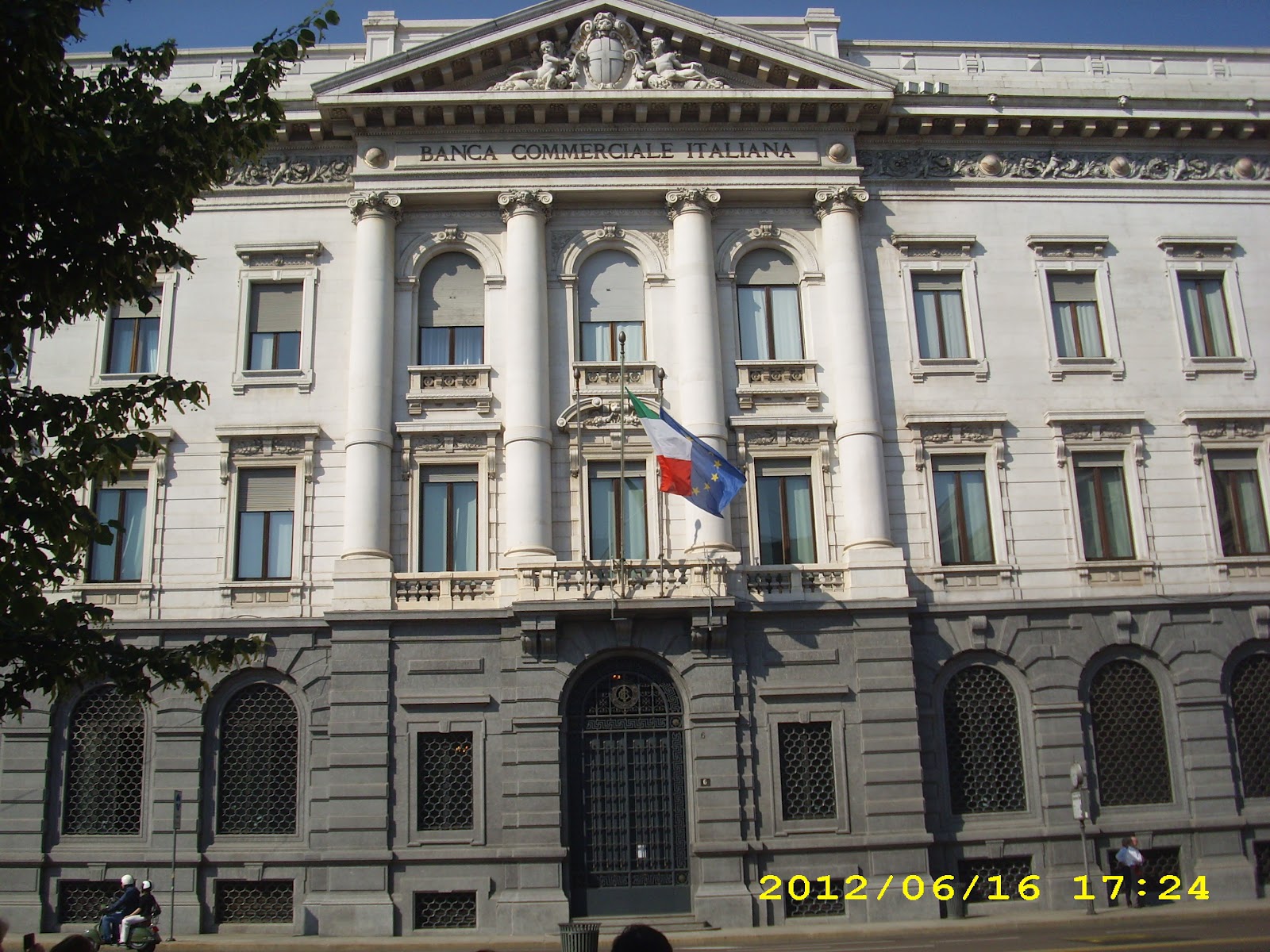
An old bank building which now serves as an art gallery.  I especially liked the two tone facade.
You can see the English version of the Gallerie d'Italia, Piazza della Scala location, here.
After I left the Piazza della Scala, I started walking north-ish, and then got a bit lost and wandered around for a while before I found where I was getting to.  Part of the problem was that my city guide was in Dutch (because I found the most adorable little booklets with maps and information about Milan and Rome, for only $2, at a big bookstore in Rotterdam).  While I was able to read up on the sights without too much trouble, it was more difficult, when walking down various streets, to read signs in Italian and then to find those names in Dutch on a tiny map.

While I was walking through the city, I saw loads of little restaurants with windows onto the street, so you could walk up to the window and order pizza or ice cream.  As far as I could tell, a lot of them didn't have any seating--they only cooked the food and served it to passers-by.  It was way too hot to get any pizza but I did stop and get a gelato--which is like super creamy Italian ice cream.  It was really excellent--it came in a very delicious, home-made, waffle cone.  However, as I started to walk away, a little old lady, who probably came up to my shoulder, held out her hand, with a coin in it, and started talking to me in Italian.  I thought at first that she was telling me I had dropped the coin, so I shook my head "no" and said thank you, and started to walk away.  Then she started to talk louder, and stepped in front of me and kept getting louder and louder and visibly more irate.  I finally slipped around her but then she kept hollering at me as I walked away.  I still don't know what she wanted.  The only thing I can guess is that she either 1) wanted me to make up the difference so that she could buy her own gelato or 2) just had a coin in her hand to demonstrate that she wanted more coins.

Milan is known as one of the fashion capitols of the world.  Practically every street I crossed,
 was full of stores selling clothes, or shoes, or scarves, or jackets.  There were lots of people
who seemed fascinated by it.  If I appreciated expensive Italian clothes more, I might have
gotten more out of it. 
You could tell that Milan was fancier than Wal-mart, say, because their mannequins were black instead of white.
Out of the blue, while I was walking down the street, I came upon this archway across the street.  It wasn't a bridge so I wasn't sure what it was at first.  It turns out that it is the Porta Nuova, one of the two remaining medieval gates to the city.  The city has grown out quite a bit since then.  The exact provenance and age of the gate are a bit mysterious.  Some websites say that it is actually part of the wall and just managed to survive WWII.   If this is true, the wall is about 800 or 900 years old.  Other websites say that it is a replica, built on the original place of the wall, on across the Via Manzoni, which is an original Roman road, in the mid-1800s.  This makes it both less old and less authentic.  These sites explain the wear on the busts in the wall as a result of them being made out of sandstone.  However, making it more confusing, "Porta Nuova" is also used to mean the neighboring business and fashion district, which may well have begun in the 1800s, which might explain the discrepancy.  
I took pictures of the busts in the wall, with the plan of trying to figure out the inscriptions.  However, the shadows and angles make it difficult and so I have been unable to do so.  However, they do look old, so I am inclined to decide the gate is original and authentic.  It is more fun that way.


Eventually, I found my way back to the Central Train Station but, since I had loads of time before my train, I decided to stroll around the area near the station and to find some place to eat.  The area around the station is, not unnaturally, full of hotels and restaurants.  Most of the restaurants seemed like the Italian version of fast food, plus there were loads of McDonalds (the Italians really seem to enjoy their McDonalds for some reason).  I stopped at the


I also found this church, while I was out walking.  It is the Santuario di San Camillo de Lellis, or the Shrine of St. Camillus de Lellis.  It is quite modern, as it was built in 1902, but it is quite classical looking--it is gothic revival.  I didn't go inside, since it was fairly late when I walked by, but if you click here you can see some pictures of the interior.  The building itself is a very interesting shape.  From the front it just looks rectangular but from the top it is a bulbous cross shape.  It is quite pretty.

The church (and the square it is on: Piazza San Camillo de Lellis) are named after a 16th century Italian priest and military man who became a medic and whose religious order was known for its care of the sick and for serving as army medics.  That's not too bad a legacy.

I kept looking for some place to eat but it was very, very hot and none of the restaurants seemed to have air conditioning.  Also, many of them were busy and very confusing looking.  A lot of the restaurants were cafeteria style and, from my experience, those kinds of places in Europe can be super difficult to navigate, especially in a foreign language.  There are loads of different counters, where prices are not clearly labeled and it seemed like too much to handle in the heat, in Italian, and while barely being able to see or breath because of the massive hay-fever like attack.  Plus, a fair number of places had sushi, and that just seemed dangerous in 100 degree heat and un-air-conditioned premises.

If you go here, you can see a collection of photos of Milan, by a really good photographer.  They are quite spectacular.

If you go here, you can see a 15 minute video of a walking tour through Milan.  It is a pretty long video but the music background isn't bad and it was kind of fun to see all of the things that I saw before from air-conditioned comfort.  What is especially nice is that it has labels which explain all of the things that you are looking at, which is quite useful.

Monday, December 31, 2012

Aachen Sights II


The Aachen Cathedral stands across the Katschhof from the Stadhuis.  The Katschhof is the central market and public area.  It is a remnant of the medieval shape of the city and the name, apparently, comes from the German term for pillory.  When I went through, there were some school groups who were having wheelbarrow races. 

This is a 360 degree video of the Katschhof.  It starts looking toward the Stadhuis and then circles around.  When the camera points toward the Cathedral, if you turn the volume way up, you can hear some of the musicians who were performing in the streets.

This is the North-East corner of the Stadhuis.  On the left, you can see the side of the Ratskeller restaurant. 
This is the Ratskeller, or City Hall Basement, Restaurant.  I think it is really cute.  It is so tiny, especially in comparison to the giant Stadhuis that it is cozied up to.   There used to be a giant horse sculpture, called Culinario, that stood in front of the restaurant (you can see some pictures of it on the restaurant website here).  It wasn't there when I was there, though.  Apparently, it got a parking ticket, for blocking the pathways for pedestrians through the marketplace.  It sounds like the restaurant is pretty sad about this and hopes to get Culinario back pretty soon.  

Shopping streets in the shadow of the Cathedral.
One of the shopping streets in the shadow of the Dom.
A fountain made out of metal marionettes.
I couldn't get a very good picture of this window, because of the glare, but this bread store looked amazing.  There are chocolate candy elephant cookies all over the place.  I am not sure about the significance of this but they were plentiful.
This is the name plate for St. Foillan Church which is right next to the Dom.  The plaque says that St. Foillan was a Scottish missionary bishop and martyr during the 7th century but St. Foillan (according to Wikipedia) was an Irish missionary of the 7th century.  Perhaps the Germans don't care to differentiate or perhaps there were more than one.  In any case, the church has had a storied history.  This says that the church was built in 1180, destroyed in a city fire on May 2, 1656, rebuilt in 1672, destroyed in a bombing on April 11, 1944 (so close to the end!), and rebuilt in 1958.  One upshot of all of this, as the sign notes, is that the building is is "gothic and neogothic with modern elements."
The stained glass windows over the alter in St. Foillan's Church.
This is a little video showing the front side of the Cathedral market and St. Foillan's.  If you turn the volume up a bit, you can here a busker (street musician) playing an accordion on the corner.
This was a booth in the Market in front of the Dom.  The sign says "Asparagus from Cleef Farms" (more or less).  They were selling asparagus there and demonstrating their nifty asparagus peeling machine.
People were pretty fascinated by the asparagus peeling machine and, I will admit, it was pretty fun to watch it in action.  People were also buying a lot of asparagus and strawberries because it was the height of the asparagus and strawberry season.  It smelled wonderful. 


I took this picture for Mom because of the sewing machine.  As far as I can tell, "Picco Bella" is Italian for "Beautiful Peak" or possibly "Point Beautiful".  The only Picco Bella I could find on the internet was some kind of cleaning, catering, and office supplier, as far as I could tell, but that doesn't have much to do with a sewing machine, so I don't really know what this is all about.
The weather was just beautiful when I was in Aachen and there were loads of people strolling through the city streets.  Since the streets are pretty narrow, it made it seem pretty claustrophobic.
This is Sankt Adalbert.  It is the second oldest church in Aachen, after the Dom.  It is a catholic church and is the base for the diocese of Aachen.  It is named after Adalbert of Prague, who was the Bishop of Prague but who was also a missionary to the Prussians.  He was martyred, in 999 (as far as I can tell) because he was too vocal in his condemnation of the Prussian practices of polygamy.  Saint Adalbert is actually one of the people commemorated in the giant statute in Wenceslas Square, in Prague, where I actually was.  I put a picture in my post here, although I think Adalbert is the statue that you can't see, to the back left of Wenceslas's horse.
I took this picture as I was walking around town on the way back to the bus station.  I just thought that it was interesting that the street was named after Martin Luther.  
I took this picture just for Mark.  I thought that it was pretty interesting that, of the five
things advertised for sale, three of them are alcohol.  ("Geschenke" means "gifts".)

Saturday, December 29, 2012

Aachen Sights


The roundabout at the border where we swapped between the Dutch and German buses.
The Aachen Hauptbahnhof, or Main Train Station, where the bus stopped to drop us off. 
The horse sculpture in front of the Hauptbahnhof.   Horses were a popular theme throughout the city.
The view down the Theaterstraße or Theater Street.  The street splits and curves around the theater as the Theaterplatz. 
The theater is really beautiful.  It is roughly rectangular but the corners are rounded and it is very white and it really stands out.
 They were setting up for a performance of some kind when I went by. 
The front of the theater.

The horse statute at the front of the theater square.


This is the street across from the front of the Theater.  The restaurant where I ate lunch is just to the right of this picture.
This is a picture from the website of the Aachener Brauhaus, the restaurant where I had lunch, because I forgot to get a picture of it myself.  I chose this restaurant because, on looking through the menus, this seemed to have the most authentically German selections.  A lot of the other restaurants in the area seemed to be significantly Frencified.  You can see the website, which includes the menu, pictures, and other information, here.
I had the Schnitzel Wiener Art mit Kartoffelsalat--the Viennese style wiener schnitzel with potato salad--because that was the way that I remember having dinners when I was in Munich.  It was pretty good food (I especially liked the potato salad) and the building was very nice and had a lot of character.  However, I am not sure that it was an entirely traditional menu.  The potato salad had cucumber curls on it and the wiener schnitzel was served with little individual packets of mustard, which didn't seem quite right.  
There were statutes all around the city.  Some of them were peculiar and a bit bulgy.  There was a whole collection of these statutes around this fountain but I couldn't get a clear picture of all of them because people were in the way.
A corner of the Stadhuis--City Hall--with one of the outdoor restaurant areas that surrounded it.
Shops across the street from the Stadhuis.  A lot of the shops and streets where named after Charlemagne.
One of the beautiful shop facades that are scattered throughout the city.
As far as I know, this is actually real gold decorating the building.
For some reason, golden unicorns were a very popular theme.
One of the many statues of Charlemagne.  This one on a fountain in front of the Stadhuis.
A statuette of Charlemagne on the corner of the building.

A pharmacy named after Charlemagne.