Thursday, December 8, 2011

December 5--Sinterklaas, Part Two

I was talking to a Dutch classmate about Sinterklaas and he told me a lot about Sinterklaas that I hadn't known before.  (His name is Lars but he said that he was genuinely Dutch, he just has a Swedish name.)  He said that Sinterklaas is a great holiday as long as there are little kids around. 

As long as there are little kids in the family who believe that Sinterklaas exists, everybody gets presents and puts them in a bag and then gets a neighbor to ring the doorbell and then run away, leaving the bag of goodies on the doorstep.  This wows the little kids--Zwarte Piet just left their presents and they almost saw him!--and everyone is happy.

Once everyone is all grown up and doesn't believe in Sinterklaas anymore, though, the holiday gets burdensome.  Everyone gets everyone else in the family a little gift but (and this is the part that apparently the whole nation finds stressfull) you have to include a little heart-felt poem inside the presents as well.  I had never heard of this before and was pretty intrigued.  Well, after class, that very same day, I had to go pay my rent and, while I was waiting for my turn at the counter, I flipped through one of the newspapers lying on the table and what should appear but a comic strip about the stresses of making Sinterklaas poems!  I couldn't take the paper with me and I havevn't been able to find the strip on the internet but I think it was called "Heinz de Kat" or something like that.  In the first panel, Heinz sits at a table with a pen and some paper and says "This year I will get all of my Sinterklaas poems done ahead of time!"  In the second panel, he hasn't written anything down and has little angry squiggles above his head.  In the last panel, he is sitting in a bar, still looking grouchy and he hasn't written anything at all.

Lars said that you could find poem-making engines on the internet to make it easier. I looked it up and if you go here, you can find the "Sinterklaas Gerdichten Generator"--the Sinterklaas Poem Generator.  It works pretty much by sticking the name of the person (and sometimes the type of gift) into a bunch of preset lines which seem to be primarily moralistic poems with a rhyming structure akin to "Roses are Red, Violets are Blue" but I suppose that you can't expect too much from a magical poem maker.

I made a little practice poem for Otis (the best name for Grace's little babykins if he's a boy) in case I were to get him a little teddy bear.

The best poem I found was:

         Weet dat hij veel van Otis houdt
         Uitvluchten laten hem Siberisch koud
         Hij hoopt maar dat dit cadeau hem niet berouwt
         Dit is een teddybeer voor een iemand met een hart van goud

(I dare you to try to sound it out.  If you want to hear what it sounds like when I say it, you can click on this link below.)


The gist of the poem is something like:
      
         Knowing Otis as he does,
         Santa probably ought to leave him in Siberia.
         So he hopes that he doesn't regret giving him this present:
         This teddy bear is for someone with a heart of gold.

Poor little Otis.  I am SURE that he deserves a teddy bear.

Wednesday, December 7, 2011

December 5--Sinterklaas, Part One

In the Netherlands, as I've mentioned before, everyone gets way more Christmas related action than we do in the US.  On December 5th, Sinterklaas comes with the Zwarte Pieten (he has several helpers, usually) and provides treats and presents for good childeren and coal, beatings, and even kidnapping and enslavement for naughty ones.  Nowadays, this threat is apparently mostly representational as you can buy Sinterklaas bags of goodies which includes a bag holding gift shaped candies (they are kind of like those hard, orange, marshmallowy "circus peanuts") which comes inside a larger bag holding "kruidenoten" (or "spice chunks") which are kind of like miniature (quarter sized), hard ginger-snaps which are representative of lumps of coal.

David Sidarus, a frequent comedic contributer to a variety of NPR programs, has written a really delightful essay on gun ownership and Dutch Sinterklaas traditions.  Someone on YouTube has put the audio of Sidarus reading that essay in three parts, together with a bunch of pictures of Dutch Sinterklaas celebrations and related "funniest home video" moments.  The whole thing is about 15 minutes long and it is definitely worth watching.  I have attached all of the videos here so that you should be able to click on the picture to watch it here or you can click on the link underneath, which will open the video in a new page.  I think the fact that he is an NPR employee should be sufficient gaurantee of both his sense of humor and his class (although I gather that some of Sidarus's other essays do include occaisional vulgarity so you might use caution if you want to look up some of his other stuff).


Saturday, December 3, 2011

Kijkubus

One of Rotterdam's notable attractions is its wild architecture.  Everything in Rotterdam is curvy, or spiky, or weird just for the sake of having cool architectural designs.  One of my professors called it a disease, it is so prevalent.  One of Rotterdam's major sights is just such a thing.  The Cube Houses, which are located by Blaakplein--which is where the Blaak Markt is held every Tuesday and Saturday.  The Cube House complex was one of the first Rotterdam landmarks I saw when I arrived.  According the the official Cube House website, which you can find here in English, the architect wanted the buildings to look like trees.

This is a scale model of the Cube House complex and the
Blaaktoren showing nearby buildings and the
location of the canals, etc.
The Kubuswoning were built in the '80s as part of an integrated living arrangement (like Windhurst) which also served as a pedestrian bridge over the rather busy road that runs through this part of town.


The buildings include businesses on the lower levels and apartments in the cube shaped top parts.  One of the cubes is a student hostel with a hostel company that specializes in having hostels located in unique or historical buildings.  One of the cubes is set up as a museum.  It is called the Kijkubus which kind of a play on words since "kijk" is root of the Dutch "to look" and "kubus" means "cube".
This is the very compact, but kind of cute, kitchen.
Notice how the walls are slanting out at an angle.
The house is very tiny, with itty-bitty stairways.  There are three floors in each house (and they are all flat) but the layout is such that there really isn't very much room.
This is the dining area and the beginning of the kitchen
plus part of the living room.


This is the living area/little gift shop area that makes up the rest of the first floor.  The stairs are on the left, just past the monkey, as is the teeny-tiny bathroom.  They were installing a new shower door on the door I was there which is one of the main reasons that I think that the museum curator also lives in the house.

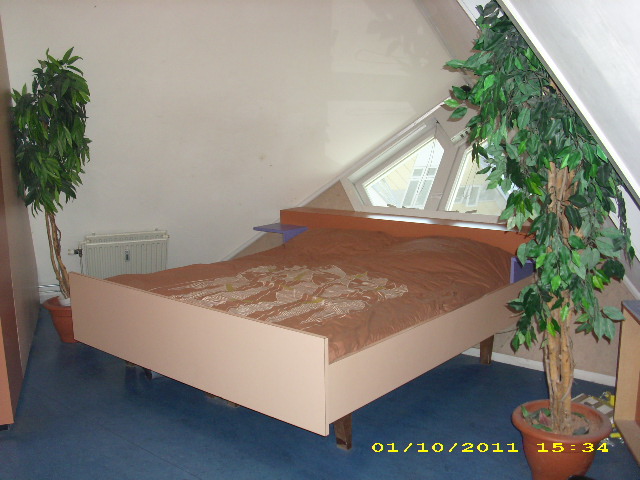
The second floor includes a bedroom and a little den area organized around the central column of the house where the stairs are located.  There are shelves all around that central column.  These shelves are full of all kinds of little trinkets and books.
There were all kinds of little collectable things.
Like these little pieces of dollhouse furniture.
I do like the little elephants, though.
This is a chess set made out of famous Rotterdam landmarks.  You will notice that the King is the Euromast, the Queen is the Erasmusbrug, the Bishops are the the World Trade Center, the Knights are the Shipping and Transport College, the Castles are the Maas Tower, and the pawns are little Cube Houses.  I really, really want this chess set.


There were also shelves and shelves of Tolkien character busts, Tolkien books, and other SciFi type books.

The third floor was set up like a little sitting room but was unbelievably hot, even with a dedicated air conditioning unit.  This is not really surprising considering that the top floor was set up kind of like a green house.  There were loads of cactus up there and they seemed to be thriving.


On the left below are the stairs leading down from the third floor to the second.  Note the walls.  On the right is the view from the third floor, across the other cube houses out to the Williamsbrug.
 

I found this sign entertaining.  Since the door is on one of the walls that is leaning in at a 45 degree angle, I suppose it would be pretty painful to let the door slam on your fingers.


The Cube House complex is actually a large group of buildings which covers a pedestrian bridge over a major 6 lane road.  Inside the complex there are little pedestrian complexes and there are businesses in the "trunk" sections of the buildings.  There were accounting businesses, several nail and hair places, and at least one tattoo place.  There were lots of potted plants and little miniature-sized work equipment.