Walter's return from Germany, and his reports of the fun time he had there, reminded me of how much I enjoyed the Christmas markets in Prague. So, in the spirit of the holiday, because I am writing about Aachen (even though I wasn't there during the Christmas season) I thought that I would share some pictures I found of the market, which is located in the Katschhof, the large plaza between the Dom and the Stadhuis.
If you go here and here, you can see some photo albums from different fairs. Here you can see an interesting blog post about visiting the market. Here you can find the official website for the market. And, if you go here, you can see an official Christmas Market website that talks all about the different German Christmas markets. If you scroll down a ways, you will find a video of the market which includes a little history of the market and a couple of really interesting bits about popular cookies and candies at the market.
Showing posts with label Holidays. Show all posts
Showing posts with label Holidays. Show all posts
Wednesday, January 2, 2013

Tuesday, December 18, 2012
Sinterklaas versus Krampus
December 5th was Sinterklaas in the Netherlands. This year, I was very sad to notice a lot less fun stuff and a lot less candy, in the good old U.S. of A. than they had in the Netherlands. It was disappointing. (To make up for it, you can look at the posts I did on Sinterklaas last year: part 1, part 2, and part 3.)
Now, I knew that many European countries have lots of different Christmas related holidays, many of which are quite weird. (The Dutch Zwarte Pieten are one example.) However, I may have found a wierdo tradition that beats all the rest to pieces. This tradition is Krampus Day. It originates in the Swiss and Austiran Alps and is also celebrated on December 5th, like Sinterklaas. It also has a similar theme without being quite so racially sensitive or so Spain-ophobic.
On Krampus, mountain demons come into the towns to beat naughty children with birch whips and to drag the really bad ones into hell or into the mountain to eat. It is quite the deal. (You can look at the Wikipedia post here, if you would like.) I have loaded a video of a Krampus song below. It is only a couple of minutes long and gives a little history of the tradition and its origins.
If you want to be really creeped out, you can watch the video below. It is about eight minutes long and is a video of a Krampuslauf, or Krampus parade, in the city of Gratz, Austria a few years ago. It is pretty impressive and kind of disturbing. I would strongly encourage you not to watch it right before bedtime.
If you still think that the less threatening Sinterklass is more for you, then you can read about how to celebrate the holiday (late) here.
Now, I knew that many European countries have lots of different Christmas related holidays, many of which are quite weird. (The Dutch Zwarte Pieten are one example.) However, I may have found a wierdo tradition that beats all the rest to pieces. This tradition is Krampus Day. It originates in the Swiss and Austiran Alps and is also celebrated on December 5th, like Sinterklaas. It also has a similar theme without being quite so racially sensitive or so Spain-ophobic.
On Krampus, mountain demons come into the towns to beat naughty children with birch whips and to drag the really bad ones into hell or into the mountain to eat. It is quite the deal. (You can look at the Wikipedia post here, if you would like.) I have loaded a video of a Krampus song below. It is only a couple of minutes long and gives a little history of the tradition and its origins.
If you want to be really creeped out, you can watch the video below. It is about eight minutes long and is a video of a Krampuslauf, or Krampus parade, in the city of Gratz, Austria a few years ago. It is pretty impressive and kind of disturbing. I would strongly encourage you not to watch it right before bedtime.
If you still think that the less threatening Sinterklass is more for you, then you can read about how to celebrate the holiday (late) here.
Thursday, February 9, 2012
Zwarte Pieten, Black Face, and America
In December, for my last class before the holidays, we had a guest speaker. He's a Ph.D. student here at Erasmus but he did exchange studies for his Master's degree at Central Michigan University--it's a small world.
Anyways, we were chatting before class started and he said that he really liked his time in America and, having traveled all around, thought that he wanted to get a job and live there once he graduated. I realized, though, when he said that, that I think that is the first time someone has said something nice about America since I got here. Granted, most of the discussions I have heard have been as part of overall discussions of empire, which generally gets people started on an unhappy note, but, in general, most folks seem to consider America to be bossy and unnecessarily inquisitive and her people to be loud, obnoxious, racist, and provincial. This fellow said that while he had gone to America with similar preconceptions, he had been converted by meeting people and talking to them (it probably didn't hurt that he spent a lot of his time hanging out in Michigan where people are nice--not quite "Minnesota Nice", but pretty close).
Since we were talking about race relations, the Zwarte Piet tradition came up and he said that colored people in the Netherlands find the tradition very offensive. I mentioned that I was surprised because in discussions I had seen, negative reactions were credited to American over-sensitivity and discounted. He said that there is a large divide between the white Dutch and the colored Dutch (who, by the way are collectively called "blauwen" (blue) instead of "black" as they are in the States. "Zwart" (black) is used sometimes but apparently has fairly negative connotations.) He said that this year several colored students wore t-shirts that said "Black Pete is Racist" (or the equivalent in Dutch) to the official landing of Sinterklaas at Dordrecht and they got put in jail (I don't know if they were causing trouble or not but it sounded like he thought it was just because of their shirts). So, while it couldn't have translated to America in any case, it sounds like this holiday tradition might have a limited life expectancy in the Netherlands as well.
Anyways, we were chatting before class started and he said that he really liked his time in America and, having traveled all around, thought that he wanted to get a job and live there once he graduated. I realized, though, when he said that, that I think that is the first time someone has said something nice about America since I got here. Granted, most of the discussions I have heard have been as part of overall discussions of empire, which generally gets people started on an unhappy note, but, in general, most folks seem to consider America to be bossy and unnecessarily inquisitive and her people to be loud, obnoxious, racist, and provincial. This fellow said that while he had gone to America with similar preconceptions, he had been converted by meeting people and talking to them (it probably didn't hurt that he spent a lot of his time hanging out in Michigan where people are nice--not quite "Minnesota Nice", but pretty close).
Since we were talking about race relations, the Zwarte Piet tradition came up and he said that colored people in the Netherlands find the tradition very offensive. I mentioned that I was surprised because in discussions I had seen, negative reactions were credited to American over-sensitivity and discounted. He said that there is a large divide between the white Dutch and the colored Dutch (who, by the way are collectively called "blauwen" (blue) instead of "black" as they are in the States. "Zwart" (black) is used sometimes but apparently has fairly negative connotations.) He said that this year several colored students wore t-shirts that said "Black Pete is Racist" (or the equivalent in Dutch) to the official landing of Sinterklaas at Dordrecht and they got put in jail (I don't know if they were causing trouble or not but it sounded like he thought it was just because of their shirts). So, while it couldn't have translated to America in any case, it sounds like this holiday tradition might have a limited life expectancy in the Netherlands as well.
Friday, February 3, 2012
Back to Rotterdam
I flew back to Rotterdam on Christmas night. I was a little worried about the night tram--the Prague public transport system was scheduled a little oddly over the weekend and I had already ended up in different places than I had intended a few times as a result of the fact that the trams' schedule had changed without warning (or at least without a warning in English). Since I figured that I didn't want to get stuck in some back corner of Prague while missing my plane, I took a fairly early bus to the airport. The down side of this was that it meant that I got to spend three hours at the airport on a Sunday Christmas evening. That is not the most enchanting way to spend a Christmas evening. Even with Christmas lights, it wasn't that fun.



On the bus ride, I ended up sitting behind four teenagers who spent the entire bus ride smooching in the most revolting fashion and (it appeared) critiquing one another's performances.
At the airport, nothing was open, of course, seeing as it was both a holiday and the weekend. But I did get a "long decoffee with milk". Well, actually, I got a cappuccino with caffeine, seeing as I knew I had a long night ahead of me but I thought that the other translation was funnier.
I had an awfully fun time in Prague. Apparently, there are a few scams which are popular in Prague and I ended up getting some of them tried out on me. I managed to escape them all, as far as I know, which means that I feel like I've gotten the real Prague "Experience" and which also allows me to feel superior for not having fallen into their traps. Folks kept trying to sell me transport tickets--which is, as far as I know, is both illegal and fraudulent. Apparently I appear either too nice or too credulous. I didn't buy any of them, though, and could say, with perfect honesty "I don't need that, thank you". That's another good reason to have a transport pass.


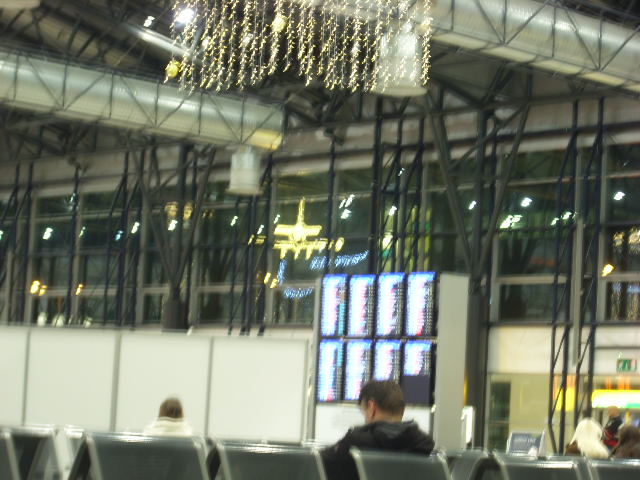

On the bus ride, I ended up sitting behind four teenagers who spent the entire bus ride smooching in the most revolting fashion and (it appeared) critiquing one another's performances.
At the airport, nothing was open, of course, seeing as it was both a holiday and the weekend. But I did get a "long decoffee with milk". Well, actually, I got a cappuccino with caffeine, seeing as I knew I had a long night ahead of me but I thought that the other translation was funnier.
I had an awfully fun time in Prague. Apparently, there are a few scams which are popular in Prague and I ended up getting some of them tried out on me. I managed to escape them all, as far as I know, which means that I feel like I've gotten the real Prague "Experience" and which also allows me to feel superior for not having fallen into their traps. Folks kept trying to sell me transport tickets--which is, as far as I know, is both illegal and fraudulent. Apparently I appear either too nice or too credulous. I didn't buy any of them, though, and could say, with perfect honesty "I don't need that, thank you". That's another good reason to have a transport pass.
Thursday, February 2, 2012
Christmas Eve
 |
| A closed Trdelník stand. Trdelníks are awesome. |
I looked for a booth selling the traditional Czech Christmas Eve diner of sauerkraut soup and baked cod. I could not find a single one. There were several stands that were advertising "traditional Czech Ham" which was being cooked on giant spits over large pans of coals. It smelled really good. But, I am still not convinced that that is really "traditional"--since I've been back I've been looking things up to see if I could find anything about it and I haven't. I am a little suspicious that this was a transparent attempt to pander to tourists because baked ham sells better than sauerkraut soup.
I was hanging around waiting for a Christmas Mass which they had at the Old Town Square Market. While I was waiting, and because it was really cold (and because I hadn't gotten to have any sauerkraut soup) I decided to try some Grogg. It was not nearly as tasty as one might have expected. It was, actually, really, really disgusting. The Christmas Mass was really just music--they didn't offer a prayer to start the show off or anything else that seemed remotely religious, although I suppose that the songs could have had some religious significance. I suppose, though, that this is in keeping with the Czech agnosticism.
I had originally planned on going to the Midnight Mass which was being held at the Strahovský Kláster, which is in the Castle Quarter. I ended up not going because I couldn't figure out how to get back with the night train schedules and I really didn't want to be stuck walking back from across the river. Also, it was cold and I was tired, but that wasn't the main reason. I ended up having to walk most of the way back to the hotel anyways because I still couldn't figure out the night trams but, on the plus side, walking was almost enough to keep me warm.
Since I couldn't get any traditional Czech Christmas Eve food in Prague, I looked up some recipes once I got back to Rotterdam. I realize these are Slovak recipes but they look the same and sound the same as the Czech recipes and they were convenient. So now you can make your very own Czech (or Slovak) Christmas Eve Dinner.
Sauerkraut Soup
Potato Salad
Fried Carp

Tuesday, January 3, 2012
New Year's Resolution
New Year's Resolution: Next year, I plan to live in a paternalistic society which prohibits the use of firecrackers in residential areas (or at least in places near me) or in a place so boring they don't do anything bigger than a sparkler.
This is what Rotterdam looked like most of the evening. This is around midnight and it kept up, about like this, until around 3 am. These are not the official city fireworks (those were out over the Erasmusbrug which is on the other side of my building). These are all personal fireworks which, apparently, every Rotterdammer and his brother had bought by the truck load.
This is what Rotterdam looked like most of the evening. This is around midnight and it kept up, about like this, until around 3 am. These are not the official city fireworks (those were out over the Erasmusbrug which is on the other side of my building). These are all personal fireworks which, apparently, every Rotterdammer and his brother had bought by the truck load.
Saturday, December 31, 2011
Happy People--Alternate Title: "I Hate Celebrations"--Alternate Alternate Title: "I Wish I Could be the Grinch of New Years and Steal All Their Stupid Firecrackers."
The Dutch are very into celebrating and they are especially into celebrating with firecrackers. Football victories, football defeats, a concert, the weekend, a boring evening, all seem to be celebrated with firecrackers. This week between Christmas and New Years has been especially packed with firecrackers---little, poppy ones, whistling screamers, and super loud ones that sound like World War III is just beginning. Daylight and late nights seem equally unable to quell this enthusiasm. As I write this, it is about 9pm and there have been firecrackers going off for at least the last 36 hours without pauses longer than 5 or 6 minutes at any point (and usually much less). Occasionally, you can hear the glass in the windows shake. Since the firecrackers are being set off in the middle of streets or in the small squares between apartment buildings, there is pretty significant echo amplification. Periodically, large firecrackers will set off all of the nearby car alarms, although, the car alarms on my street have only been set off once so far. Its hard to sleep well in what has to be a pretty near approximation of a war zone. I am not amused and I do not feel celebratory.
This video fails to capture the loudness and loudness of whole thing--my ears are ringing. Also, the video goes on a long time (about a minute)--if you watch the first 20 seconds (and then image that, way louder and lasting, I can only imagine, for three or four days) you will get the idea.
This video fails to capture the loudness and loudness of whole thing--my ears are ringing. Also, the video goes on a long time (about a minute)--if you watch the first 20 seconds (and then image that, way louder and lasting, I can only imagine, for three or four days) you will get the idea.
Wednesday, December 28, 2011
The Prague Trip
For my Prague trip I got a transportation pass which, for about $7 a day meant I could hop on and off any of the buses, trams, or metros of the Prague public transport whenever I needed. I probably could have saved a little money by buying tickets only when I actually needed them but apparently it can sometimes be hard to find a ticket stand, so the convenience and security factor made it definitely worthwhile to have the ticket. I also got the "Prague Card" which gives you free, or discounted, access to all kinds of museums and monuments in the city. It can save you a lot of money, if things work out right, but it really turned out to be a complete waste of money for me. Some of the sites were closed because it was off-season, which I knew ahead of time, but because of the state funeral for Vaclav Havel, a former Czech president and national hero, a lot of other stuff, and especially the stuff I really wanted to see, was closed. As it is, I have a very expensive souvenir for my scrapbook. If you want to see the stuff you can normally get into with the card, including pictures and brief descriptions of the sites, you can go to the official Prague Card website here.
When I flew into Prague, there was snow on the ground. And it smelled like snow. And it there was more snow predicted for the weekend. We didn't get any snow and, on Saturday and Sunday, the temperature was about 33 degrees and it sleeted. But the snow hopes were nice while they lasted.
It was funny how different things are, so close to the Netherlands (it was only a one hour flight). I only saw one bike shop the whole time I was there. I saw this, as well, which you would never see in the Netherlands, which forbids biking in a park. Also: weirdest looking bike ever.

Also there are hills and mountains in the Czech Republic Everything was in Czech, of course, but a lot of advertisements, television, and the occasional instruction where in German. One funny thing I saw was that in German McDonald's they now sell some special premium sandwiches, including a chicken and Camembert sandwich. In the advertisement, the gooshy cheese is oozing all over the sandwich. You can see a picture of it, here. If you go here, you can watch the commercials (which are kind of entertaining). From what I gather, there is a fancy chef who keeps astounding the McDonald's guy with the amazing new recipes he is creating for the store. The Camembert chicken ad is labeled "Teil 3". The video labeled "Teil 1" advertises the "Big Rosti" which is a hamburger, chicken, bacon, cheese, and cheese sauce on one sandwich.
There were a lot of police. It could have just been because of the Christmas Markets or it could have been because of the funeral, but there was just a huge police presence. I alternated between figuring that at least there would be someone within call if there were problems and wondering why on earth they needed that many police. I watched some "Alaska State Troopers" a little while ago and, from what I remember of those stories, they policed giant snow mobile events while outnumbered 1 to 1,000,000 and people hardly ever died. I am left with the impression that, either, folks in Alaska are more honest or their criminals are less effective. To be honest, though, Prague would be an easy city to be a pick-pocket in. It is a ridiculously beautiful city and you find yourself walking around staring up at the buildings and the sights and forgetting to watch out for your bags.
If you go here you can look at the Google map which I put together with all of the places I wanted to see. If you click on the name of the site, or the little blue balloon, you can usually zoom in or see the street view of the area.
To get into the city, I took a bus from the airport to the metro, and then took the metro into the city. When I got off the metro, I couldn't figure out where I was exactly. But, since I wasn't in a hurry, I decided to just look around and see what was going on. I walked down a couple of streets and then turned a corner and had to stop to let two horse-drawn carriages go past.


Then I walked to the edge of a square and was right in the middle of a Christmas Market. It was ridiculous. This was my first view of Prague's Old Square and I think this was when I knew that I was going to have a ridiculously good time.


When I flew into Prague, there was snow on the ground. And it smelled like snow. And it there was more snow predicted for the weekend. We didn't get any snow and, on Saturday and Sunday, the temperature was about 33 degrees and it sleeted. But the snow hopes were nice while they lasted.
It was funny how different things are, so close to the Netherlands (it was only a one hour flight). I only saw one bike shop the whole time I was there. I saw this, as well, which you would never see in the Netherlands, which forbids biking in a park. Also: weirdest looking bike ever.

Also there are hills and mountains in the Czech Republic Everything was in Czech, of course, but a lot of advertisements, television, and the occasional instruction where in German. One funny thing I saw was that in German McDonald's they now sell some special premium sandwiches, including a chicken and Camembert sandwich. In the advertisement, the gooshy cheese is oozing all over the sandwich. You can see a picture of it, here. If you go here, you can watch the commercials (which are kind of entertaining). From what I gather, there is a fancy chef who keeps astounding the McDonald's guy with the amazing new recipes he is creating for the store. The Camembert chicken ad is labeled "Teil 3". The video labeled "Teil 1" advertises the "Big Rosti" which is a hamburger, chicken, bacon, cheese, and cheese sauce on one sandwich.
There were a lot of police. It could have just been because of the Christmas Markets or it could have been because of the funeral, but there was just a huge police presence. I alternated between figuring that at least there would be someone within call if there were problems and wondering why on earth they needed that many police. I watched some "Alaska State Troopers" a little while ago and, from what I remember of those stories, they policed giant snow mobile events while outnumbered 1 to 1,000,000 and people hardly ever died. I am left with the impression that, either, folks in Alaska are more honest or their criminals are less effective. To be honest, though, Prague would be an easy city to be a pick-pocket in. It is a ridiculously beautiful city and you find yourself walking around staring up at the buildings and the sights and forgetting to watch out for your bags.
If you go here you can look at the Google map which I put together with all of the places I wanted to see. If you click on the name of the site, or the little blue balloon, you can usually zoom in or see the street view of the area.
To get into the city, I took a bus from the airport to the metro, and then took the metro into the city. When I got off the metro, I couldn't figure out where I was exactly. But, since I wasn't in a hurry, I decided to just look around and see what was going on. I walked down a couple of streets and then turned a corner and had to stop to let two horse-drawn carriages go past.


Then I walked to the edge of a square and was right in the middle of a Christmas Market. It was ridiculous. This was my first view of Prague's Old Square and I think this was when I knew that I was going to have a ridiculously good time.


Monday, December 26, 2011
Prague Christmas Love

I thought it only fair to mention that I did not feel homesick this Christmas. I barely even missed you guys at all and I certainly didn't pine for you.

You might have stood a chance of standing out in my thoughts if there wasn't snow on the ground when I flew into Prague. And if it hadn't smelled like more snow. And if they weren't selling roasted chestnuts out of little wheeled carts. And if the carts weren't right next to little stands that sold hot chocolate. And if those weren't right next to stands where they baked traditional Czech donoghts on sticks over beds of coals. And if you couldn't take carriage rides around the city with your choice of matching pairs of horses. And if some of those pairs of horses didn't have matching pink and purple ear-warmers. And if the whole city didn't light up at night, like a fluffy, twinkly, sparkly, fairy-tale land.
But as it was, you didn't stand a chance.
Well, on my way home, at 11 o'clock at night, after a long afternoon at the airport, when I was already tired and cold, while I was riding the bus back home through the suburbs and saw Christmas lights through warm family-room windows, then I felt a little misty.
But, the rest of the time, you guys were pretty much eclipsed.

Prague was A.W.E.S.O.M.E.
Although, in retrospect, I think you are supposed to peel roasted chestnuts before you eat them.
Tuesday, December 20, 2011
Christmas in Prague
Over Christmas I will be going to Prague! It should be pretty fun. Prague (Praha in Czech) is known for having loads of very old buildings, for its impressive music and opera scene, and for its impressive Christmas Markets. If you click here, you can see the Google search result for pictures for Christmas in Prague--pretty impressive, eh? It is supposed to snow over the weekend as well, which is exciting.
I anticipate that I will try the traditional Czech Christmas Eve menu of sauerkraut soup and baked cod. I will, however, try very, very hard to avoid tripe soup, which apparently is a popular dish in the Czech Republic. I looked it up on Google Translate and there are three Czech words for tripe (which is really way too many for any one language) and while I can in no way pronounce any of them, I will avoid any menu items which include any of these words: dršťky, šmejd, or droby.
If you want to see what kinds of things I will be seeing, the official Prague tourism website includes three live webcams of Prague. You can click through them all but the one that this link opens, is of the Charles Bridge, which crosses the Vltava River, beside which I will be living. The bridge is pretty famous and also pretty famous for being beautiful. It is worth seeing at night, especially.
I anticipate that I will try the traditional Czech Christmas Eve menu of sauerkraut soup and baked cod. I will, however, try very, very hard to avoid tripe soup, which apparently is a popular dish in the Czech Republic. I looked it up on Google Translate and there are three Czech words for tripe (which is really way too many for any one language) and while I can in no way pronounce any of them, I will avoid any menu items which include any of these words: dršťky, šmejd, or droby.
If you want to see what kinds of things I will be seeing, the official Prague tourism website includes three live webcams of Prague. You can click through them all but the one that this link opens, is of the Charles Bridge, which crosses the Vltava River, beside which I will be living. The bridge is pretty famous and also pretty famous for being beautiful. It is worth seeing at night, especially.
Friday, December 9, 2011
December 5--Sinterklaas, Part Three
The best part of the Dutch holidays is that they get THREE Christmas-type days.
First, they have Sinterklaas on the 5th.
Then they have Kerst (Christmas) on the 25th. This is not such a big thing as it is in the US, although it is getting bigger, but they do have all kinds of newspaper advertisements centered around it in the papers, as well as different kinds of wrapping papers and other holiday paraphernalia, although I gather that most of the stuff just goes up in the middle of November and then serves for both holidays. The funny thing, though, is that for Kerst, they have the regular, old, familiar Santa Claus, with a floppy hat and flying reindeer (or, at least, that is how they decorate their Christmas advertisements).
Then, to top it all off, the Dutch have Tweede Kerst--"Second Christmas"--on the 26th. This is equivalent of Boxing Day in Canada or England. Lars, my Dutch informant, said that you don't get presents on Second Christmas, it is mostly just a day to see family that you didn't see on First Christmas and you usually have another big traditional meal. I think that I could live with that--it sounds like an excellent plan, and also a good way to work out holiday sharing with the in-laws. The 26th is also gaining a reputation as being a big shopping day, too, kind of like a Black Friday thing, although on a smaller scale, which makes it seem a little less family centered, and probably makes it harder to make another giant meal.
Next year, we should start doing multiple Christmases. When you think about it, just about every other former English colony ended up with Boxing Day, which is almost as good as a Second Christmas. If you do Hanukkah, you get 8 days. If you do Kwanzaa, you get 7 days. If you are from Ye Olde Englande, you get 12 days. And here we are, stuck with one measly Christmas and then a day standing in the customer service lines to return stuff. I think that it is time to change this.
I would like to point out that the U.S. Consulate in the Netherlands has figured out a pretty good way to do these kinds of things--they just celebrate the national holidays of both the U.S. and the Netherlands. It just seems friendly to take the day off when other people are having a fun celebration. (You can see the calendar of official U.S. and Dutch holidays here.) We could extend it a little, too. If you go here, you will see the Wikipedia list of all kinds of countries and then pick fun holidays to share. (I thought we could start with countries with which we have a connection--Germany was disappointing and doesn't do any extra fun stuff. Ireland just takes off the first day of June and the first day of August, for no apparent reason. The National Day of Sweden on June 6th (we could eat lefse and argue about whether herring is actually edible). I think this is a pretty good plan.
I vote that next year we do Sinterklaas and Tweede Kerst, at least. It will be like I am an ambassador for celebratory multiculturalism and diversity. I am also perfectly willing to compromise and switch to 12 days of Christmas, instead.
First, they have Sinterklaas on the 5th.
Then they have Kerst (Christmas) on the 25th. This is not such a big thing as it is in the US, although it is getting bigger, but they do have all kinds of newspaper advertisements centered around it in the papers, as well as different kinds of wrapping papers and other holiday paraphernalia, although I gather that most of the stuff just goes up in the middle of November and then serves for both holidays. The funny thing, though, is that for Kerst, they have the regular, old, familiar Santa Claus, with a floppy hat and flying reindeer (or, at least, that is how they decorate their Christmas advertisements).
Then, to top it all off, the Dutch have Tweede Kerst--"Second Christmas"--on the 26th. This is equivalent of Boxing Day in Canada or England. Lars, my Dutch informant, said that you don't get presents on Second Christmas, it is mostly just a day to see family that you didn't see on First Christmas and you usually have another big traditional meal. I think that I could live with that--it sounds like an excellent plan, and also a good way to work out holiday sharing with the in-laws. The 26th is also gaining a reputation as being a big shopping day, too, kind of like a Black Friday thing, although on a smaller scale, which makes it seem a little less family centered, and probably makes it harder to make another giant meal.
Next year, we should start doing multiple Christmases. When you think about it, just about every other former English colony ended up with Boxing Day, which is almost as good as a Second Christmas. If you do Hanukkah, you get 8 days. If you do Kwanzaa, you get 7 days. If you are from Ye Olde Englande, you get 12 days. And here we are, stuck with one measly Christmas and then a day standing in the customer service lines to return stuff. I think that it is time to change this.
I would like to point out that the U.S. Consulate in the Netherlands has figured out a pretty good way to do these kinds of things--they just celebrate the national holidays of both the U.S. and the Netherlands. It just seems friendly to take the day off when other people are having a fun celebration. (You can see the calendar of official U.S. and Dutch holidays here.) We could extend it a little, too. If you go here, you will see the Wikipedia list of all kinds of countries and then pick fun holidays to share. (I thought we could start with countries with which we have a connection--Germany was disappointing and doesn't do any extra fun stuff. Ireland just takes off the first day of June and the first day of August, for no apparent reason. The National Day of Sweden on June 6th (we could eat lefse and argue about whether herring is actually edible). I think this is a pretty good plan.
I vote that next year we do Sinterklaas and Tweede Kerst, at least. It will be like I am an ambassador for celebratory multiculturalism and diversity. I am also perfectly willing to compromise and switch to 12 days of Christmas, instead.
Thursday, December 8, 2011
December 5--Sinterklaas, Part Two
I was talking to a Dutch classmate about Sinterklaas and he told me a lot about Sinterklaas that I hadn't known before. (His name is Lars but he said that he was genuinely Dutch, he just has a Swedish name.) He said that Sinterklaas is a great holiday as long as there are little kids around.
As long as there are little kids in the family who believe that Sinterklaas exists, everybody gets presents and puts them in a bag and then gets a neighbor to ring the doorbell and then run away, leaving the bag of goodies on the doorstep. This wows the little kids--Zwarte Piet just left their presents and they almost saw him!--and everyone is happy.
Once everyone is all grown up and doesn't believe in Sinterklaas anymore, though, the holiday gets burdensome. Everyone gets everyone else in the family a little gift but (and this is the part that apparently the whole nation finds stressfull) you have to include a little heart-felt poem inside the presents as well. I had never heard of this before and was pretty intrigued. Well, after class, that very same day, I had to go pay my rent and, while I was waiting for my turn at the counter, I flipped through one of the newspapers lying on the table and what should appear but a comic strip about the stresses of making Sinterklaas poems! I couldn't take the paper with me and I havevn't been able to find the strip on the internet but I think it was called "Heinz de Kat" or something like that. In the first panel, Heinz sits at a table with a pen and some paper and says "This year I will get all of my Sinterklaas poems done ahead of time!" In the second panel, he hasn't written anything down and has little angry squiggles above his head. In the last panel, he is sitting in a bar, still looking grouchy and he hasn't written anything at all.
Lars said that you could find poem-making engines on the internet to make it easier. I looked it up and if you go here, you can find the "Sinterklaas Gerdichten Generator"--the Sinterklaas Poem Generator. It works pretty much by sticking the name of the person (and sometimes the type of gift) into a bunch of preset lines which seem to be primarily moralistic poems with a rhyming structure akin to "Roses are Red, Violets are Blue" but I suppose that you can't expect too much from a magical poem maker.
I made a little practice poem for Otis (the best name for Grace's little babykins if he's a boy) in case I were to get him a little teddy bear.
The best poem I found was:
Weet dat hij veel van Otis houdt
Uitvluchten laten hem Siberisch koud
Hij hoopt maar dat dit cadeau hem niet berouwt
Dit is een teddybeer voor een iemand met een hart van goud
(I dare you to try to sound it out. If you want to hear what it sounds like when I say it, you can click on this link below.)
The gist of the poem is something like:
Knowing Otis as he does,
Santa probably ought to leave him in Siberia.
So he hopes that he doesn't regret giving him this present:
This teddy bear is for someone with a heart of gold.
Poor little Otis. I am SURE that he deserves a teddy bear.
As long as there are little kids in the family who believe that Sinterklaas exists, everybody gets presents and puts them in a bag and then gets a neighbor to ring the doorbell and then run away, leaving the bag of goodies on the doorstep. This wows the little kids--Zwarte Piet just left their presents and they almost saw him!--and everyone is happy.
Once everyone is all grown up and doesn't believe in Sinterklaas anymore, though, the holiday gets burdensome. Everyone gets everyone else in the family a little gift but (and this is the part that apparently the whole nation finds stressfull) you have to include a little heart-felt poem inside the presents as well. I had never heard of this before and was pretty intrigued. Well, after class, that very same day, I had to go pay my rent and, while I was waiting for my turn at the counter, I flipped through one of the newspapers lying on the table and what should appear but a comic strip about the stresses of making Sinterklaas poems! I couldn't take the paper with me and I havevn't been able to find the strip on the internet but I think it was called "Heinz de Kat" or something like that. In the first panel, Heinz sits at a table with a pen and some paper and says "This year I will get all of my Sinterklaas poems done ahead of time!" In the second panel, he hasn't written anything down and has little angry squiggles above his head. In the last panel, he is sitting in a bar, still looking grouchy and he hasn't written anything at all.
Lars said that you could find poem-making engines on the internet to make it easier. I looked it up and if you go here, you can find the "Sinterklaas Gerdichten Generator"--the Sinterklaas Poem Generator. It works pretty much by sticking the name of the person (and sometimes the type of gift) into a bunch of preset lines which seem to be primarily moralistic poems with a rhyming structure akin to "Roses are Red, Violets are Blue" but I suppose that you can't expect too much from a magical poem maker.
I made a little practice poem for Otis (the best name for Grace's little babykins if he's a boy) in case I were to get him a little teddy bear.
The best poem I found was:
Weet dat hij veel van Otis houdt
Uitvluchten laten hem Siberisch koud
Hij hoopt maar dat dit cadeau hem niet berouwt
Dit is een teddybeer voor een iemand met een hart van goud
(I dare you to try to sound it out. If you want to hear what it sounds like when I say it, you can click on this link below.)
The gist of the poem is something like:
Knowing Otis as he does,
Santa probably ought to leave him in Siberia.
So he hopes that he doesn't regret giving him this present:
This teddy bear is for someone with a heart of gold.
Poor little Otis. I am SURE that he deserves a teddy bear.
Wednesday, December 7, 2011
December 5--Sinterklaas, Part One
In the Netherlands, as I've mentioned before, everyone gets way more Christmas related action than we do in the US. On December 5th, Sinterklaas comes with the Zwarte Pieten (he has several helpers, usually) and provides treats and presents for good childeren and coal, beatings, and even kidnapping and enslavement for naughty ones. Nowadays, this threat is apparently mostly representational as you can buy Sinterklaas bags of goodies which includes a bag holding gift shaped candies (they are kind of like those hard, orange, marshmallowy "circus peanuts") which comes inside a larger bag holding "kruidenoten" (or "spice chunks") which are kind of like miniature (quarter sized), hard ginger-snaps which are representative of lumps of coal.
David Sidarus, a frequent comedic contributer to a variety of NPR programs, has written a really delightful essay on gun ownership and Dutch Sinterklaas traditions. Someone on YouTube has put the audio of Sidarus reading that essay in three parts, together with a bunch of pictures of Dutch Sinterklaas celebrations and related "funniest home video" moments. The whole thing is about 15 minutes long and it is definitely worth watching. I have attached all of the videos here so that you should be able to click on the picture to watch it here or you can click on the link underneath, which will open the video in a new page. I think the fact that he is an NPR employee should be sufficient gaurantee of both his sense of humor and his class (although I gather that some of Sidarus's other essays do include occaisional vulgarity so you might use caution if you want to look up some of his other stuff).
David Sidarus, a frequent comedic contributer to a variety of NPR programs, has written a really delightful essay on gun ownership and Dutch Sinterklaas traditions. Someone on YouTube has put the audio of Sidarus reading that essay in three parts, together with a bunch of pictures of Dutch Sinterklaas celebrations and related "funniest home video" moments. The whole thing is about 15 minutes long and it is definitely worth watching. I have attached all of the videos here so that you should be able to click on the picture to watch it here or you can click on the link underneath, which will open the video in a new page. I think the fact that he is an NPR employee should be sufficient gaurantee of both his sense of humor and his class (although I gather that some of Sidarus's other essays do include occaisional vulgarity so you might use caution if you want to look up some of his other stuff).
Friday, November 25, 2011
What I Did on Thanksgiving in the Absence of Any Pies
Thanksgiving in the Netherlands is something of a non-event. They don't sell turkey (or at least I couldn't find any in the grocery store), they don't really do pies, and, obviously, their Indians didn't teach them how ti grow corn. (That joke would be funnier if there were more non-Amer Indians living here but since presumably you are not au currant on the immigration statistics of the Netherlands, we'll just pretend it works.) I had to go pick up some bread and some butter and I kept thinking that I had to go before Thursday before I would remember that nothing would be closed on Thursday, after all.
I did have a special Thanksgiving treat, though. I had stampot (mashed carrots, potatoes, and sauerkraut) --I figured that if I couldn't have traditional American food, I'd go traditional Dutch. I also splurged and bought canned peas. They are super expensive here--a regular sized can costs about $1.50. I thought about making pea salad but didn't because 1) Dutch mayonnaise is weird and quite sweet and 2) they don't really have cheddar cheese here or, rather, they have "cheddar" but it is super, super expensive and it isn't the pretty extra-orange color you need to make a real pea salad.
But, to make the day special (after I pretended to do a lot of home work), I wore my Christmas socks with Santas on them, listened to Christmas music, and did this:
(Please ignore the little typo, there.)
For the last week or so I have been making origami Christmas decorations (usually when I should have been doing school work, but that is beside the point). So I put up all the rest of it together in an homage to the Christmas trees we had when I was little. Plus, to top it all off, it only cost about $6 in crepe paper and origami paper.
Happy Thanksgiving Everybody!
I did have a special Thanksgiving treat, though. I had stampot (mashed carrots, potatoes, and sauerkraut) --I figured that if I couldn't have traditional American food, I'd go traditional Dutch. I also splurged and bought canned peas. They are super expensive here--a regular sized can costs about $1.50. I thought about making pea salad but didn't because 1) Dutch mayonnaise is weird and quite sweet and 2) they don't really have cheddar cheese here or, rather, they have "cheddar" but it is super, super expensive and it isn't the pretty extra-orange color you need to make a real pea salad.
But, to make the day special (after I pretended to do a lot of home work), I wore my Christmas socks with Santas on them, listened to Christmas music, and did this:
(Please ignore the little typo, there.)
For the last week or so I have been making origami Christmas decorations (usually when I should have been doing school work, but that is beside the point). So I put up all the rest of it together in an homage to the Christmas trees we had when I was little. Plus, to top it all off, it only cost about $6 in crepe paper and origami paper.
Happy Thanksgiving Everybody!
Wednesday, November 9, 2011
Subway Posters
Dutch subway posters are electronic and they cycle through three different pictures, one at a time. There have been some pretty interesting ones that I never got around to photographing before they were replaced, but I caught some of these.


"Step on over to HollandseWind (a Dutch energy company)"
There was also a version with a cow tumbling through the air.
I just find this very entertaining for some reason.
The Dutch celebrate Christmas on December 25th, just like everybody else but they also have a special holiday on the 5th, and that is where Sinterklaas comes and puts presents and candy in shoes and his decidedly un-politically-correct assistant Zwarte Piet comes and puts switches in the shoes of bad kids.

Well, a year or so ago, the movie "Sint" came out. It is a horror movie, set in Amsterdam, about how the Sint (Saint) comes and kills people on December 5ths which are on full moons. The movie came out on December 5th. It has just been released on DVD so there have been posters up all over, showing it. You can see the movie trailer here, the violence isn't really graphic (it is mostly startling) and it is in Dutch, so if there is any swearing, you can't really tell. It is kind of fun to see it because it is a little campy and you kind of get an idea of the rhythm of spoken Dutch. People from my class are making plans to see this this coming December 5th.
And finally, did you know they are making a TinTin movie? Well they are.

There are at least four different TinTin movie posters and this is the least interesting one and also the only one I've managed to get a picture of. However, I will keep trying. You can watch a trailer for the movie here. It is in English, too, so it isn't too bad.
Monday, October 10, 2011
Leiden Ontzet
On October 3, 1574, Leiden was delivered dramatically from the Spanish. The Dutch saw it is a stamp of Divine approval on their endeavor to create a new nation and to free themselves from the religious and spiritual tyranny of Spanish rule.
Since his ascension to the Spanish throne in 1555, Philip II had enacted a series of taxes, religious persecutions (including the resurrection of the Inquisition), and oppressive political policies, which infuriated the Dutch populace, especially the Calvinists and other Protestants in the north of the country. Beginning in 1572, the scattered defensive actions of the Dutch, and the ubiquitous but ephemeral actions of the Sea Beggars were consolidated to create a more or less united Dutch revolutionary force. The Spanish response was brutal, and focused on making an example of those who had revolted. By the fall of 1574, the Spanish had had Leiden under siege, off and on, for almost a year and the residents of the city were starving and disheartened. Spanish policy toward surrendering cities made surrender an unattractive option.
The Dutch forces, under the guidance of William of Orange (William the Silent), were at a disadvantage because their greatest strength lay in their navy. On land they were outnumbered, out-gunned, and out-trained. While it was possible to get to Leiden through the canals, it would have left anyone approaching completely at the mercy of the Spanish troops who were waiting for just such an attempt. Advised by Johan van Oldenbarnevelt, among others, it was decided that the best plan would be to cut through the dikes which protected the Low Countries' dry land, thus enabling the Dutch fleet to sail up to Leiden and meet the Spanish with greater strength. They broke the dike in September but the land was high enough and tides and winds were strong enough against them that the Dutch ships were not able to sail to Leiden. At the beginning of October, however, the winds changed and a storm came in, flooding the polders between the North Sea and Leiden enough that the Dutch ships were able to sail in, sending the Spanish fleeing.
The arriving Dutch ships brought with them herring and white bread, which is apparently Dutch sailor food. And, I suppose, if you're hungry enough, swallowing a herring whole starts to seem like a pretty good idea. The Relief of Leiden was also the origin, at least according to legend, of the Dutch Stampot--the height of Dutch cuisine and also a traditional 3 October dish. The Spanish, fleeing the storm and the incoming Dutch fleet, ran away, leaving their suppers still cooking on their camp-fires and, apparently, Spanish troops at the time where eating mainly boiled root vegetables. Maybe the Spanish were looking for an excuse to go somewhere else for dinner?
On a related note, not everyone was pleased about the piercing of the dikes. I suppose there must be a visceral disinclination to letting the sea in when you live your life below sea level. Also, if you consider how much water would have to be let in to allow ships, with presumably substantial drafts to sail through (the "shallow" drafts of the Dutch ships seems like a relative term when you are sailing through someone's living room), there must have been substantial damage to the intervening polders. And it is a pretty long way from the North Sea to Leiden. My squinty interpretation of this Google map puts it at about 7 miles of houses and towns and fields that had to be flooded several feet deep to let the ships come through.

In a minor set of coincidences, this 3 of October was the first Monday of the month. The first Monday of the month, at noon, is the time for testing the warning sirens which would be used to alert the Dutch of flooding polders and incoming Germans, presumably. What was funny, though, is that this month there was something wrong with the sirens at Leiden and they didn't go off when they were supposed to. They ended up going off a little later on and I wonder how many people, presumably fairly inebriated as they celebrated the flooding which had saved Leiden, heard the siren, thought "must be noon", looked at their watch, and panicked a little.
Since his ascension to the Spanish throne in 1555, Philip II had enacted a series of taxes, religious persecutions (including the resurrection of the Inquisition), and oppressive political policies, which infuriated the Dutch populace, especially the Calvinists and other Protestants in the north of the country. Beginning in 1572, the scattered defensive actions of the Dutch, and the ubiquitous but ephemeral actions of the Sea Beggars were consolidated to create a more or less united Dutch revolutionary force. The Spanish response was brutal, and focused on making an example of those who had revolted. By the fall of 1574, the Spanish had had Leiden under siege, off and on, for almost a year and the residents of the city were starving and disheartened. Spanish policy toward surrendering cities made surrender an unattractive option.
The Dutch forces, under the guidance of William of Orange (William the Silent), were at a disadvantage because their greatest strength lay in their navy. On land they were outnumbered, out-gunned, and out-trained. While it was possible to get to Leiden through the canals, it would have left anyone approaching completely at the mercy of the Spanish troops who were waiting for just such an attempt. Advised by Johan van Oldenbarnevelt, among others, it was decided that the best plan would be to cut through the dikes which protected the Low Countries' dry land, thus enabling the Dutch fleet to sail up to Leiden and meet the Spanish with greater strength. They broke the dike in September but the land was high enough and tides and winds were strong enough against them that the Dutch ships were not able to sail to Leiden. At the beginning of October, however, the winds changed and a storm came in, flooding the polders between the North Sea and Leiden enough that the Dutch ships were able to sail in, sending the Spanish fleeing.
The arriving Dutch ships brought with them herring and white bread, which is apparently Dutch sailor food. And, I suppose, if you're hungry enough, swallowing a herring whole starts to seem like a pretty good idea. The Relief of Leiden was also the origin, at least according to legend, of the Dutch Stampot--the height of Dutch cuisine and also a traditional 3 October dish. The Spanish, fleeing the storm and the incoming Dutch fleet, ran away, leaving their suppers still cooking on their camp-fires and, apparently, Spanish troops at the time where eating mainly boiled root vegetables. Maybe the Spanish were looking for an excuse to go somewhere else for dinner?
On a related note, not everyone was pleased about the piercing of the dikes. I suppose there must be a visceral disinclination to letting the sea in when you live your life below sea level. Also, if you consider how much water would have to be let in to allow ships, with presumably substantial drafts to sail through (the "shallow" drafts of the Dutch ships seems like a relative term when you are sailing through someone's living room), there must have been substantial damage to the intervening polders. And it is a pretty long way from the North Sea to Leiden. My squinty interpretation of this Google map puts it at about 7 miles of houses and towns and fields that had to be flooded several feet deep to let the ships come through.

In a minor set of coincidences, this 3 of October was the first Monday of the month. The first Monday of the month, at noon, is the time for testing the warning sirens which would be used to alert the Dutch of flooding polders and incoming Germans, presumably. What was funny, though, is that this month there was something wrong with the sirens at Leiden and they didn't go off when they were supposed to. They ended up going off a little later on and I wonder how many people, presumably fairly inebriated as they celebrated the flooding which had saved Leiden, heard the siren, thought "must be noon", looked at their watch, and panicked a little.
Tuesday, October 4, 2011
3 October
Every 3 October, there is a huge party in Leiden, celebrating the city's relief from a Spanish Siege in 1574, during the Eighty Year's War. It is a massive party and everything is shut down for the day. I didn't go.
Mostly this is because I have class on Mondays. I think I might have been able to convince a history teacher of the need to participate in this shared cultural memory (if it was my other class, I really might have tried because that class is all about cultural memory) but my Monday class is more of an International Relations study and I don't think they would have been too moved.
The rest of the reason I didn't go was because of herring. It is traditional to eat herring and white bread, first thing in the morning, because it was the first food that the Leideners got to eat when they were released from the siege. And I bet if you're starving, herring tastes pretty amazing, too. They hand out the herring and white bread for free. It seemed like, had I gone, it would have been really culturally awkward to refuse to eat the herring and I decided that the better part of valor might be avoiding situations in which cultural sensitivity necessitated me eating raw herring at 7 o'clock in the morning.
The local Leiden paper, the Leidsch Dagblad, included a bunch of pictures of the festivities. If you click here you can see them. When the page opens you will see a rather scantily clad woman who participated in the parade but if you scroll about half way down the page, under a label that says "Leidens Ontzet 2011, de dag in foto's" (Releif of Leiden 2011: the day in photos), you will see the picture and you can either let it do a little slide show or you can click on the little "+" sign under the picture to go through them at your own speed. Looking through the first pictures I was feeling kind of bad. Here were all these people singing patriotic songs together (even if rather early in the morning); it is apparently a big rite of passage with baby bibs commemorating it; and here I had decided to skip it. After all, I thought, if I had gone over early in the morning I could have returned in time for class and I could have at least sung some songs and seen the parade and been part of something larger than myself.
And then I got to the pictures of the herring and I didn't feel the least bit bad anymore. This year, apparently, Leiden set the record for the most herring eaten at a public event in 4 hours (or something like that). They had officials come to weigh baskets of fish before and after every one had eaten and then estimated from that how much herring was eaten. It was a lot. And they looked gross. And, I bet, they smelled strong at 7 o'clock in the morning. If you click here you can go to a page with a video about the herring. It is worth watching, even if parts of it are in Dutch. The Guiness World's Record guy appears a couple of times and speaks in English and there is a woman demonstrating the approved way of eating a herring (at 7 o'clock in the morning!). Also, you can see Leideners queuing in their pajamas, waiting to pick up their floppy herrings and you can also see inebriated Leideners (at 7 o'clock in the morning!) singing patriotic songs together. It appears that good times were had by all and my qualms at missing what is most probably my only opportunity for participating first hand in the Leiden Ontzet Festival are almost entirely assuaged by the fact that I didn't have to get up at 4 o'clock in the morning and spend $20 on a train ticket to eat raw herring.
I did, however, eat stampot, out of solidarity, and that worked out quite well.
Mostly this is because I have class on Mondays. I think I might have been able to convince a history teacher of the need to participate in this shared cultural memory (if it was my other class, I really might have tried because that class is all about cultural memory) but my Monday class is more of an International Relations study and I don't think they would have been too moved.
The rest of the reason I didn't go was because of herring. It is traditional to eat herring and white bread, first thing in the morning, because it was the first food that the Leideners got to eat when they were released from the siege. And I bet if you're starving, herring tastes pretty amazing, too. They hand out the herring and white bread for free. It seemed like, had I gone, it would have been really culturally awkward to refuse to eat the herring and I decided that the better part of valor might be avoiding situations in which cultural sensitivity necessitated me eating raw herring at 7 o'clock in the morning.
The local Leiden paper, the Leidsch Dagblad, included a bunch of pictures of the festivities. If you click here you can see them. When the page opens you will see a rather scantily clad woman who participated in the parade but if you scroll about half way down the page, under a label that says "Leidens Ontzet 2011, de dag in foto's" (Releif of Leiden 2011: the day in photos), you will see the picture and you can either let it do a little slide show or you can click on the little "+" sign under the picture to go through them at your own speed. Looking through the first pictures I was feeling kind of bad. Here were all these people singing patriotic songs together (even if rather early in the morning); it is apparently a big rite of passage with baby bibs commemorating it; and here I had decided to skip it. After all, I thought, if I had gone over early in the morning I could have returned in time for class and I could have at least sung some songs and seen the parade and been part of something larger than myself.
And then I got to the pictures of the herring and I didn't feel the least bit bad anymore. This year, apparently, Leiden set the record for the most herring eaten at a public event in 4 hours (or something like that). They had officials come to weigh baskets of fish before and after every one had eaten and then estimated from that how much herring was eaten. It was a lot. And they looked gross. And, I bet, they smelled strong at 7 o'clock in the morning. If you click here you can go to a page with a video about the herring. It is worth watching, even if parts of it are in Dutch. The Guiness World's Record guy appears a couple of times and speaks in English and there is a woman demonstrating the approved way of eating a herring (at 7 o'clock in the morning!). Also, you can see Leideners queuing in their pajamas, waiting to pick up their floppy herrings and you can also see inebriated Leideners (at 7 o'clock in the morning!) singing patriotic songs together. It appears that good times were had by all and my qualms at missing what is most probably my only opportunity for participating first hand in the Leiden Ontzet Festival are almost entirely assuaged by the fact that I didn't have to get up at 4 o'clock in the morning and spend $20 on a train ticket to eat raw herring.
I did, however, eat stampot, out of solidarity, and that worked out quite well.
Subscribe to:
Posts (Atom)