Thursday, May 3, 2012

The "Schultzes" in Denmark

As I mentioned previously, sometimes Jael and I ended up in unexpected places, unexpectedly.  This was sometimes inconvenient because of missing things but otherwise occasionally resulted in seeing interesting things.  When were on the way to Roskilde, we ended up not in Roskilde for a while and (because of the Easter Week train track construction) a little longer than normal.


We got off the train in Viby Sjælland.  I would like to point out two things about this.  First, the name of the town has Jael's name in the middle of it.  How many towns could she say that about?  I think she should thank me for not noticing that the nearest exit might be behind me.


Second, the name of the region/town--Sjælland--really means "Sealand" (so, a connection to Mom's side of the family); the town is an in-the-middle-of-nowhere, farming community; and, it is the only non-tourist place that we visited.  On the bases of these considerations, Jael and I have made the executive decision that this is probably where "Hans Hanson", our ancestor Danish ancestor, was probably from.  We (or at least I) therefore consider this little side-trip to be a genealogically-relevant one.  Since our only actual information about our Danish ancestors is that a hundred years ago, or so, some guy named Hans sailed from Copenhagen to the U.S., it didn't seem like we really had enough information to do real research.  In any case, I think we both felt satisfied with the lazy/opportunistic version of genealogical "research".

The town is pretty little.  But it was also awfully cute.  There was hardly anybody
around when we got there, because nothing in town opened up before 10 am.
But, see the grandmother with her little snow-suited granddaughter?  Cute!
Then, just exactly at 10 am, loads of little old people showed up on the streets and started lining up outside the shops. 
Since we ended up having an hour before the next train came, we wandered around town a bit.  We stopped at a thrift store and did a little shopping.  Funny thing is, thrift stores look and smell exactly alike no matter where you are  in the world.  We also picked up a real estate magazine--they have the same kind of "Free Real Estate Guide" stands that they have in the States.  We figured we needed to see more about what  our homeland looked like.  If you click here, you can see an online Viby Sjælland real estate guide.  If you click on the picture of a house, and then click on the menu option on the left that says "Billeder Grundplan/360" and it will open up a photo gallery of the house.  One thing you can say is that those Danes sure do know how to make houses.  They are pretty excellent looking interiors.  For price comparisons, 5 DKK is approximately $1, so a house that is listed at 3 million DKK is really only $600,000.

It was sunny out, when we were there (one of the few sunny times on the trip)
with pretty, fluffy little clouds.
This is the Viby Røgeri.  Røgeri means "smokehouse."
I thought that Dad would appreciate what his name almost means in Danish.
A lot of the houses had these really pretty pounded metal roofs with designs marked on them.

The tallest building in town was the inn.  (Kro means inn).  It was really cute.  I don't think they plan on having too many people stay over at any one time.


Sjælland is the large "island" on the east side of Denmark.  All of the travel that Jael and I did (I am pretty certain) was on this island.  According to legend, Sjælland is the bit of Denmark that was created by Gefion, when she was plowing with her offspring oxen.

If you want to see what the Viby Sjælland train station looks like in the winter, you can watch this video of trains going through Viby Sjælland in the winter.  I don't know why someone bothered to do this, but it really is what the station looks like.  (Nephews might appreciate the trains.)


The worst part of the whole trip was the train back to Roskilde.  Because of the reduced train schedule, the little tiny train that came was absolutely packed.  We were in standing room only, with probably 20 people standing in the little door area where you step onto the train.  The guy standing right next to Jael was having a very angry, very loud conversation with someone on his cell phone.  It was not the most fun ever.  But we survived.  And got in touch with our family history so it was worth it.
The long, skinny version of the Danish flag.

Wednesday, May 2, 2012

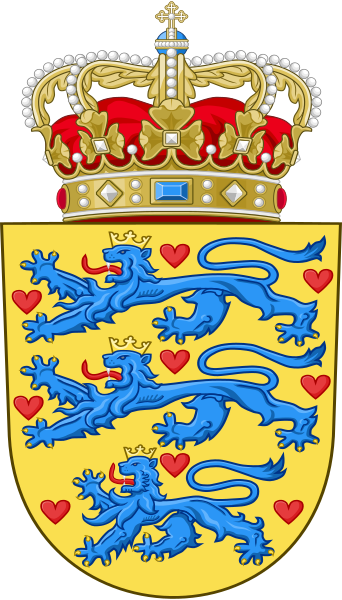
Danish Heraldry


File:National Coat of arms of Denmark.svg

This is the current Danish coat of arms.  The only description of what the symbols mean was in the Holger Danske story which I posted the other day.  According to Andersen, the three lions (which symbolize strength) stand for King Canute, King Valdemar, and Queen Margaret I.  The hearts apparently stand for heroic Danes, although Andersen only mentions four of them.  However, through history (as you can see in the example before) has varied over time.  I don't know why they finally settled on nine hearts.

Cnut the Great was the Danish king who, in 1015, took over England (well before the Normans got around to taking it over).  According to a Wikipedia quote of a very old history of the vikings:
"Knut was exceptionally tall and strong, and the handsomest of men, all except for his nose, that was thin, high-set, and rather hooked. He had a fair complexion none-the-less, and a fine, thick head of hair. His eyes were better than those of other men, both the handsomer and the keener of their sight."1
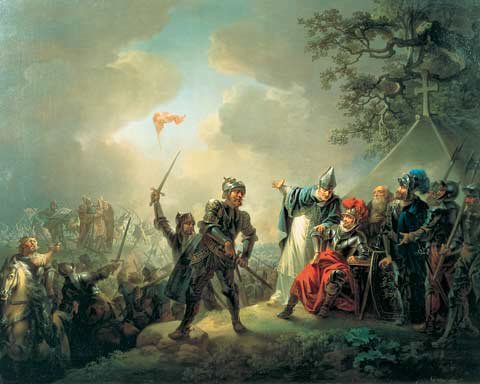
There are several kings name Valdemar and there are two kings that could fit the qualifications of taking over  Wends.  Valdemar I was known as "Valdemar the Great" so I figured that he was a good candidate for being featured on the coat of arms but it turns out his son, Valdemar II was called "Valdemar the Victorious" and carried on his father's activities.  Both of these first two Valdemars were also the subject of myths and  
historical legend.  Wikipedia includes these two pictures of famous events that occurred during their reigns.
This is Valdemar I, conquering the Wends and tearing down idols, under the supervision of Bishop Absalon, a famous Danish political and religious figure.
Valdemar II's victory over the Estonians.  Bishop Sunesen performs a Mosaic feat of arm-holding-up to ensure victory.
One of the older coats of arms, with lots more hearts, and with the lions facing forward.

Tuesday, May 1, 2012

Unfortunate Stereotypes

I hate to lend any credence to certain unfortunate stereotypes about females of the species being bad at following directions but, in the course of Jael's trip here, it seemed as though we spent an awful lot of time on trains going in the wrong direction, in missing our right stops, and in completely losing our way.  It made for a much less structured (and therefore funner and more spontaneous?) trip.  I am sure that all of those various adventures will come up in conversation.

I will mention when Jael couldn't figure out which door she needed to use to step onto the platform, as opposed to stepping out onto the other train track, so we missed our stop.

Jael will casually bring up in conversation the time when I went the long way through the train car, missing both the nearest exit and our train stop.

It will all be hysterically amusing.  I am sure enough time will have passed shortly.


However, and this is a pretty big "however", we made up for absolutely every bit of this "entertainment" with our incredibly excellent choices in places to eat.  We did really, really, really well on that count.

Jael, who was brave enough to pull out her camera in every restaurant we went to, in order to take pictures of  our food, and who was collected enough to remember to take the pictures of the food, almost always before we actually finished it, has agreed to write some posts about our wonderful culinary experiences.  She'll write them periodically, when she has some free time.

So, get ready to appreciate how good we are at choosing food, once we actually find it.

patat met saus en ketchup, photo by Jael