Wednesday, January 25, 2012

Kutná Hora Ossuary


THE reason to go to Kutná Hora, really, is to visit the ossuary.

As a result of plagues that swept through the area and the wars of religion that were going on in the 15th century, the Cistercian monks found themselves with a bunch of extra bodies lying around and (apparently) a hearty enthusiasm for recycling.

The crypt underneath this small and modest looking church is decorated with the bones of about 40,000 people.


The purpose of the decoration, at least originally, was to stand as a reminder of human mortality.  However, it has been noted that some of the more recent decorations are more decorative than is strictly necessary.  I got an English language guide when I went into the crypt and it contained what almost appeared to be a Gospel message (allowing for some translating discrepancies) which makes sense a little, as I believe this is still run by the church.  The last paragraph of the guide says:

"It's guessed the Ossuary is a common grave of about 40,000 people.  This work reminds us of the fact and the worth of eternity.  God has concluded a covenant that put us under an obligation of responsibility towards God and our neighbors.  The observance of the covenant will be appreciated when we die."


This trip did seem to be a little grim, altogether.  Everywhere I turned around, there were reminders of human mortality and I was about to develop a little complex.  All of the Czech Republic was in mourning for Vaclav Havel.  There was even a memorial in Kutná Hora.  And then, for my devotions the same night I got back from  Kutná Hora, I read Psalm 103 which reads in pertinant part (verses 15 and 16) "As for man, his days are as grass: as a flower of the field, so he flourisheth.  For the wind passeth over it, and it is gone; and the place thereof shall know it no more."

Just to round it off, I thought I would include Psalm 90:10, for good measure: "The days of our years are threescore years and ten; and if by reason of strength they be fourscore years, yet is their strength labour and sorrow; for it is soon cut off, and we fly away."


This chandelier includes every bone in the human body at least once.

There were several rooms around the perimeter of the crypt which were literally stuffed with bones.  
You were not supposed to reach through and touch the bones.

However, people were apparently in the habit of using one of the rooms as a kind of wishing well,
and there were loads of coins that had been thrown in amongst the skulls.

In the center of the crypt, there were pillars set up, decorated with skulls, other bones, cupids,
and, apparently, occasionally  decorated with candles.
Which I bet makes the whole place incredibly creepy.  

If you notice the skulls, some of the upper jaws look very intact while others, like the bottom skull in  this picture, have chunks missing at the places where the teeth would have been.  It is possible that this is post mortem damage but I wonder if those are the results of abscesses and tooth decay.  If that is the case, I think I am pretty grateful for Colgate.

There were also a couple of lit display cases.  They had a label that read as follows:
"The skulls of warriors from the Hussite wars, 1421-1424.
"Fatal injuries caused by swords, flails, maces, and arrows.
"Scientific studies have proven survival of some injuries.  (You can notice an apparent process of healing.)"


There was a lot of atmosphere in the crypt.  Also, it was really cold down there.  You could see your breath.  But perhaps the most surprising thing was that the decorating didn't end in the 15th century.  This, really, just seems to be a little too recent.

I found a website which has a lot of information about Kutná Hora which includes a lot of pictures that turned out better than mine did.  If you click here, you can look at some of those plus get a little more information about the ossuary.

Tuesday, January 24, 2012

Kutná Hora Day Trip

While I was in the Czech Republic, I took a day trip to Kutná Hora.  I went on Saturday, which was Christmas Eve.  It was an interesting trip.  It was fun to see people walking through the streets carrying bags of Christmas presents.  It felt very festive.  It was also fun to see the rural bits of the Czech Republic.  It looks very different from the Netherlands.  If you look at this link, you can see the map I made for this trip.  Below is a picture of it.


The Ossuary is at the top right corner and St. Barbara Cathedral is down at the lower left.  Conveniently, there are three train stations near Kutná Hora so I didn't have to walk all the way around to get back.


This is the main train station at Kutná Hora.  It isn't a very large or a very busy town.


Even though the city is a little more run down than Prague, there were still a lot of the same kind of architectural sights around.


This is a map of the city that is built into the sidewalk periodically throughout the city.  I took this picture at a map outside of St. Barbara's Cathedral, if you'll notice the little red "you are here" dot in the lower left corner.  To note the relative size of the cathedral and the Jesuit College which is next to it, the Jesuit college is the large backwards "F" shaped building just north of the cathedral.


Kutna Hora is a city that dates from the early Middle Ages.  It was founded because of the presence of silver and grew as a mining community and then later as a religious center because of the Jesuit College.  During the summer you can go down into the old abandoned silver mines.  I had thought that might be kind of interesting to see and felt a little bad that I didn't get the chance to go down into them.  But then I read the official guide to the mines and what is like down there (you can read the whole page here).  The tour lasts an hour and a half and you walk through a drift that is 800 feet long (almost three football fields!) where "the path is sometimes very narrow and it is necessary to walk sideways."  After that I wasn't sad about missing the mine trip anymore.  If you want to read more about the Kutna Hora silver mines (albeit in somewhat awkward translations) you can read about "ore mining in Kutna Hora" here, "how the silver was mined" here, and about "Kutna Hora coinage" here.

What I am kind of sad to miss, though, was the Alchemy Museum.  (Lots of stuff in Kutna Hora is only open during the summer tourist season.)  The museum is devoted to magical stuff, how to make gold out of lead, and more basic, vaguely magical medieval understandings of science generally.  If you go here you can see a description of the museum by someone called "The Grumpy Traveler" (the name strikes me as fun).  The writing is a little more florid than I would normally go for but it is interesting nonetheless.

Monday, January 23, 2012

Christmas Market

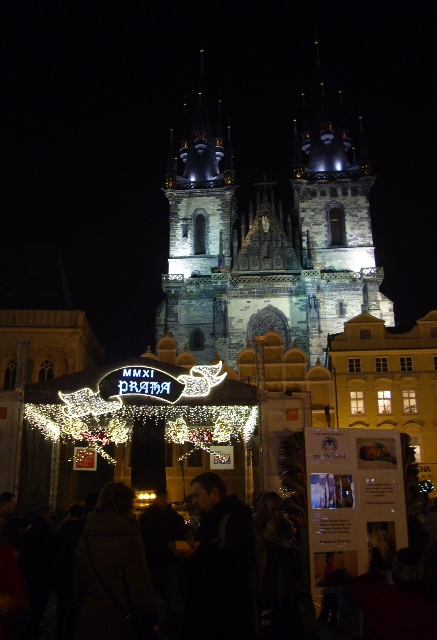
As I mentioned before, Prague has awesome Christmas Markets.  When I was looking up places that I should go over Christmas it looked like Vienna was the number one Christmas place to go and Prague was a close second.  Since I had already been to Vienna I decided that Prague was the best choice.

The Christmas Markets run from early December through the middle of January.  It is set up with loads of tiny little huts, mostly selling very expensive little tourist things.  Plus food.  Lots and lots of food.

There were little rolling carts selling roasted chestnuts which were good but not nearly as good as I would have thought from years of singing "chestnuts roasting on a open fire . . ."  They had carts selling warm wine (and handing out free samples) which smelled a-mazing but tasted kind of like warm wine--so kind of a disappointment.

They had stands that sold fried cheese sandwiches--which was deep-fried cheese on a hamburger bun--that's a winner, for the record.  They also sold brats.  Really, really good brats.  They had two kinds of brats:  bavorské klobása (Bavarian brats) and Václava klobása (Wenceslas Brats).  I tried a Bavarian brat the first night I was in Prague because I remember the brats from Munich (which is in Bavaria, Germany) with great fondness and had been severely disappointed by the Dutch attempt at the brat.  Well, the Czechs have it figured out.  That brat was just about as good as I remember those German brats being.  The bun wasn't quite as good as the German bun--the German brat buns are hard and crunchy on the outside and and soft and chewy on the inside and the Czech buns were just kind of soft all the way through, but altogether, it was not too shabby at all.  I am a fan.  Later, I tried the Wenceslas brat (which, I assume, means "Czech brats").  It was not too bad (though not quite as good as the Bavarian brat).  It was kind of a pale white color and the flavor reminded me a little bit of the blood sausages I had one time by accident.

A Trdlo stand, behind a horse and carriage for hire.
By far the best thing at the Christmas market, though, food-wise, was the the Trdelník or the Trdlo (these names seem to be used interchangeably).  Trdlos are traditional Czech donuts.  They are pretty awesome.  They are kind of a sugar dough (not really like a yeast donut or like a sour cream dough) which is twisted around a long skewer, rolled in sugar and cinnamon, roasted over a bed of coals, and then rolled in more sugar, cinnamon, and crushed pecans.  As mentioned, awesome.  If you look here you can see another person's blog post about trdlo.  It even includes a little video of how they make the Trdlos.  And, if you go here you can find a Trdelník recipe . . .


There were a lot of folks at the Christmas markets.  One thing that was interesting was the number of kids.  And dogs.  I looked it up and apparently the Czech Republic is in the middle of a gigantic and unprecedented baby boom.  It was pretty interesting, as well, that most of the parent looked like they were older--you would see kids that were 5 or 10 and then their parents looked like they were in the 40s.  One really interesting thing, though, was that folks swatted their kids when they needed it.  And not just sneaky little, embarrassed, half-hearted smacks, either.  A couple of different times I saw kids being obnoxious and their parent turned around and gave them enthusiastic and meaningful paddlings.  It is not something that you would expect to see in the US and it probably suggests good things about the future of those kids.  The dogs were well behaved as well.  There were tons of them and most of them were off-leash.  It was kind of an interesting experience to see people just walking around followed by everything from giant, wolf-hound-mix looking dogs to little chihuahuas, with no leashes and, apparently, nobody bothered by it.

There were also big touring groups.  Sometimes the guides would carry big yellow umbrellas or giant flowers, so that people in their group could keep track of whom they were supposed to be following.  My favorite thing, though, was that one tour company, at least after dark, would carry giant, sparkly, lighted snowflake wands.  I thought that was pretty nifty.

There was a giant Christmas tree in the square as well.  It was lit up so that, during the concert I went to, the lights blinked and cascaded in rhythm with the music.  And it almost wasn't ruined by the giant, Christmas-light advertisement at the base.  According to an article I saw, the tree uses LED lights and was good for the environment, so it was alright.