The first thing that Jael and I did, when we were in Copenhagen, after dropping our stuff off at the hotel, was to go to the House of Amber Museum. I hadn't even heard of it before but Jael found it in the book of "things you can get into for free with the Copenhagen Card". It turned out to be a
lot of fun. If you click
here, you can see the pretty little building where the museum is located. All of rest of the buildings behind the museum, running along the canal, are restaurants and, when we walked through the area, the outdoor tables were pretty full despite the fact that it was really cold out. All the folks at those tables were wearing their winter jackets and hats as well as blankets that were provided by the restaurants. I still couldn't convince Jael that it was a good idea to eat outside, though.

The museum was in a little house on the edge of one of the main tourist-type canals. The ground floor was a showroom and sales room. The actual museum was on the first and second floors up lovely little spiral staircases.

Jael standing in the little stairway.
Jael reading educational material near the stairway.
The museum is kind of a combination of artist's studio--art museum--science exhibit--trade museum. It is really well done and interesting. They also have a pretty interesting
website which is easy to look through and which has a lot of information about the science, trade, and art of amber plus lots and lots of pictures of their amber jewelry.
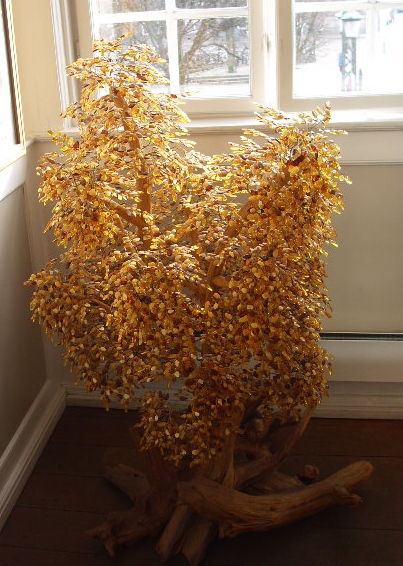
If you'll notice, there is a tree in the picture above. This tree, and others like it in various sizes from 5 or 6 inches high to 3 or 4 feet tall, are all over the museum and the shop. The trees are made out of thousands of pieces of amber individually wired onto the drift-wood tree shapes. Most of them were with different shades of yellow and brown amber in varying degrees of opacity. Some of the smaller ones are made with different shades of amber but they are rarer and, so, more expensive. This tree, if I remember correctly, was around $17,000 if you wanted to take it home with you.

The trees are actually really beautiful. The trees that were near windows, especially, looked really spectacular in the sunlight, with all of the different shades and pieces. I am not usually a big fan of giant art pieces but if I had an extra 17-grand lying around, I might be tempted.
The Museum had a pretty big science section. There was a whole row of tables with microscopes so that you could look and see the bugs ("inclusions") which had been trapped in amber ages ago.

This is a picture of a cockroach from ages ago. I think that Danish name, "Kakerlak" is way cuter than the English word. If you notice, the label is also written in Chinese, below the glass. There is, apparently, a really large Chinese audience for the museum (the House of Amber also has a branch in China). When we went into the museum there were a whole bunch of Chinese folks who had been through just before we got there (and who were buying some of the
really expensive jewelry) and one of the clerks was Chinese, as well.
They had big educational plaques around with information about Amber. The biggest disappointment of the whole trip was that they said that you can't make dinosaurs out of amber.

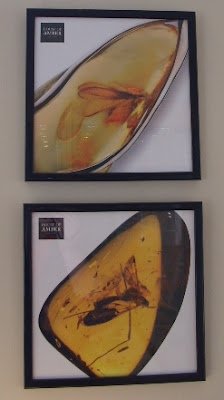

They had charts showing the kinds of bugs and other materials that are found in amber and what percentage of inclusions they make up. They also had much clearer pictures of some of the bugs in the amber in posters on the wall.

Apparently, the color and transparency of amber is related to its age and its area of origin. Green amber, for instance, is most common in tropical areas. Baltic amber (amber coming from the Baltic sea area, such as near Denmark) tends to be yellow and more opaque.
The museum has the largest piece of Baltic amber ever found (or a replica of it). This piece of amber was pulled out of the ocean in a fishing net. The guy who pulled it out was an amber hunter, as well as a fisherman, so hopefully he wasn't too disappointed about getting the amber instead of dinner.
This is a collection of some of the kinds and colors of amber that are found in the Baltic Sea area. You can see a lot of different colors and opacities.
There was a room on the second floor which was either actually a studio for making amber art pieces or is just set up that way. For some reason, I ended up without any pictures of that room but it was pretty nifty.
There was also a huge collection of amber art. Besides the trees, ships made out of amber mosaics were really popular. They were also really, really expensive.
I really, really like the chess sets. The big one was over $7,000 and the little one was almost $3,000.

I think that the little white legs and handles on the little box are ivory, although I am not sure. The little blue knit cap is Jael. That is how I kept track of her on the whole trip. When it got warmer and she took the hat off, I couldn't ever find her in the crowds.
There were also a lot of sculptures (some small and some quite large) made out of single pieces of amber. The blurry, out-of-focus sculpture in the foreground is the Little Mermaid, which makes complete sense. If you notice the sculpture in the rear, however, it is piles of rats swarming over a piece of wood. I have no idea why someone would spend all that time carving something like that.
And then, below, you can see a little nativity scene. And Jael's little blue cap.
We had hoped to talk a canal cruise (which we could do for free with our cards and which left from the canal right in front of the museum) but it really was pretty cold, the had just stopped using the boats that were heated and covered, and though they ended up being open later, we thought that we had missed the last cruise of the day.