Vyšehrad is an ancient fortification and a major tourist attraction. It is a huge compound which has a couple of restaurants, a giant cemetery, a museum, a couple of art galleries, and some large gardens. It is a
trace itallienne fort which is star shaped and which was designed to defend against cannons at the dawning of the gunpowder age. In the picture below (which I got from Google Maps), I have outlined the walls of the castle so that you can see the modified traditional star fort shapes. You'll see that one bit sticks out over the road and into the river. The road tunnels through, under the cliff/castle wall. It wasn't until I was doing this post that I realized that this was the tunnel that I rode through every time I went from my hotel to the city center.
You could walk around the castle casements, which is quite a long walk. And walking up to the castle you have to walk up windy, narrow walled streets.


The wall and the main entrance to the castle.


There were statutes all over the place in the different garden areas. A lot of them I did not recognize but the one below, on the right, is of Good King Wenceslas.


On the left is one of the art galleries in the castle grounds.

The cathedral, St. Peter's and St. Paul's, is a really pretty building. What was really interesting, though, is that the interior is entirely covered with Art Deco paintings. It is pretty impressive and kind of bizarre since the structure itself is kind of a Romanesque/Gothic fusion. I couldn't get any good pictures of the interior because you weren't allowed to use flash but the exterior, especially the doors were pretty interesting.

 |
| These pictures over the doors are made out of tiny detailed mosaics. The gold bits were very, very shiny. |


The doors were really pretty. I don't know what all of the pictures symbolize but they were in pretty pastels and they did not match the interior (which was rusts and tans and browns and blacks in Art Deco paintings) at all.
I went looking for pictures of the interior, because it really was fascinating, and found that apparently everyone had trouble with the photography. I suppose that it makes sense not to allow flash photography--red pigments are traditionally the most easily lost--but it does make life harder. If you click
here there is a picture of one of the interior arches which can give you an idea of what the church looks like.
This one is by the same person but isn't quite as clear. At floor level, there were life-sized paintings of saints in Art-Decoey style.
This link shows some of them, but they do tend to be a little blurry.
In my search, though, I found some pretty impressive collections of pictures. This picture
here is a picture from the the casements at the part of the wall that juts out into the the river (which you can see on the map above). I would also suggest that you scroll through the rest of her pictures. They are definitely better than mine (and, as far as I looked, entirely tasteful) and she has pictures from Petrin Hill, Prague Castle, and St. Vitus's Cathedral, as well.
If you go to
this link, there is a movie panorama of Prague, taken from the top of the cathedral, which is very pretty. I did not go up there because it was c.o.l.d. Cold, cold, cold. So cold that my camera was not working very well. (Which is part of the reason that I have fewer pictures from the second part of this day.) I could take two or three pictures and then my camera would stop working and I would have to put it back in my pocket and wrap my hands around it til the motor would go again. Even inside the cathedral, all of the ticket takers had on jackets and gloves and scarves and hats. I went in to use the restroom and realized it was a pay toilet. (There was a lady who sat in a tiny room, maybe three feet square, with windows into the men's toilet and the women's toilet, collecting money.) I decided that I didn't really need to go but, since it was really busy, I waited in the pay-the-attendant line for a couple of minutes anyway, just because it was so nice and warm in there.
The most interesting parts of the whole castle was the cemetery. It was really large and had a whole lot of interesting stones and memorials. A lot of the monuments commemorated married couples and Roman themes were really popular.
The one on the right is kind of touching, with the husband and wife holding hands as (presumably) they walk down into the underworld together. The ones below don't look so thrilled to be stuck in eternity together.

One interesting thing about the cemetery was the number of monuments which images of Jesus on them, as opposed to images of Mary on them. This is, apparently, a Prague distinctive (I found this out by talking to my co-tenants at the hotel) but I think that Google translate didn't really suffice to getting details about why this is so.

In both of these pictures, each of the three figures visible is Jesus. If you look at the mosaic picture in the middle of the picture on the left, you will notice that the image has Eastern, almost Byzantine style, characteristics, which I think is quite interesting.


There were some very interesting monuments. The one on the left reminds me of some of the monsters from Doctor Who.
It is interesting that the one thing the fellow below wanted people to remember about him was that he liked to ski.
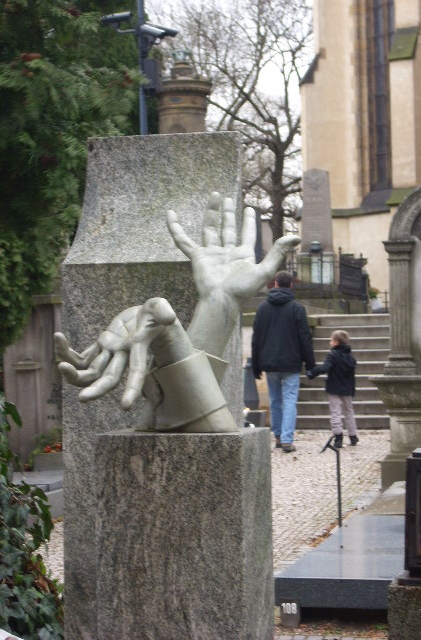
And I don't know what the statute with the hands is supposed to represent but there is something kind of unsettling about it.


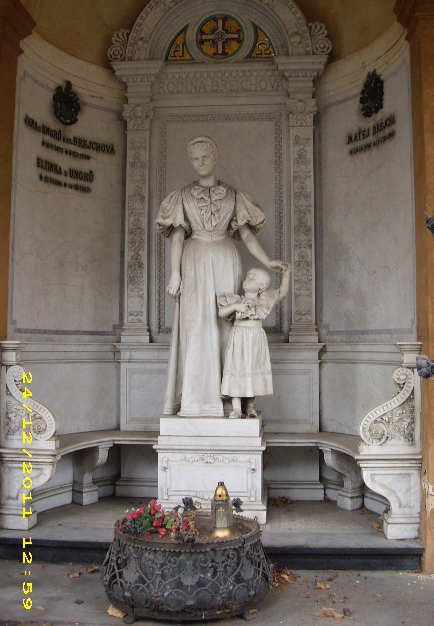
This one is really sad. If my understanding of Czech names is correct. This is the tomb of a little three year old girl who died in 1897, her twenty-five year old mother, who died the next year, and her father, who died in 1902.

This one is for Dad--there were a fair number of stones with similar inscriptions. University professors usually had their profession included on their tombs and PH DR is the Czech for PhD. Medical doctors are MUD DR.

This one has 3-D barbed wire on it and the inscription reads "Victims and opponents of totalitarian regimes 1939-1945 1948-1989"