The first place that I went when I got to Leiden,

after a quick trip to the VVV (Tourist Center) was the Museum Volkenkunde--literally the Museum of the Study of the Nations--the Ethnology Museum. Sadly enough, it is currently undergoing a massive renovation and only a very small part of the museum was actually open. If you see the little map on the sign you can see the size of the museum. The only two parts open are marked with red arrows and black boxes. The big black box on the bottom of the map is pointing to a special outside exhibit.

The special expedition was "Op Expeditie"--On Expedition. In the picture below, you will see the big white tarps covering the parts of the museum under construction, an African expedition style truck and a series of giant shipping crates. They had different expeditions inside.

This is the display inside the first packing crate. There was a video going about expeditions (notice the fellow riding the little donkey and leading the camel?) but it was all in Dutch and it seemed like too much work to figure out what was going on. There were little packing case seats to sit on and, for some reason, lots of knotted ropes hanging down from the roof. It smelled like fresh lumber and ropes in there so I think it was a pretty new exhibit.
The second crate was set up in a similar fashion and the third crate was still under construction but with the fourth crate I hit the jackpot. It was set up so that you could make postcards with your picture in and then they were emailed to you. Since there was no one around, I made all three postcards that they had available. It was spiffy.
 |
| This says "Greetings from Arabia" it turned out the best. I was even hamming it up and waving! |
 |
I think that this one should have turned out better but for some reason I appear to be winking weirdly.
This says "Greetings from Kalimantan, Indonesia." |
 |
| This one says "Greetings from Suriname." |
These are all places where the Dutch had a large trading/colonizing influence.

The museum was definitely set up to be kid friendly. At first I thought that this was just construction related stuff around the entrance. When I got into the museum, though, I realized that this was a special entrance for kids, so I came back out to get a picture. See, you can hold on to the ropes and use them to help you walk up the steep-ish ramp. On the other side, you get down by climbing down a rope ladder or by swinging across on the rungs.
Inside the museum, they only had two rooms open, the Africa room and the Asia room. It was a pretty small collection and I had seen a lot of the same kind of stuff (and a lot of it in better shape) at the Wereldmuseum. They did have some nice stuff though.

I especially liked these puppets.
This museum was a lot preachier than the Wereldmuseum though, often to a goofy extent. At one display, the plaque said that some peaceful tribe had long been the object of British envy and so the British took the opportunity of the tribe massacring a troop of soldiers to subdue the tribe.

One of the more interesting parts of the museum was the part related to an ongoing preservation project in Africa. The city is called (I think) Djenne and it is a very, very old city and the Museum Volenkunde and some other groups are working with local folks to preserve this old temple/city of which they had a scale model at the museum. It was a pretty interesting looking place.

This blurry picture is a model of a cliff-dwelling city somewhere in Africa. Apparently it was from a long time ago and there were only a very few archaeological remains there, so there were a couple of ideas as to what the city was for. Apparently one of the few things that were there was a large graveyard. So, one possible option, the museum said, was that some folks built a special "city of the dead" and would then wrap up their dead bodie and swing them over the cliff and down into the cliff dwellings.
The other option was that there used to be an easier way to get to and from the place and it used to be a regular city and they just had an annexed graveyard.

When I finished seeing this part of the museum, I had to leave the building and then walk around through the museum garden to the back of the museum to the special exhibition that they had going on. On the way I saw these white and brown swans. When I stopped to take the picture they started swimming toward me pretty fast so I think they are used to being fed.
This is the special exhibition which I was pretty exited to see. There have been posters up all over the University for this. This is the big display at the back entrance of the museum.

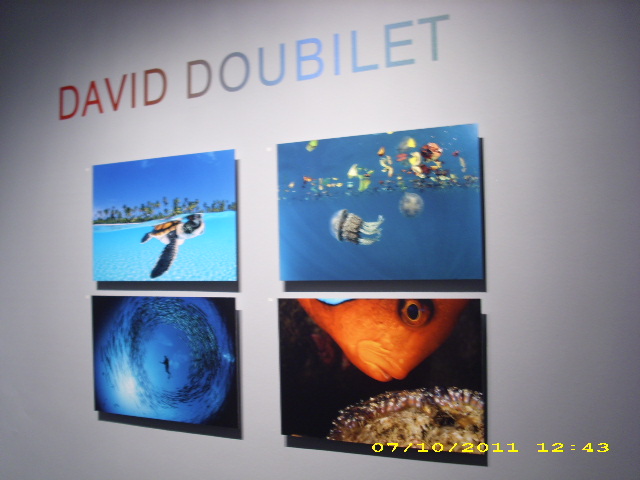
The exhibit was the National Geographic "Masters of Photography" exhibit. It showed a whole bunch of the most famous Nat.Geo. photographers and pictures.
They let you take pictures as long as you didn't use the flash.

This was the photo that was used in all of the advertisements. I remember seeing this on the cover of the Nat.Geo. magazine. I don't remember for sure what the article was (I
think that it was an article on the red haired, green eyed children that sometimes crop up among the mongols and which was really wowing the DNA folks, but I am nor sure) but I sure do remember that photo.
I don't remember all of the pictures but I do remember seeing a lot of them.
They had a couple of rooms of photographs and they also had a film running which showed some of the behind-the-scenes video footage of the photographers working as well as having interviews with the photographers themselves. It was pretty interesting. The main jist of the interviews was that they all really, really liked their jobs.