Tuesday, October 18, 2011

De Burch

The last thing I saw in Leiden was De Burch.  The mound is at least a thousand years old and the castle, in more or less similar form, has been around for 800 years or so.  It is the oldest thing in Leiden.  You enter the complex around De Burch through this little arch-way.  When I took this picture I was standing more or less near the Hooglandse Kerk.  You can probably see that it is wet but, actually, it was pouring rain from about two minutes before I took this picture until I got on the train.  The morning had started out perfectly--there were thunderstorms and lots of rain but only when I was inside museums.  In the afternoon, though, I ended up getting pretty wet.  In all of the pictures here, I was covering my camera with my hand to protect it and then hiding it under my sweater in between, trying, fairly ineffectually, to keep it dry.  Apparently it is a sturdy camera, though, and it hasn't broken yet.

You may notice the device over the arch is the lion and the crossed red keys on a white ground.  That is the symbol of Leiden.

The complex around De Burch is made up of some municipal buildings and a cafe.  To get to the actual castle, you go up through these gates.  The devices on this gate represent, I believe, the different noblemen who were allied and who would have taken refuge in this tour if the need arose.

The sign below is right next to the gate:


The small English section has this:


The sign has also has this label on it.  I assume that these things are all forbidden but I am not sure that the sign makes that very clear, especially as there is a bar just across from the sign.


This is the view into De Burch by the front door.

And this is the view out to the city from inside De Burch.

I was going to stick my head into one of the slits for firing arrows to get a picture of the city through that but just as I was ducking my head through, I saw this inside of it, and then I stayed far, far away from the corners.


There were interesting little plaques up all around
the walls with information about the city and
about De Burch.


"De sleutels van de stad" means "The Keys
to the City" according to this plaque, the Leiden
device of crossed keys are a reference to the St.
Pieterskerk and Peter's holding of the keys
of the kingdom.


This is a view of the Burch from the inside top ramparts.  Since it was raining everything was very slick and while parts of the outside wall were about head height, there are places that are about knee height (I guess so that it would be easier to pout boiling oil on people, should the need arise) and I was pretty sure I was going to slip and fall out of one of those holes and die.


This is the main door to De Burch.  The coats of
arms are for the dukes who worked together for this.


This is a view down into the square from
the front door of De Burch.  If you notice
little guy in the blue shirt, just to the left
of the gate, he vomited all over the road
just after I took this picture.  Since it was
just about 5:30, it seemed a little early to
be quite that drunk, even on a Saturday
but, when he had finished, he trotted right
back into the bar (the building on the left
of the photo) apparently ready to keep on
having a good time.


The best thing about De Burch was that you could take pictures of the city skyline.  Leiden has very, very narrow streets and it was hard to get any pictures of the taller buildings and, since the Netherlands are really flat, there aren't that many ways to get big pictures like this.

Hooglandse Kerk, Leiden

The Leiden Stadhuis 
Leiden


Leiden

Monday, October 17, 2011

SieboldHuis

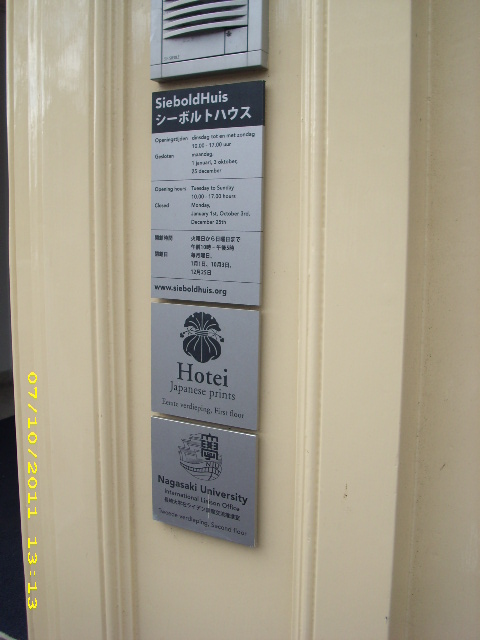
Door marker at the SieboldHuis Museum.
The second place I stopped in Leiden was at the SieboldHuis museum.  Philip Franz von Siebold was a German physician who, during the 19th century, served as a Dutch liason and diplomat, in Japan.  He was chosen because of his exemplary service in the Dutch East India Company.  Since Japan had just barely begun to open up to western visitors, and only to Dutch traders at that, Siebold had an unprecidented opportunity to study Japan and its plants and animals.  While he was in Japan he had a Japenese "wife".  Westerners were not allowed to marry Japanese citizens but, apparently, were allowed to live with them.  Seibold named a variety of hydrangea after his Japanese wife (there was a dried specimen of this hydrangea at the museum but hydrangeas are not one of the kinds of flowers that dries well) and his daughter became the first female Japanese doctor (at least according to Dutch Wikipedia).


Siebold got kicked out of Japan during "the Siebold Affair." (It is always bad when international relations disasters get named after you.)  Apparently, among other things, Siebold collected Japanese maps, which it was illegal for Westerners to own because of the Japanese fear of spying.  The contraband was found when servants were unpacking Siebold's luggage, which he had had sent ahead of him on a trip somewhere.  I wasn't sure if he knew he shouldn't have the maps and it was just one of those little flukes that he got caught or if he was really unaware and wasn't secretive because he wasn't worried.  The Museum plaques did not elaborate on that.  Siebold was accused of spying for the Russians, placed under house arrested and ordered to inform on the folks who had drawn the maps for him.  He refused (and apparently the Japanese thought this was honorable) and he was eventually sent home to the Netherlands.  The Japanese have not held a grudge, though.  One of the exhibits on display was a special vase that the president (I think) of Japan and his wife brought over when they visited the museum in 2000.


Bust of Siebold in the small garden at
the SieboldHuis museum.

The museum is eclectic.  Siebold's faithful dog is there, all stuffed.  It is not an attractive looking animal.  There are other stuffed animal specimens as well, including some birds that are now extinct.  Also, there are several jars of poisonous-looking snakes in alcohol.  There is a room full of weapons and armor and toys.  There is, ironically enough, a map room, full of old Japanese maps--I don't know if Siebold had managed to hang on to some of these when he was kicked out or if they were just obtained later, once it was permitted, but they are super detailed, with important cultural monuments written out in red on a predominantly black ink map and they are all hand drawn.  They were pretty incredible.  The map room has a large file with lots of wide shallow drawers that you can pull out, so there is a lot of stuff available to look at.  There are also some very pretty drawings and things in that room.

There was also another series of rooms that wasn't actually part of the museum but which you were allowed to look at.  Part of one of the floors was used by an art dealer who sells Japanese art work.  He lent me a catalog to look through so that I could see the provenance and date and price of the different pieces.  There were some really beautiful paintings and they were all incredibly expensive.  I guess that, when you go to a museum, you figure that there is valuable stuff there and you should be careful but when you actually see that many zeros next to something you really try not to even breath hard next to them.

What the really big draw is, right now, is the Hello Kitty exhibit.  The whole top floor of the museum, and all of the hall ways, and the gift shop, and the tea room, and the kids play area downstairs were all done up in pink Hello Kitty stuff.  Actually, Hello Kitty is pretty cute with her little Dutch flag bow and her little Dutch bonnet.  But it was still an awful lot of pink.

If you look here, you can see the English language homepage for the Siebold House which includes a lot of Hello Kitty.  The museum had a lot of stuff set up for kids.  There were little activity areas including one little table with hello kitty stools and little chopsticks and little fake sushis so that little kids could practice their chopstick skills


The evidence of the Japanese influence on the Netherlands isn't limited just to the museum.  This fountain in front of the Leiden Stadhuis (City Hall) has a very Japanese flavor to it, what with the dragons/fish and the tiling.


There is also a section of the large Botanical Garden maintained by the University of Leiden which is maintained with Japanese plants in a Japenese style called the Von Siebold Memorial Garden.

Even the walls that surround that part of the garden look like they have a Japanese influence.  I think that the light bulbs are supposed to create a "lantern" feel but I guess they needed something that would stand up to a little wind.


Saturday, October 15, 2011

The Pilgrims

One thing which I failed to do, much to my shame, was to adequately plan for checking out Pilgrim stuff when I was at Leiden.  I did try to see the Pilgrim Museum but I could not find it. (I plan on blaming that on Google Maps.)  Moreover, I ended up walking past all kinds of good stuff--like the place where they used to chop off criminals' hands--without a second thought, or stopping to take a picture.  My only consolation is that I ran out of time to do a bunch of stuff while I was there so I will probably go back at some point, anyways.  I definitely need a picture of the place where they chopped off hands.  You, however, do not have to wait until I catch up on my homework to see that and other cool historical things.  You can look at the website of the "Leiden American Pilgrims Museum" right here.  They have a fair bit of historical stuff there as well as some pretty extensive photo slide shows about Leiden.  The most pertinent is the "Pilgrims' Tour of Leiden" which is quite full (it has 68 photos) with lots of interesting information.  You can go straight to it here if you would like.

This, however, is a picture St. Pieter's Kerk, beside which many of the Pilgrims lived during their stay in Leiden.  If my various wild assumptions are correct, the row of houses that is standing where the Pilgrim houses once stood is just the other side of the church, behind that car.  That may be a door and window of one of the houses just visible between the tree branches.


A Correction about the Leiden Relief (which we will pretend was our little joke): of course William didn't flood 7 miles of Dutch folk (i.e. half of the Netherlands) to save Leiden.  He flooded Leiden out of some river or canal or something, much closer to Leiden (although still inflicting significant damage to nearby towns) which explains why they needed so much wind to make it work.