Thursday, October 20, 2011

St. Pieter's Kerk

St. Pieter's Kerk is a very tall church in Leiden.  It was the church beside which the Pilgrims lived.  It was also closed the day that I went because they were preparing for an event the next day.


This is the sign that says you can't go into the building.  It was sad because it looked like it was mighty pretty.  There was a choir practicing inside when I was walking around the church, though, and it sounded very pretty.


This is the little sign with information about the church and below is the English part of the text.  
Some of the Pilgrims who died in Leiden are buried inside the church.


This is a road sign right next to the church.  Note the directions to the Van der Werfpark, where I went; the Pilgrim Archives, which is currently closed because it is moving; the Sieboldhuis, where I went; and the Latijnse (Latin) School, where (I believe) Rembrandt attended school for a little while at around the same time as the Pilgrims were living there.

 This is one of the little streets leading away from the church.  I took this picture just after it was raining and just before it started with the torrential down-pours.  One good thing about streets this narrow is that, if you squish up against the wall, you can usually avoid at least some of the rain.  When the rain would get really bad then people would be lined up along the walls, waiting for a little break in the rain before they started off again.


I am fairly certain that the Pilgrim's houses would have been lined up just the other side of the church in this picture.

Wednesday, October 19, 2011

Haven Kerk

One of the surprising things that I got to see when I was at the Schiedam Openmonument dag was the Haven Kerk.  It is completely closed now, while going through some (much needed) restorations.  But it was open when I went and they had displays up detailing the restoration process and the guys who were doing the restoration were there answering questions about what they had to do to make the church safe and sound.  The Haven Kerk (Port Church) is right on one of the main canals through town.

When I went into the church, it was very cool (which was nice because it was a warmish day out) and it also had a really familiar smell.  At first I couldn't think what it was and then I realized that it smelled just like the basement at Temple Baptist, and it had that same cool, unused feeling.


This is the plaque about the church that is set outside the front door.  Note that it was built in a "neo-classical style with a neo-baroque interior".


This was the first view of the sanctuary.  Even without the pews, and with looking kind of ratty up close, this is a pretty spectacular view.
This is what you would call a real pulpit.  If you notice the lady in the lower left corner, you will get an idea of the scale.  The lowest edges of the railings are about chin high.  This is a rear/side view because the sun was coming through the windows right behind the pulpit and none of my pictures turned out from the front.  If you notice the figures at the front of the pulpit they are slightly larger than life size.


There is a historic organ in the church.


This is the confessional.  The little old lady was entertaining.  I kept waiting for her to move so I could get a clearer shot but she seemed so interested in it that I decided to just included her.  She was peering through the bars and ducking around looking under the signs and trying to get a better view.  The pictures that are on the fence are of other Dutch churches that have had similar restorations and which they were using as inspiration for this project.

This is the left side of the church.  There are four separate creches here. 
Although, it is worth noting that, in Dutch, creche doesn't just mean scene of 
mother and child, especially of Jesus and Mary, it also means, and is used 
frequently for, a nursery.  So church bulletins mention who is playing the organ
and who is serving in the creche.  When I first saw that notation, I was, seriously, 
looking around the church trying to find the Manger Scene and wondering why 
the church started its Christmas celebrations so early.

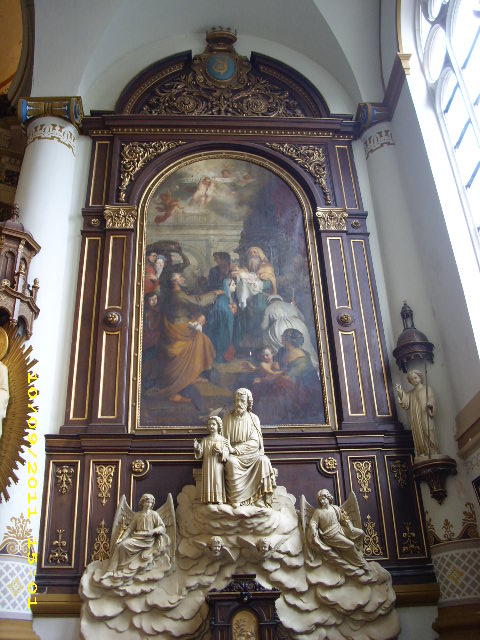
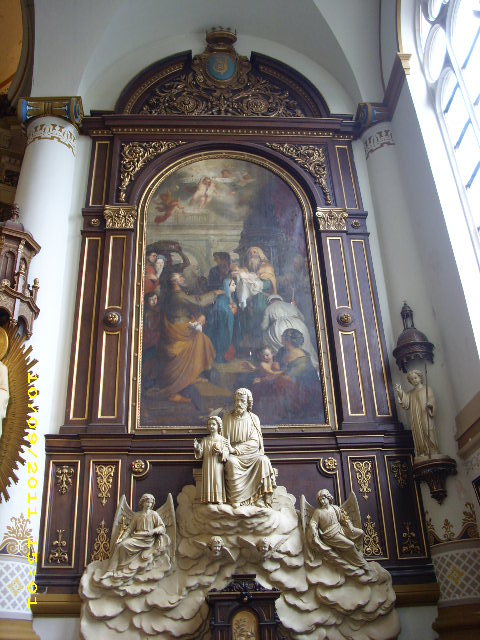
This is the right side of the church. The painting, I think, is the scene were
Simeon sees the baby Jesus at that temple.


This is the front of the church.  The inscription on the crown, above the scene where Jesus is crowning his mother Mary, says "To God Alone be Honor and Glory."

The church had stained-glass windows that depicted all of the apostles.  It also had apostles/significant early Christian figures in statues that must have been at least three feet tall, stuck to all of the pillars through the sanctuary.


<---Andrew--Ben, you should notice his cross which is the basis for Scotland's flag.


Bartholomew--I am a little curious about what that curvy knife signifies.--->

These are both labeled St. Jacobus--that is to say, James.

<---Before I saw the label on this one, I assumed that it was supposed to be a statue of Jesus.  I am assuming, then, that this must be James the brother of Jesus and that the artist was going for a family resemblance.

Which would make this one the James that wasn't Jesus's brother--->


<---John


Matthew--notice that he is writing in what looks like a little tax record book.-->


<---Paul--I am not sure about the significance of the sword.


Peter, holding keys--->


<---Thaddeus--he is sleeping, I think.


Thomas--->


<---Philip

Simon--->

Tuesday, October 18, 2011

De Burch

The last thing I saw in Leiden was De Burch.  The mound is at least a thousand years old and the castle, in more or less similar form, has been around for 800 years or so.  It is the oldest thing in Leiden.  You enter the complex around De Burch through this little arch-way.  When I took this picture I was standing more or less near the Hooglandse Kerk.  You can probably see that it is wet but, actually, it was pouring rain from about two minutes before I took this picture until I got on the train.  The morning had started out perfectly--there were thunderstorms and lots of rain but only when I was inside museums.  In the afternoon, though, I ended up getting pretty wet.  In all of the pictures here, I was covering my camera with my hand to protect it and then hiding it under my sweater in between, trying, fairly ineffectually, to keep it dry.  Apparently it is a sturdy camera, though, and it hasn't broken yet.

You may notice the device over the arch is the lion and the crossed red keys on a white ground.  That is the symbol of Leiden.

The complex around De Burch is made up of some municipal buildings and a cafe.  To get to the actual castle, you go up through these gates.  The devices on this gate represent, I believe, the different noblemen who were allied and who would have taken refuge in this tour if the need arose.

The sign below is right next to the gate:


The small English section has this:


The sign has also has this label on it.  I assume that these things are all forbidden but I am not sure that the sign makes that very clear, especially as there is a bar just across from the sign.


This is the view into De Burch by the front door.

And this is the view out to the city from inside De Burch.

I was going to stick my head into one of the slits for firing arrows to get a picture of the city through that but just as I was ducking my head through, I saw this inside of it, and then I stayed far, far away from the corners.


There were interesting little plaques up all around
the walls with information about the city and
about De Burch.


"De sleutels van de stad" means "The Keys
to the City" according to this plaque, the Leiden
device of crossed keys are a reference to the St.
Pieterskerk and Peter's holding of the keys
of the kingdom.


This is a view of the Burch from the inside top ramparts.  Since it was raining everything was very slick and while parts of the outside wall were about head height, there are places that are about knee height (I guess so that it would be easier to pout boiling oil on people, should the need arise) and I was pretty sure I was going to slip and fall out of one of those holes and die.


This is the main door to De Burch.  The coats of
arms are for the dukes who worked together for this.


This is a view down into the square from
the front door of De Burch.  If you notice
little guy in the blue shirt, just to the left
of the gate, he vomited all over the road
just after I took this picture.  Since it was
just about 5:30, it seemed a little early to
be quite that drunk, even on a Saturday
but, when he had finished, he trotted right
back into the bar (the building on the left
of the photo) apparently ready to keep on
having a good time.


The best thing about De Burch was that you could take pictures of the city skyline.  Leiden has very, very narrow streets and it was hard to get any pictures of the taller buildings and, since the Netherlands are really flat, there aren't that many ways to get big pictures like this.

Hooglandse Kerk, Leiden

The Leiden Stadhuis 
Leiden


Leiden